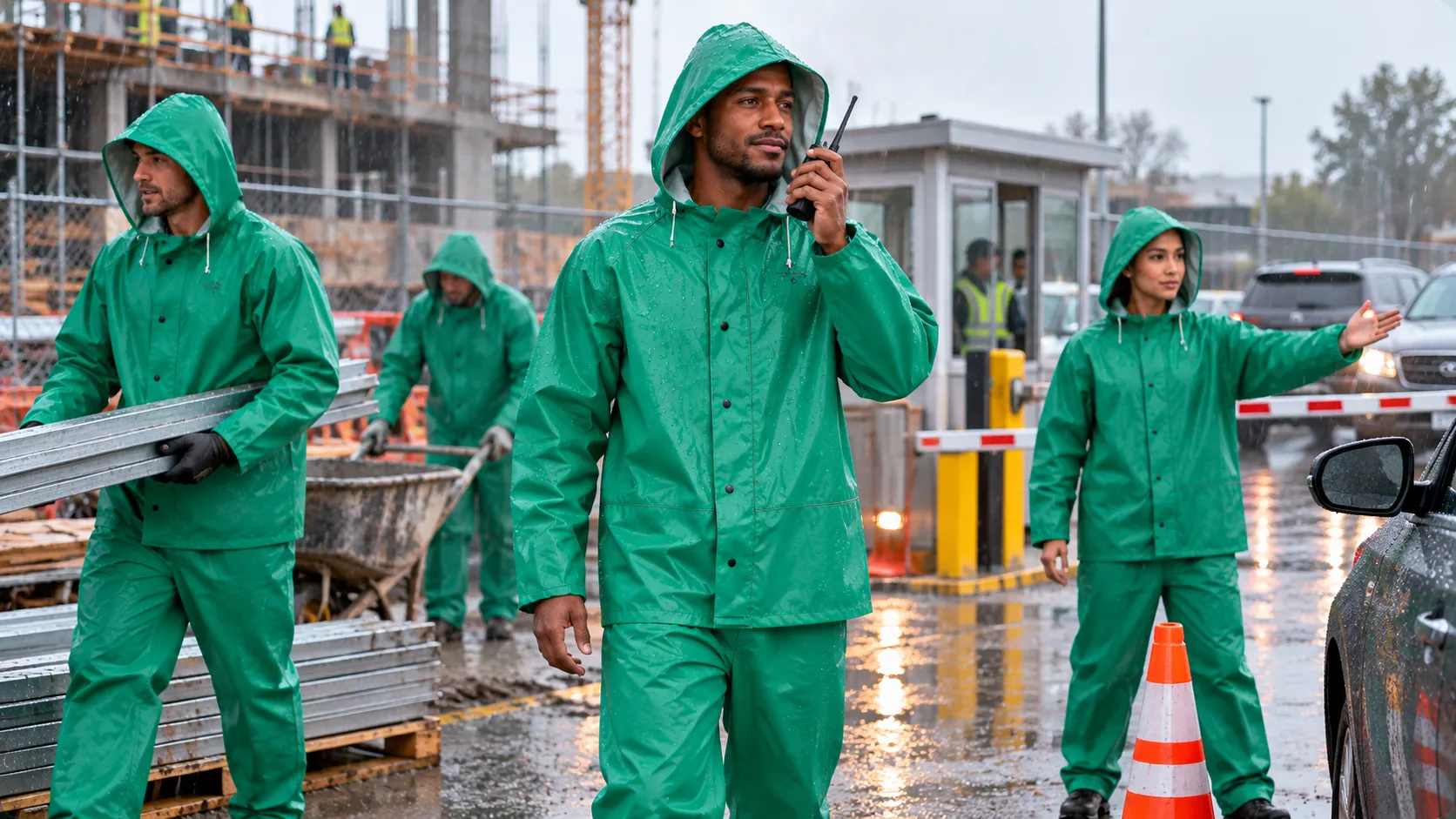
Buy bulk raincoats by matching each role to its exposure, movements and equipment. Construction crews may need coverage that stays secure during physical work; security staff need access to communication tools; parking attendants need unrestricted signaling and awareness around vehicles. A shared supplier can simplify purchasing, but one garment specification may not suit all three teams.
The buying decision is whether these groups can safely share a design, which differences require separate styles, and what evidence is needed before committing to volume.
Define the Job Before Choosing a Raincoat
Create a short duty profile for each team. Record time outdoors, wind exposure, physical effort, clothing layers and equipment worn underneath. Distinguish brief trips between buildings from sustained outdoor shifts. A coat that feels comfortable during a short fitting may become restrictive or hot during active work.
Keep rain protection separate from other hazards. Ordinary work rainwear should not be assumed to provide flame, chemical or electrical protection. Where such hazards exist, have the responsible safety professional define the protective clothing requirements before requesting a quote. Procurement can then compare eligible products against the same requirements.
Match Rainwear to Each Team
Construction: Check Movement and Contact Points
Rain gear for construction must fit the actual tasks. Ask sample wearers to bend, reach overhead and take a full step while wearing their normal layers and equipment. Watch for sleeves pulling back, the front opening under tension, or a hem interfering with movement.
Inspect areas likely to contact tools, rough surfaces or carried materials. Request the fabric construction, seam method and any relevant durability evidence rather than treating thickness as proof of service life. Check hood compatibility with required head protection without changing how that protection fits. Select the garment length only after the movement trial.
Security: Preserve Identification and Equipment Access
A security raincoat needs to work during patrols and at fixed posts. Trial radio operation, access to keys or approved equipment, and the ability to fasten the front while wearing gloves. Equipment access should not require leaving the rainwear open throughout a wet shift.
Check that staff identification remains readable with the hood raised and equipment in position. Assess the hood while the wearer turns to look behind and to either side. A long coat may suit a stationary post, while frequent walking or vehicle entry can justify another cut. Confirm these differences with wearers before standardizing the uniform.
Parking: Test Signaling and Vehicle Entry
Parking attendants may alternate between standing, walking lanes, signaling drivers and entering vehicles. Test repeated arm movements, backward glances and sitting in the proposed rainwear. Check whether the cuffs cover the hands or the hem catches during entry and exit.
Include the actual footwear and work layers in the trial. Decide whether lower-body exposure calls for rain pants rather than relying on coat length alone. For teams working near moving vehicles, ask the site safety lead to define visibility requirements. Uniform color, readable job identification and documented high-visibility performance address different needs; purchasing should specify each where relevant.
Choose the Coverage System
Compare a long coat with a jacket-and-pants combination against the duty profiles. A coat offers coverage in one item, but its usefulness depends on hem clearance and the tasks performed. Separate pants can extend coverage during active work, with extra fitting, storage and changing requirements.
Reserve emergency ponchos for uses supported by the site assessment. Loose material can be unsuitable around moving equipment or where controlled movement matters. A compact backup item is not automatically an appropriate daily uniform.
Standardize only where requirements overlap. For example, a patrol team and a parking team might share a garment after successful trials, while a construction crew needs a different cut. Keep the common requirements in one purchasing brief and identify role-specific exceptions explicitly.
Verify Weather Protection and Comfort
When evaluating waterproof rain gear for work, examine the complete garment. Ask how seams are sealed, how the front closure sheds water, and how cuffs and the hood adjust. A fabric description alone does not establish protection at openings or seams.
For any performance claim, request the test method, result and scope: does it concern a fabric sample, seam or finished garment? Compare results only when the methods and conditions are comparable.
Breathable rain gear for work also needs a precise specification. Vent openings allow air movement; they do not by themselves establish moisture-vapor performance through the fabric. Trial comfort at the expected work rate and temperature, checking whether vents admit wind-driven rain. Ask for cleaning and drying instructions so the selected design fits the site’s maintenance routine.
Consider what happens between shifts. Shared rainwear needs an issue, cleaning and drying process that follows the care instructions. Check storage space before choosing bulky garments. Establish inspection and replacement triggers for damage to seams, closures or required visibility features; avoid assigning a service-life promise from material names alone. Include replacement availability when comparing otherwise suitable styles.
Confirm Visibility Before Approving Samples
A bright color or reflective stripe does not by itself establish compliance with a high-visibility clothing standard. Where a standard applies, request documentation for the exact garment, relevant classification and proposed configuration. Confirm that printing or other customization preserves the required design.
Approve representative samples for each distinct role, including wearers at the ends of the planned size range. Record pass or fail against movement, equipment access, coverage and required documentation. A practical wear trial supports fit decisions; it does not replace laboratory testing or compliance review. Keep an approved sample and written specification as the reference for production inspection.
Turn the Requirements into a Bulk Order
Once the role requirements are settled, compare suitable styles within the work raincoat and poncho range. RAINCOATGIFT offers rainwear categories including PVC polyester, PU, EVA and PE. Category names help create a shortlist; the exact construction and finished-garment specification determine suitability.
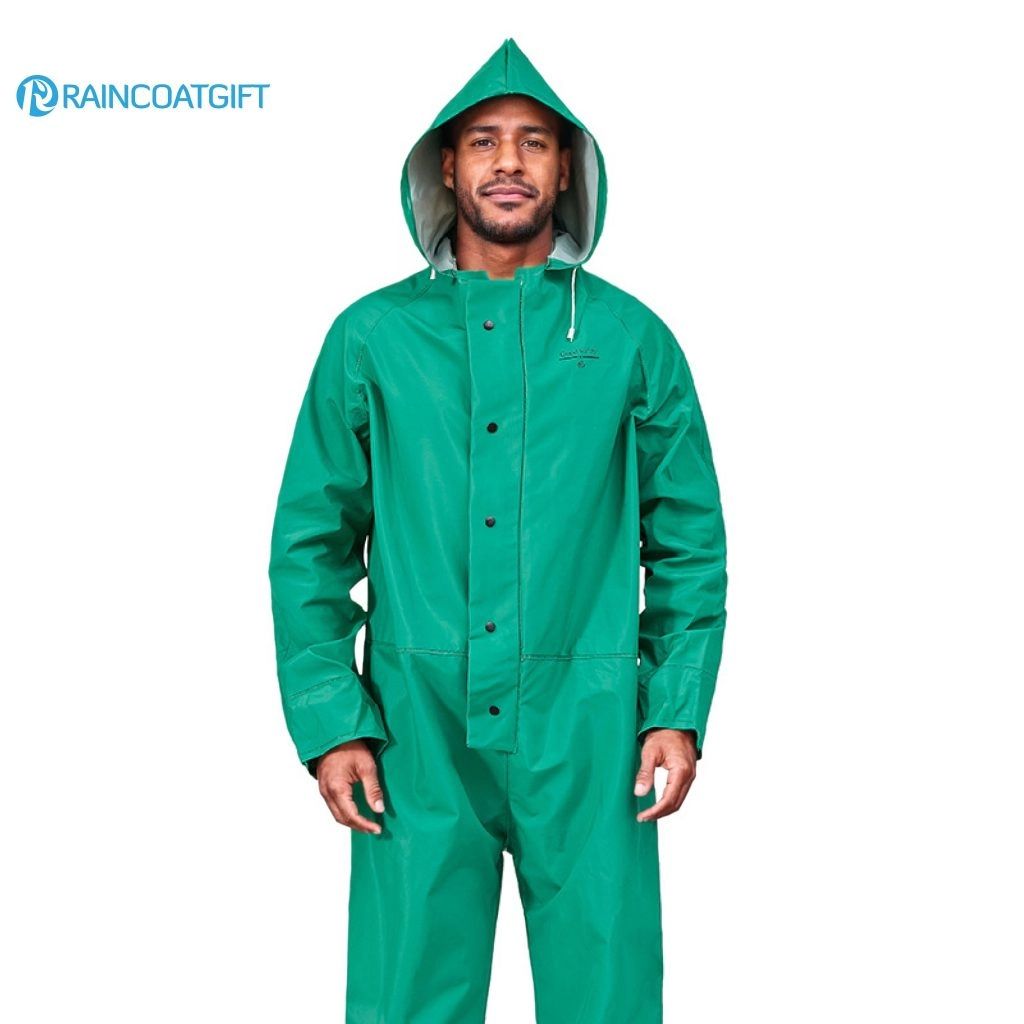
The custom PVC polyester rainwear listing from RAINCOATGIFT includes adult rainwear with logo customization. Treat it as a candidate for specification review and sampling. Confirm available sizes, closures, seam construction and any required performance documentation before approving it for a particular team.
Send suppliers the same RFQ package: quantities by role and size, required garment configuration, performance evidence, customization, packing needs and delivery destination. Ask whether minimum quantities apply by style, color or print version, and obtain written sample and production schedules for the proposed order.
Compare total landed cost, including sampling, decoration, freight, applicable import charges and inspection. Confirm what happens if delivered goods differ from the approved sample. For rollout details, use the size runs, logo placement and bulk packaging checklist to organize the order after the garment choice is settled.
Conclusion
A useful bulk raincoat program starts with separate duty profiles and ends with verified specifications. Share a design where the work and sample trials support it; keep separate styles where coverage, movement or visibility requirements differ. Clear acceptance criteria make supplier quotations and production checks more meaningful than a low unit price alone.
FAQs
Can all three teams use the same raincoat?
Possibly, if exposure, movement, equipment access and applicable safety requirements align. Approve it through role-specific trials rather than assuming a common adult size or shared logo makes it suitable.
Is PVC polyester suitable for work rainwear?
It can be a candidate, depending on the garment construction and working conditions. Verify seams, closures, comfort, fit and supporting performance evidence for the proposed model.
Does reflective trim make a raincoat compliant?
Reflective trim alone does not establish compliance. Request the applicable documentation for the exact garment and confirm that the supplied configuration matches it.
What should a bulk raincoat RFQ include?
Include roles, exposure, quantities by size, garment configuration, required documentation, customization, packing and destination. Request samples and an order-specific schedule before confirming production.
Discuss Your Rainwear Requirements
To discuss a bulk order with RAINCOATGIFT, request a rainwear specification and sample review with the team roles, working conditions, required sizes and quantities, visibility requirements, and logo artwork. Use the agreed sample and written specification to confirm the final order.