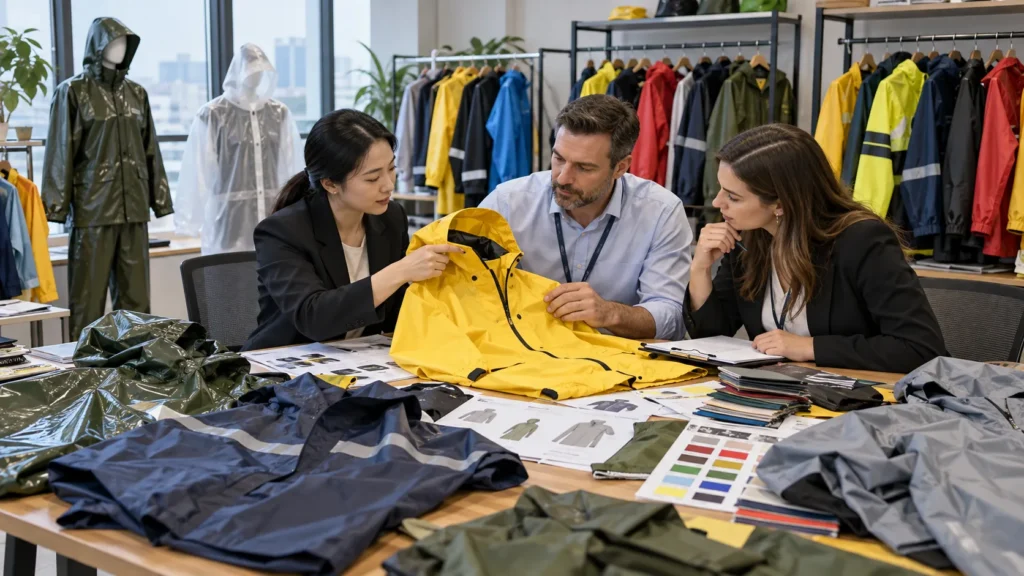
Sourcing custom raincoats from China works best when the buyer treats the project as a controlled production program, not a catalog purchase. The commercial result depends on a clear use case, a complete specification, supplier verification, an approved sample, and written quality and delivery controls. A low quotation is useful only when it covers the same material, construction, logo, packaging, quantity split, inspection scope, and shipping basis as competing offers.
Screen Rainwear Suppliers Before Comparing Price
Start by checking whether a candidate regularly handles the rainwear type you need. Disposable PE ponchos, flexible EVA garments, PVC work rainwear, and coated polyester jackets use different materials and production methods. Ask for relevant product examples, the legal company name, business address, export experience, and a clear explanation of which operations are performed in house or by subcontractors. A trading company is not automatically unsuitable, but the buyer should know who controls materials, printing, sewing or welding, inspection, and packing.
Review the supplier’s product scope and business information, then verify claims against current documents. Raincoat Gift Co Limited states that it was established in 2014 and supplies rainwear and umbrellas from Yiwu, China. Those facts can support initial screening, but buyers should still request the records, audit evidence, test reports, or compliance documents required for their own market and application.
Define the Product Before Sending the RFQ
A useful request for quotation identifies the wearer, weather exposure, expected reuse, required coverage, target market, and delivery date. Select a reference construction from the supplier’s custom raincoat range, then state the material, thickness or fabric weight where relevant, dimensions, size range, color, hood and closure design, seams, pockets, reflective details, logo method, individual packing, carton quantity, and carton marks. Reference samples and drawings reduce interpretation, but written specifications must control the order.
Send the same specification to every shortlisted supplier. Require each quotation to list assumptions and exclusions, sample charges, tooling or printing setup, packaging, testing, inspection, freight basis, and payment terms. If a supplier proposes an alternative, ask it to identify the changed material or construction and explain the effect on price, minimum order quantity, performance, and lead time.
Evaluate MOQ and Total Order Economics
Minimum order quantity may apply to the total order, each style, each color, or each print design. A nominal 1,000 piece order can become four 250 piece production lots when it is split across colors, and the supplier may not accept every variation at the same price. Build a quantity matrix by style, color, size, and logo version before asking for a final quotation.
Compare landed cost rather than unit price alone. Include samples, printing setup, custom labels, packaging, testing, inspection, freight, duty, storage, and the cost of unusable stock. The guide to planning 500 1000 and 5000 piece custom raincoat orders explains how increasing variety can weaken the economics of an otherwise practical order size. Keep the first order simple when demand is uncertain.
Use Samples to Lock the Production Standard
Separate sample stages. A material swatch answers questions about color, hand feel, transparency, and surface. An artwork proof checks logo size and placement. A finished preproduction sample should represent the intended material, pattern, seams, closures, dimensions, printing, and packing closely enough to serve as the bulk reference. Record the sample version and every approved change.
For example, Raincoat Gift lists an OEM PVC polyester rainwear product with a customized logo option, standard adult sizing, a 500 piece MOQ, custom design sampling of 5 to 7 days, and a stated production time of 30 days. It also lists one piece per PE bag, 20 pieces per carton, and Ningbo or Shanghai as ports. Treat these figures as planning references and reconfirm them for the final design, order date, and shipping plan.
Approve the physical sample with a signed specification sheet, final artwork, color reference, measurement table, packaging instructions, and photographs. State which deviations are acceptable and which require resampling. A sample approval should never be inferred from silence or a casual message, because that leaves production and inspection teams without one controlled standard.
Control Bulk Production and Quality
Before production starts, confirm that purchase order quantities, material details, artwork revisions, logo position, size tolerances, closures, accessories, packing, and carton marks match the approved sample. Ask the supplier to report any proposed material, component, or process change before using it. Late buyer changes can require new materials, revised printing, or another sample and should trigger a written cost and schedule review.
Match inspection points to the order risk. Incoming material checks can catch color or thickness problems before conversion. In process checks can identify repeated seam, welding, print, or measurement defects while correction is still possible. A pre shipment inspection can compare selected finished units with the approved sample and specification, including appearance, dimensions, closures, logo, packing, carton count, and labels. Define the sampling plan and acceptance criteria with the inspection party instead of relying on the word quality.
Plan Production Shipping and Delivery Together
A quoted production time is only one part of the schedule. Work backward from the required arrival date and include RFQ clarification, artwork, sample preparation, approval, material confirmation, mass production, inspection, packing, export handling, international transport, customs clearance, and final delivery. Add decision deadlines for your own team because slow artwork or sample approval can consume the buffer intended for production.
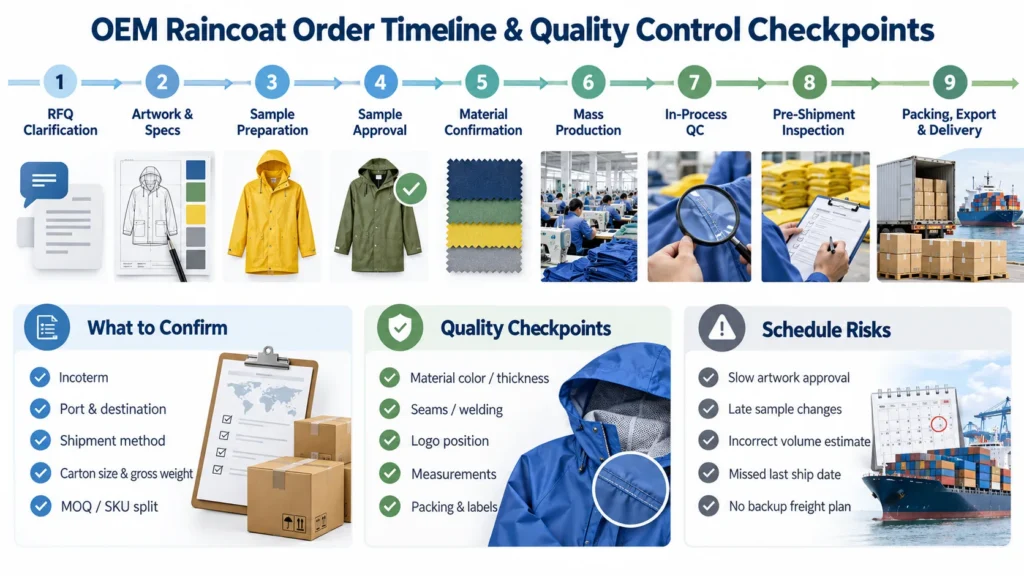
Confirm the Incoterm, port, destination, carton dimensions, gross weight, shipment method, and responsibility for export and import charges. Ask the freight provider to plan from the final packed volume rather than an early product estimate. For a fixed event or launch, identify the last acceptable ship date and the cost of a faster backup option before approving production.
Choose the Supplier With a Comparable Scorecard
Score suppliers against the same evidence: specification understanding, relevant rainwear capability, document verification, response quality, sample accuracy, quoted scope, MOQ fit, quality controls, production plan, and logistics clarity. Resolve differences before selecting the lowest total compliant offer. A supplier that asks precise questions and records assumptions may be easier to manage than one that confirms every request without explaining how it will be produced.
Conclusion
Successful OEM rainwear sourcing begins with a precise brief and ends with a shipment checked against the same approved standard. Verify the supplier, compare equivalent quotations, control SKU complexity, approve a production intent sample, define inspection criteria, and build the schedule around the required arrival date. These steps make price, quality, and delivery decisions visible before the order becomes difficult to change.
Frequently Asked Questions
What information should a custom raincoat RFQ include?
Include the application, material, construction, dimensions or size range, color, quantity by SKU, logo artwork and position, packaging, destination, required delivery date, sample needs, testing requirements, inspection plan, and requested shipping basis. Ask the supplier to list assumptions and exclusions.
How can a buyer verify a rainwear supplier in China?
Check the legal entity, address, relevant product experience, production and subcontracting responsibilities, business documents, references, sample quality, and any market specific compliance evidence. Use an independent audit or inspection when the order value or application justifies it.
How long does an OEM raincoat order take?
The total schedule includes specification review, artwork, sampling, approval, material preparation, production, inspection, packing, transport, customs, and local delivery. Published sample or production estimates should be reconfirmed for the final specification, quantity, season, and shipping method.
Should buyers choose the lowest raincoat quotation?
Only when all offers cover the same product and commercial scope. Compare material, construction, quantity split, logo, packaging, sample work, testing, inspection, freight basis, payment terms, lead time, and exclusions. An incomplete quotation can create a higher landed cost later.
To review a sourcing project, send a complete custom raincoat RFQ with the product reference, intended use, quantity matrix, logo files, packaging, destination, and required date. The supplier can then confirm feasibility, sampling, MOQ, pricing, and the production schedule against one defined brief.