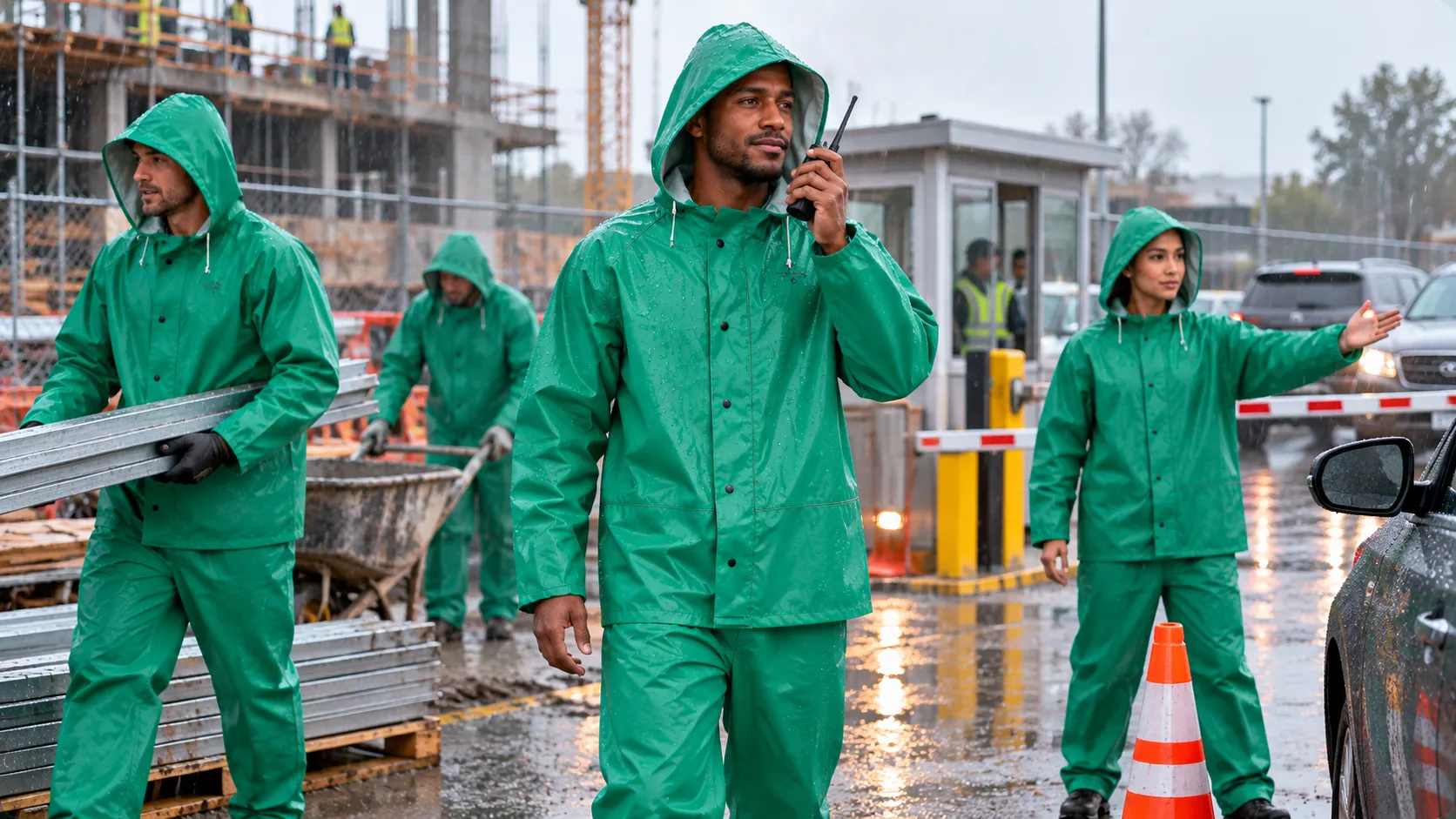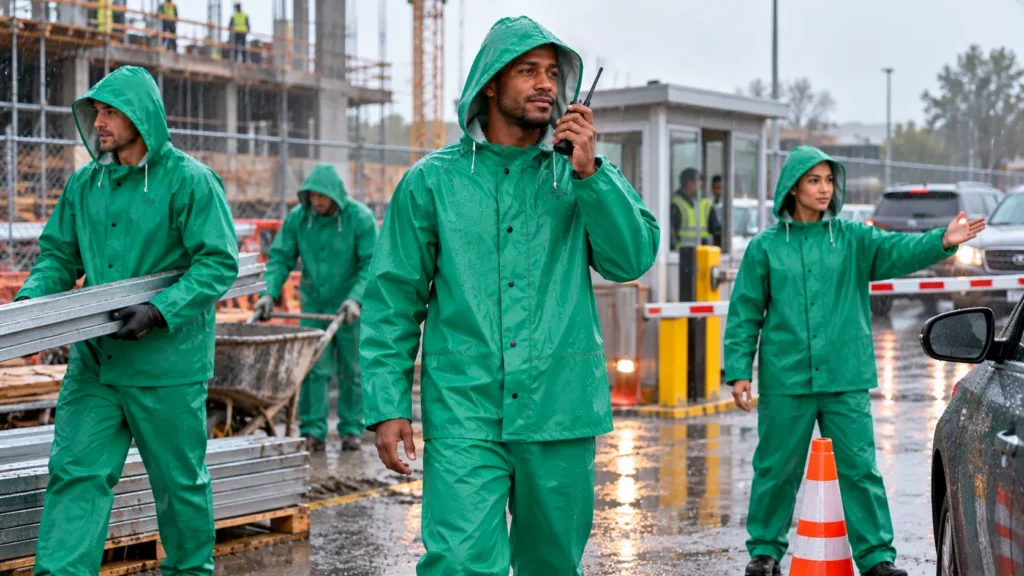
A bulk raincoat order should standardize what can be shared without forcing different jobs into one unsuitable garment. Construction, security and parking staff may all work outdoors, but their movement, visibility, coverage and identification needs differ. Start by mapping each role to its exposure and uniform layers, then confirm material, size range, reflective treatment, logo, packing and delivery details against an approved sample. This gives procurement a comparable specification, helps departments receive the right items and avoids treating an attractive unit price as the only measure of fit.
Why One Bulk Order May Need More Than One Specification
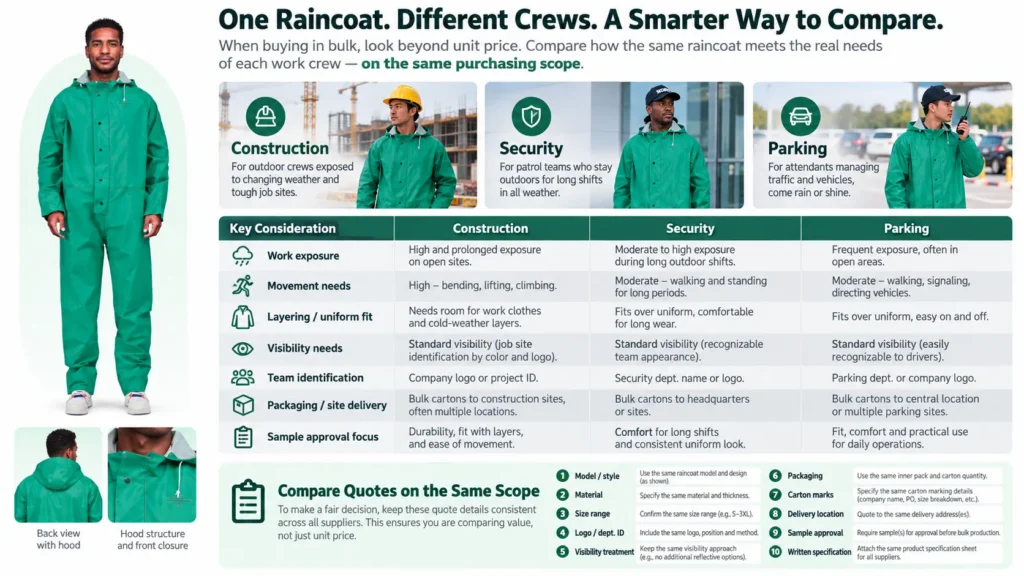
Consolidating demand can simplify purchasing, but one style may not fit every team. Construction personnel may bend, climb, carry materials or work near rough surfaces. Security staff may use radios or badges, while parking attendants work near vehicles and need visibility and freedom of movement. These are different use conditions, not just different department names.
Separate shared requirements from role-specific ones. A common color family, logo or ordering schedule may support a consistent program, while coverage, pockets, layering and visibility details may vary. If one base garment is preferred, have representatives from each role test it before approval; a movement check can reveal issues a product photo cannot.
Map Garment Options to Work Conditions
Describe the job before choosing a fabric or style. A practical use profile should record: [
- Where the garment will be worn: an active jobsite, a guarded entrance, a parking area or another outdoor setting.
- How the employee moves: walking, bending, reaching, directing traffic, standing for long periods or handling equipment.
- What the rainwear must cover: a shirt or uniform, a heavier layer, work trousers, or equipment worn over or under the coat.
- Conditions that affect selection: expected rain, wind, temperature, abrasion, storage and how often the garment is worn.
For construction crews, balance coverage with the mobility the task requires, and ask whether the shell and seams are intended for the expected wear conditions. For security teams, check whether the cut and closures work with their usual uniform and equipment. For parking teams, assess visibility from the directions drivers actually approach and confirm that rainwear does not interfere with hand signals or other duties. The answers should drive the specification; do not infer performance from a product name or photograph.
RAINCOAT GIFT displays rainwear options including PVC/polyester styles and reflective rainwear examples. A listing can help buyers identify a starting point, but fabric composition, construction, coverage and reflective details should be confirmed for the exact model and configuration. Its custom PVC/polyester rainwear options may be considered where that material category fits the application, subject to specification review. The company’s bulk rainwear comparison for events and outdoor worksites provides a related product-type discussion; this guide focuses on how to organize a multi-team order.
Check Visibility and Reflective Details Separately
A reflective feature on a product page is not, by itself, proof that a finished coat meets a workplace or regulatory requirement. Before ordering for construction zones, traffic-adjacent parking work or other controlled settings, have the responsible safety lead identify the applicable requirements. Confirm the garment’s visibility configuration, reflective placement, usable area after sizing, labeling and available supporting documentation for the exact item. If the supplier cannot verify a requirement, do not describe the garment as compliant.
Inspect the sample in the conditions where staff will use it. Check visibility from the front, back and sides, and review how a hood, pockets, logo or another layer affects the visible surfaces. Keep decoration away from reflective elements unless the supplier and safety reviewer approve the layout. For roles that need team identification, decide whether a logo, department name or staff label is required, and ensure the placement remains legible without interfering with any safety feature.
Build a Size Plan Around Layers and Real Users
Bulk ordering makes size planning more important, not less. Ask for the supplier’s garment measurements and sizing method, then compare them with the layers employees will wear. A raincoat fitted over a light shirt may feel restrictive over a sweatshirt, insulated uniform or tool belt. Avoid assuming that every size runs the same way across different styles or materials.
Estimate sizes by team and, where possible, actual wearer measurements rather than a historical ratio alone. Request representative samples. Have users test reach, bending, cuff closure and hood adjustment, then record fit issues before approving production. Agree on exchange or reserve sizes, and ask whether size labels appear on the garment and its package.
For multi-site organizations, use one size chart and one approved sample reference across locations. Keep a record of the model, size breakdown and approved fit notes so a later reorder is comparable. If departments need different cuts, list them separately on the purchase order instead of combining them into an ambiguous line item.
Coordinate Logos, Department Identification and Packaging
Customization adds decisions to an otherwise straightforward garment order. Share a production-ready logo file, preferred colors, print or embroidery location, finished dimensions and any required department wording. Ask for a placement proof on the actual garment layout, especially when reflective strips, pockets, seams or closures limit usable space. Approve the proof and a decorated sample before authorizing the full quantity. RAINCOAT GIFT’s article on logo placement for custom rain ponchos addresses a related branding decision; raincoat placement still needs to be confirmed for the selected style.
Packaging should match how the garments will be received and issued. Decide whether each item needs an individual bag, a size or department label, or a site-specific carton mark. For distribution across several facilities, specify quantities and delivery destinations by location. Confirm carton counts, packing lists and the handling of mixed-size cartons before the order is released. Packaging instructions are operational details: include them in the written order, not only in an informal message.
Compare Quotes on the Same Scope
Compare quotes against one specification. Ask each supplier to identify the model, material, sizes, colors, reflective options, logo method, packaging and exclusions. Compare the delivered scope, including samples, decoration, packing, freight, applicable taxes or duties, payment terms and how shortages or defects are handled. A low unit price may not include the same customization or delivery details.
Before ordering, confirm quantities and size mix, logo proof, sample approval, schedule, delivery split and inspection process in writing. Minimums, colors, timing and packaging can vary by configuration; verify current terms and agree how mismatched sizes, logos or quantities will be handled.
Prepare a Sample and RFQ Checklist
A complete request for quotation helps suppliers respond to the same brief. Include the following information:
- Departments, job tasks, operating environments and the expected use frequency.
- Required garment coverage, material preferences, color and any performance or visibility criteria that the safety team has specified.
- Estimated quantity by style, color, size and department, including an agreed reserve quantity if needed.
- Logo artwork, placement, decoration method, department text and proof-approval contact.
- Individual packaging, carton labels, packing-list details and each delivery address.
- Sample requirements, inspection criteria, requested delivery window and reorder expectations.
Compare the sample with the written specification, not appearance alone. Test fit over intended layers, closures, movement, hood and pocket use, logo legibility and visibility. Record the approved sample. If a change affects another feature, such as a larger logo reducing reflective area, review a revised proof.
Conclusion
The most reliable bulk raincoat program begins with role-based requirements, then consolidates only the features that genuinely fit across teams. Procurement should verify the exact garment, visibility requirements, size mix, branding proof, packaging and delivered scope before approving production. For construction, security and parking groups, a documented fit check and written sample approval can make one purchasing process work across distinct outdoor roles without assuming one garment suits every task.
Frequently Asked Questions
Should construction, security and parking staff receive the same raincoat?
Not automatically. Compare tasks, equipment, exposure and visibility first; approve one style only after each team confirms fit.
What should buyers confirm about reflective rainwear?
Verify the exact garment, reflective placement, sizing and supporting documentation against the safety lead’s requirements.
How can a buyer reduce size problems in a bulk order?
Use garment measurements, allow for uniform layers and test representative sizes with intended wearers.
What helps a supplier quote logo raincoats accurately?
Send quantity by size and destination, logo artwork and placement, packaging, sample needs and delivery window.
For a project-specific fit check or quotation, send the intended applications, quantity by team and size, logo artwork, packaging plan, delivery locations and any safety requirements that need confirmation. You can contact the RAINCOAT GIFT team with your RFQ details.