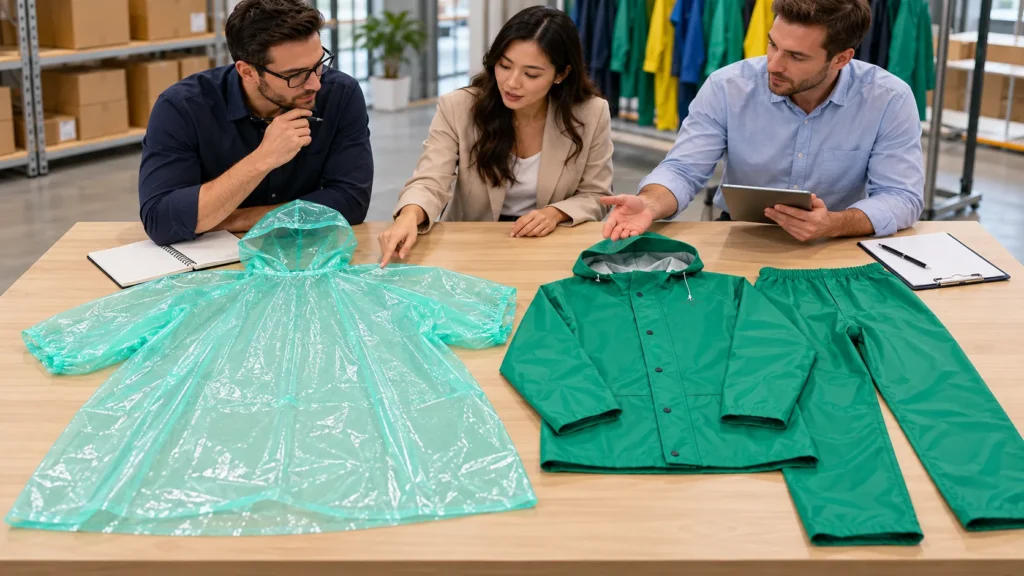
A distributor should choose PVC/polyester rainwear when the buyer’s brief names that material and a wearable rainwear format, with a logo option and a specification that can be confirmed before ordering. A PE poncho is a closer match when the brief calls for a disposable poncho; if lightweight handling or compact packing matters, verify the unit weight and packed dimensions for the exact SKU. Neither is a universal upgrade: the decision depends on garment format, issue plan, customer requirements, and approved product details.
The distinction matters for assortment planning. Material alone does not verify construction, performance, work suitability, or compliance; confirm those points for the selected product.
Start With the Buyer’s Distribution Job
Before recommending either option, ask how the customer expects to use and issue the item. Workwear accounts may specify a wearable rainwear model, sizing, branding, and repeat purchasing. Events may need a disposable poncho for a defined distribution plan. Do not collapse both briefs into one generic SKU.
- Workwear accounts: confirm the garment format, size range, clothing layers, branding, and any written performance or safety requirements.
- Event and promotion accounts: confirm whether the item is intended for one-time distribution, how it will be packed, and what quantity must be available at each point of issue.
- Industrial, agricultural, and outdoor-activity accounts: define the intended conditions, expected wear duration, and any written safety or performance requirements for the selected SKU.
These are discovery prompts, not material performance claims. Confirm any work-use, hazard, or compliance requirement against the exact product specification.
When PVC/Polyester Rainwear Fits the Request
PVC/polyester rainwear is the more direct match when the buyer has requested a named rainwear construction rather than a disposable poncho. RAINCOATGIFT’s PVC/polyester rainwear listing, identifies the material as PVC Polyester, lists a standard adult size, and offers customized logos. Those fields give a distributor concrete starting points for an apparel-format brief, but they do not replace a finished specification.
Quote this option when the account needs a defined garment for a uniform or workwear order, a custom logo, or a confirmed size and configuration. Ask what the listing includes, then check the sample’s shape, openings, closures, seams, print location, and fit over expected layers.
Do not present the material name as proof of durability, comfort, reuse, or regulated-task suitability. For repeat wear or a specified protection level, request construction details, a test basis, and written acceptance criteria for the exact SKU.
When a PE Poncho Fits a Lightweight, Disposable Brief
A PE poncho is a better fit when the customer specifically wants a poncho-style item described as disposable. If ‘lightweight’ is part of the brief, verify the unit weight and packed dimensions for the chosen SKU rather than inferring them from PE alone. This format may suit an event handout, a visitor issue, or a short-term contingency program when the brief calls for a poncho, clear issue logistics, and defined short-term use rather than a fitted rainwear garment. RAINCOATGIFT’s PE poncho listing describes an adult PE poncho with a customized-logo option; confirm the production dimensions, packing, and artwork on the chosen version.
Do not assume every PE poncho is identical or every event needs disposable issue. Ask whether recipients keep it, need it to fit over layers, and how packs will be stored. If repeat wear, field work, or a named performance level is expected, gather exact requirements before proposing it.
A useful qualifier is: ‘Is this a one-time handout, or a specified garment for planned work use?’ The answer helps select a product family and identify what to confirm next.
Compare the Two Listings Without Overreading the Material Labels
The website’s current examples show why the quote must be tied to a particular listing. The PVC/polyester listing and the disposable PE poncho listing differ in product label, stated material, and listed minimum quantity. Those are model-level fields, not universal rules for every PVC/polyester or PE product.
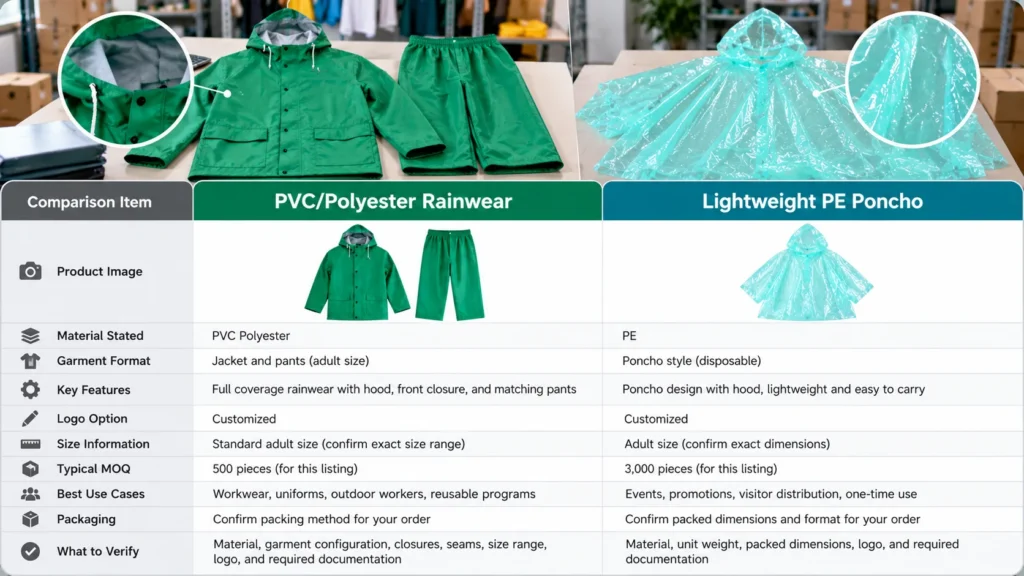
| Listing detail | PVC/polyester rainwear | PE rain poncho |
| Material stated | PVC Polyester | PE |
| Product label | Custom PVC/polyester rainwear; standard adult size listed | Disposable adult PE rain poncho |
| Logo field | Customized | Customized |
| Listed MOQ | 500 pieces for this listing | 3,000 pieces for this listing |
| Distributor check | Confirm size, garment configuration, logo, and required documentation | Confirm dimensions, pack format, issue plan, and required documentation |
One PVC/polyester listing shows an MOQ of 500 pieces; one PE poncho listing shows 3,000 pieces. Treat these as published values for those specific listings, not as a material-wide MOQ promise. Before comparing landed cost, request the current MOQ and price tiers for the exact size, logo method, packaging, and order quantity. Confirm any field that has changed since the listing was published.
Use a Short Verification Gate Before Adding Stock
For a first order or new customer segment, tie approval to the intended SKU. A sample can confirm details a listing leaves open; a written requirement makes replenishment easier to compare. Use the same checks for each alternative:
- Match the sample and quote to the same product name, material, size basis, color, logo artwork, and revision.
- Record the finished dimensions, size options, package format, carton quantity, and any tolerances in the order specification.
- Try the sample over the customer’s expected clothing layers and check movement, closure operation, logo placement, and packaging as applicable to the actual design.
- Document the intended use and any performance or compliance requirement; obtain product-specific evidence before making those claims.
If a buyer needs a detailed inspection sequence, use the work rainwear sample inspection guide as a separate approval reference. It complements this selection decision; it does not decide whether a disposable poncho or a specified rainwear model belongs in the customer’s order.
Keep Separate Buying Lanes in the Assortment
Keep both product families in separate buying lanes. Position PVC/polyester rainwear for accounts whose written brief names a wearable model, material, size, or logo requirement. Position a disposable PE poncho for short-use plans that call for a poncho and fit its confirmed dimensions and pack.
Set replenishment rules from order history, seasonality, storage space, current MOQ, and budget. Avoid deep stock in an untested variant; an initial evaluation and clear SKU description can show whether the account reorders and the format fits its program.
If the customer is choosing between PE and EVA ponchos rather than between a poncho and PVC/polyester rainwear, route that separate question to the PE vs. EVA poncho comparison. Keeping that distinction clear prevents a distributor from forcing several different material and use-case decisions into one page or sales conversation.
Make the RFQ Specific Enough to Compare
An RFQ should let the supplier price the intended product. Include product family, material, dimensions and size breakdown, color, logo artwork and placement, pack and carton details, quantity, delivery destination, required date, acceptance criteria, and needed performance documentation.
Ask the supplier to separate standard details from configurable options and confirm current MOQ, sample process, timing, and price basis. For a comparison, hold artwork, dimensions, pack, quantity, and inspection requirements constant where possible.
Conclusion
Choose PVC/polyester rainwear when the customer brief specifies a wearable model and its size, logo, construction, and performance requirements can be confirmed. Choose the PE poncho when the brief calls for a disposable poncho and the issue plan fits the verified product. If lightweight handling or storage size matters, compare those specifications for the exact SKU. For distributors, the sound decision matches the end customer’s format and order specification, not a blanket material ranking.
For a fit check or RFQ, contact the rainwear team with the target product format, material, dimensions, quantity, logo requirements, packaging, intended application, and delivery destination.
Frequently Asked Questions
Is PVC/polyester rainwear more durable than a PE poncho?
The material names alone do not establish durability. Compare the exact construction, dimensions, sample condition, and any documented test criteria for the SKU being quoted.
Can a distributor replace every PE poncho with PVC/polyester rainwear?
Not without checking the buyer’s brief. A wearable rainwear model and a disposable poncho are different product formats and may serve different distribution plans.
Does logo customization make the PVC/polyester option unique?
Both example listings describe customized-logo options. Compare the available placement, artwork method, sample approval, and any added cost for the chosen model.
How should distributors compare the listed MOQs?
Use the published MOQ only as a starting point for that model. Request a current quote for the exact configuration and quantity; do not infer a material-wide minimum from one listing.