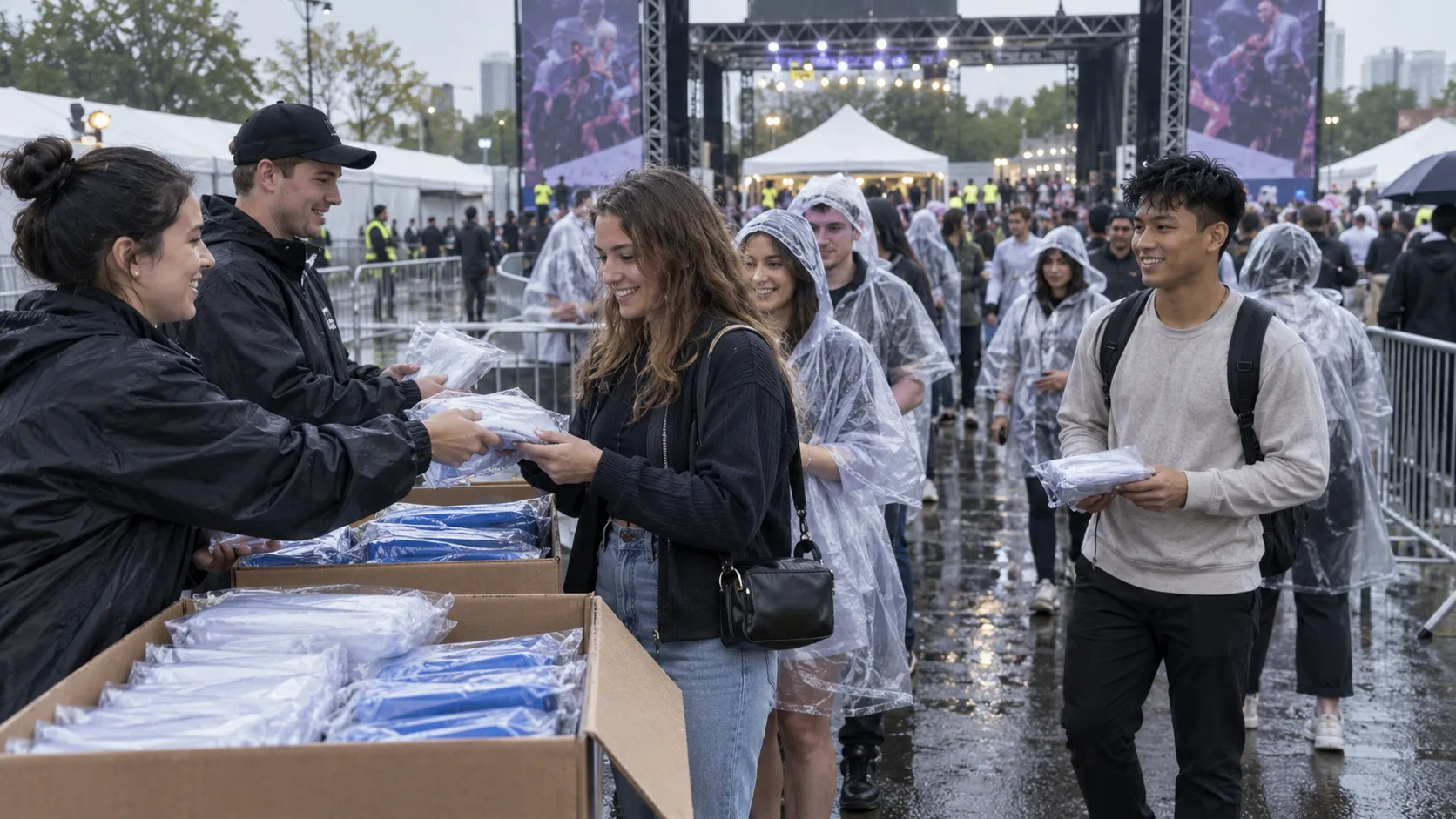
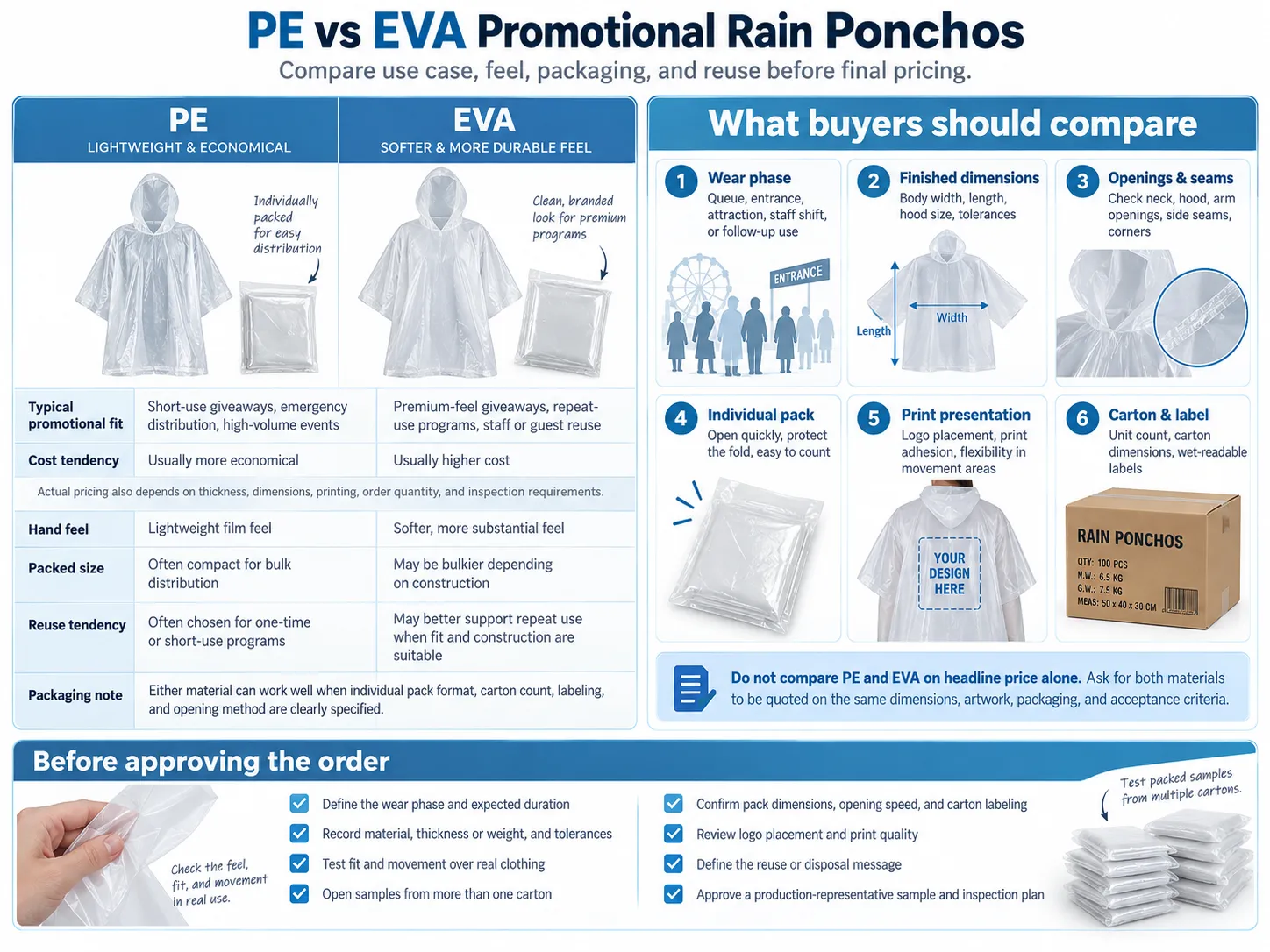
For a promotional rain poncho program, PE and EVA are not interchangeable line items. The material choice affects the expected unit cost, hand feel, packed size, print presentation, and whether recipients are likely to keep the garment for another outing. PE commonly fits short-use giveaways and emergency distribution when low weight and simple packing matter. EVA may be considered when a softer, more substantial feel and repeat use justify a different cost and package. The right decision starts with the campaign’s use case, not a material label alone.
Start With the Promotional Job to Be Done
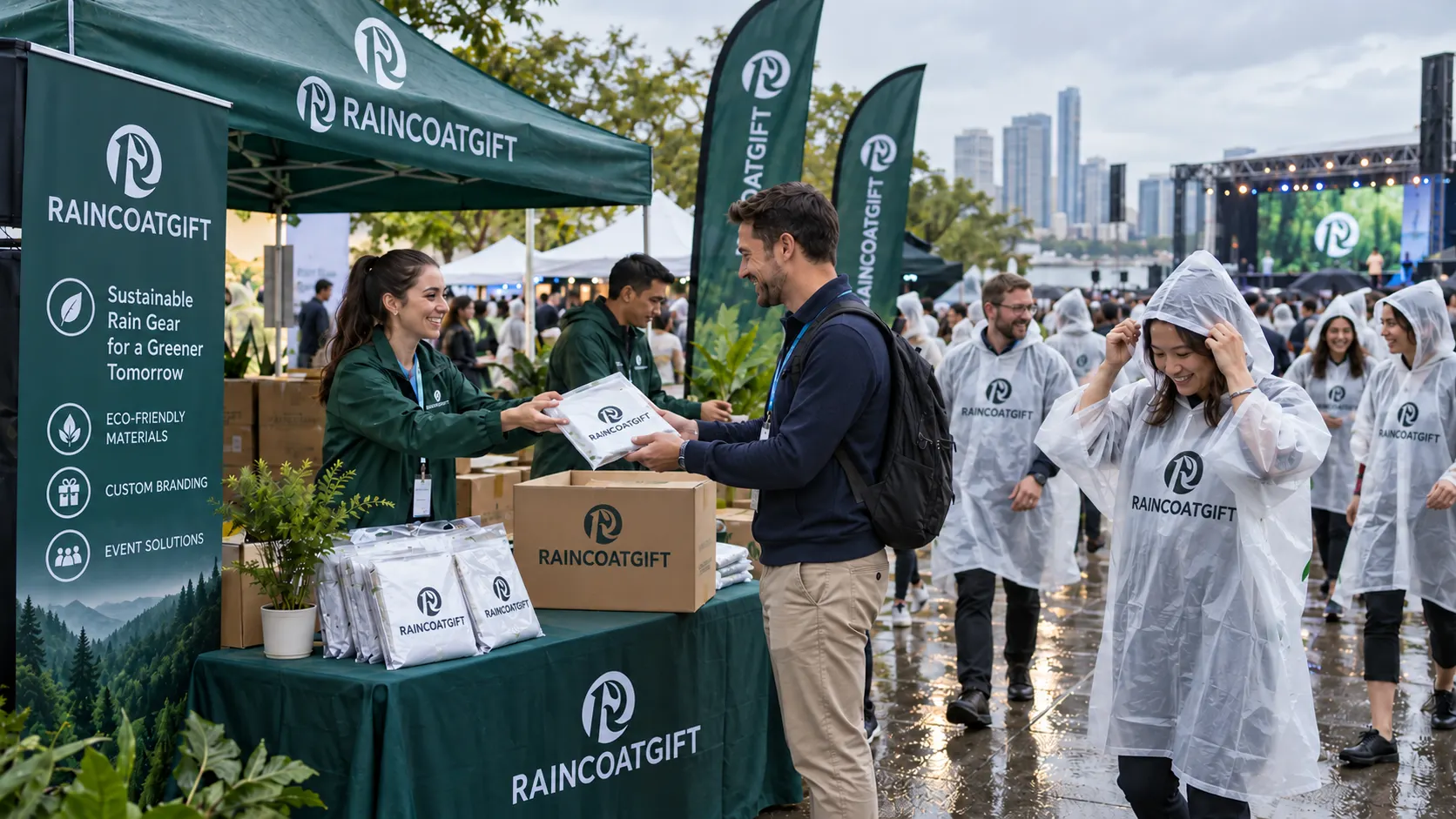
Promotional buyers should first define what the poncho must accomplish. Is it handed out at a concert entrance, placed in a race kit, sold at an outdoor attraction, or issued to staff for several wet shifts? Will recipients wear it for a short walk, keep it in a backpack, or return it for another event? The answer sets the useful balance between low acquisition cost and a product people will want to retain.
Also define the operating environment. Standing in a queue creates different demands from cycling, active running, or carrying equipment. Wind, layered clothing, repeated dressing, and contact with barriers can load neck openings, arm openings, and side seams. Neither PE nor EVA should be presented as automatically suitable for every activity; fit, construction, and event rules still require confirmation on an approval sample.
Compare PE and EVA on the Decisions Buyers Actually Make
Cost and Material Use
PE is often selected for economical, lightweight rain protection because the material can be supplied in a compact format for large quantities. That does not mean every PE poncho has the same cost or quality. Film thickness, dimensions, hood design, individual packing, printing, order quantity, and inspection requirements all affect the quotation. A low unit price can become expensive if too many units fail during opening or if the package does not match the distribution plan.
EVA usually enters a promotional comparison when the buyer wants a more substantial garment or a better chance of reuse. The price difference should be evaluated against the campaign objective: a premium-feel giveaway may support a longer brand impression, while a one-time weather contingency may not need that extra material. Ask the supplier to quote PE and EVA against the same finished dimensions, artwork, packaging, and acceptance criteria so the comparison is meaningful.
Feel, Appearance, and Wearer Acceptance
Feel is a practical marketing variable. Some recipients perceive a very thin film as an emergency layer, while a softer or heavier-feeling poncho may seem more suitable for keeping. The actual hand feel depends on formulation, thickness, surface finish, temperature, and construction, so buyers should not rely on the material name or a catalog photograph. Handle samples, open them from production-style packs, and test them over the clothing people will actually wear.
Check whether the hood, neck opening, and arm coverage allow normal movement without pulling at the seams. For branded programs, inspect how the artwork sits on the surface and whether printing changes flexibility at high-movement areas. A clean logo on a garment that is uncomfortable or hard to put on will not create the intended promotional experience.
Packaging and Distribution Efficiency
Packaging can matter as much as material when thousands of units must move through an event. Individual bags support counting, protect folded garments from dirt and punctures, and make it easier to allocate stock by station or sales point. Buyers should specify the opening method, unit count per carton, carton dimensions, labeling, and whether packs can be handled with wet or gloved hands.
RAINCOATGIFT publishes a PE option described as lightweight and individually bag packed; review the PE rain poncho product specification as a starting reference, then confirm that the quoted material, dimensions, artwork, and pack format apply to the promotional order. The site’s PVC and EVA raincoat ponchos category should likewise be treated as a product family to evaluate, not as proof that every EVA configuration has identical packing or performance.
Reuse, Return, and End-of-Event Handling
Reuse is a program decision, not a promise created by choosing EVA. A poncho is more likely to be reused when it remains intact after opening, fits comfortably, dries without damage, and can be stored cleanly. Repeated use also exposes the importance of seam quality, opening dimensions, and care instructions. If the campaign expects one-time wear, a lightweight PE format may be operationally appropriate. If recipients or staff will keep the item, verify that the proposed construction and packaging support that expectation.
Plan the material pathway before printing the campaign. Decide whether ponchos are collected, placed in event receptacles, taken home, or used at a later activation. Disposal language should match the actual material and local procedures; do not imply recyclability or a specific environmental outcome unless the supplier and the applicable program can document it.
A Practical Buyer Checklist
Put the comparison into a written specification before requesting final pricing. Use the same checklist for samples from each material so the decision does not default to the lowest headline quote.
- Define the wear phase, expected duration, weather exposure, clothing layers, and whether use is stationary, active, or repeated.
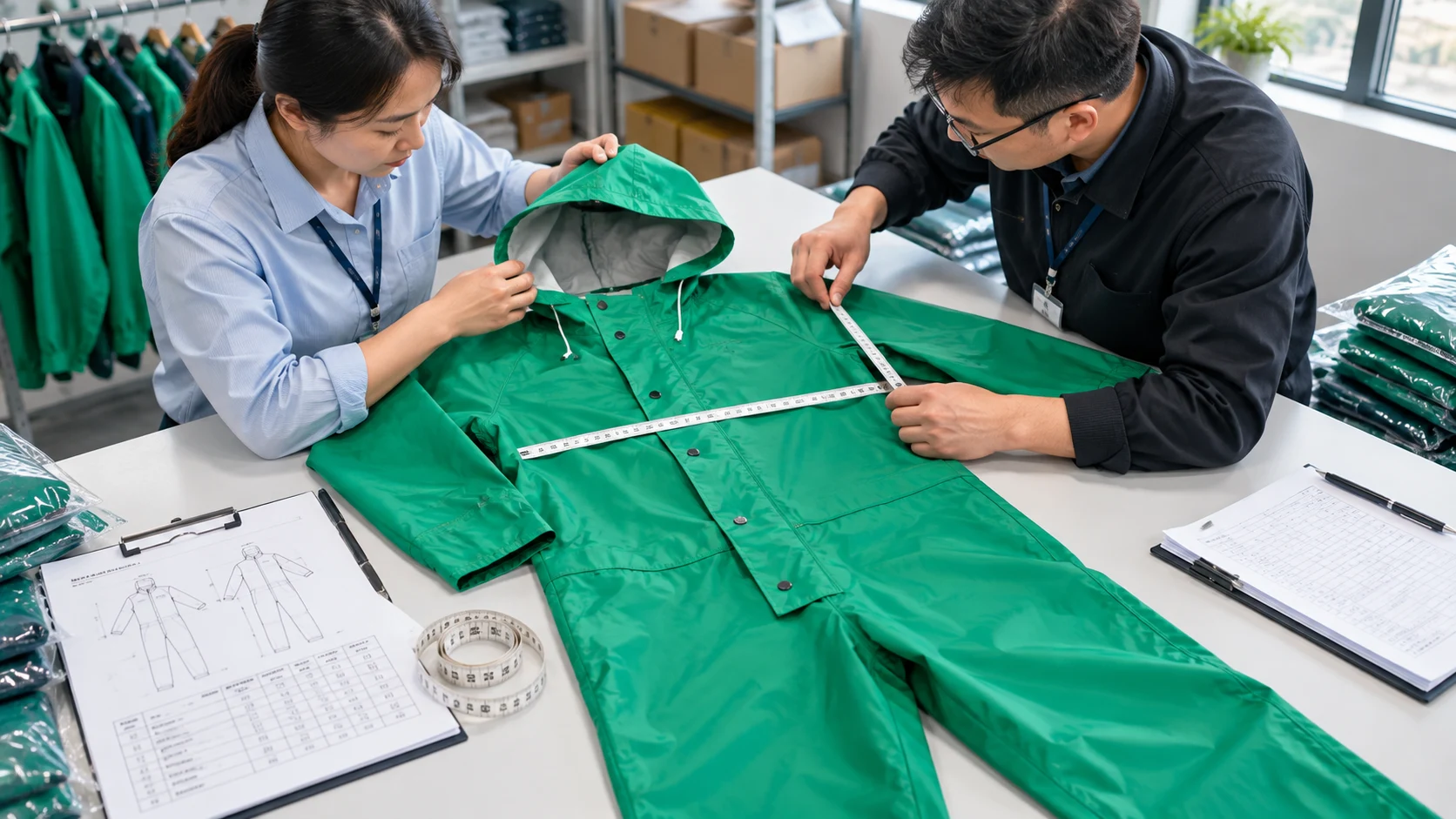
- Name the proposed material and record thickness or weight, finished dimensions, tolerances, and the measurement method.
- Check hood, neck, arm openings, side seams, corners, and cut edges for clean, consistent construction.
- Open units from multiple cartons and confirm individual pack dimensions, opening speed, unit count, carton labeling, and protection from compression.
- Run a movement test over representative clothing, then record stretching, whitening, seam opening, or tearing in a consistent sequence.
- Review logo placement, print adhesion, color approval, and whether artwork crosses a seal or stiffens a high-movement area.
- Define the reuse or disposal message and confirm that it matches the actual material, event process, and local handling instructions.
- Approve a production-representative sample and an inspection plan covering random units from more than one carton.

Turn the Comparison Into a Clear RFQ
A useful RFQ asks the supplier to separate material, size, packaging, printing, and inspection variables rather than bundling them into a vague “promotional poncho” description. Request comparable PE and EVA options where both are feasible, with the same artwork and target quantity. Ask which details are standard, which are configurable, and which require a sample approval. This makes cost differences explainable and helps the marketing team choose a product that matches the audience’s expectations.
RAINCOATGIFT’s PE raincoat and poncho category provides a useful route for identifying a starting PE configuration. In the RFQ, include the event date, quantity, material preference, finished dimensions, packaging, print requirements, distribution method, and acceptance criteria. Requirements may vary with the selected material, order quantity, size, customization, and production configuration.
Conclusion
PE and EVA rain ponchos serve different promotional priorities, but the material name is only the beginning of the buying decision. Compare cost against the campaign’s wear phase, assess feel with real samples, specify packaging for the distribution workflow, and define what reuse means after the event. A controlled specification lets buyers choose an economical PE giveaway or a more substantial EVA option without confusing a marketing preference with a verified performance claim.
For a material comparison or quotation, contact the rainwear team with the target quantity, use scenario, artwork, finished dimensions, pack format, and inspection requirements.
Frequently Asked Questions
Is EVA always better than PE for promotional rain ponchos?
No. EVA may suit a program that values a more substantial feel or repeat use, while PE may fit short-use distribution and compact packing. The appropriate choice depends on the application, specification, and verified sample.
Which material is easier to package for bulk distribution?
Either material can be packaged effectively when the individual pack, carton count, dimensions, labeling, and opening method are specified. Confirm the production pack rather than assuming material alone determines packability.
Can buyers claim that a poncho is reusable?
Only when the construction, care guidance, and intended use support that claim. Reuse also depends on how the wearer handles, dries, stores, and transports the poncho. Use conditional wording until the product and program are verified.
What should be compared on PE and EVA samples?
Compare finished dimensions, hand feel, openings, seams, print quality, movement allowance, package protection, opening speed, and condition after representative handling. Keep the test sequence and acceptance criteria the same for both materials.