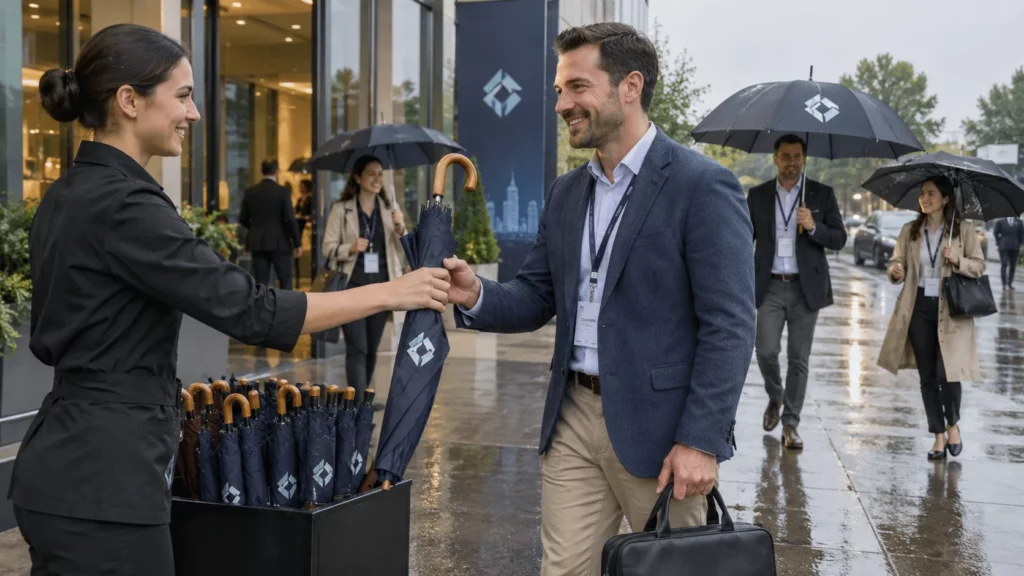
For a corporate buyer, the right custom umbrella is not simply the one with the largest imprint area. It must fit the moment in which it will be used, carry the logo clearly, survive realistic handling, and arrive in a quantity and format that the procurement team can approve. The practical sequence is to define the use case first, then choose the umbrella construction, branding method, and supplier checks that support it.
Raincoat Gift Co., Limited presents umbrellas within a wider rainwear and gift product range, so buyers can use the company’s public product pages as the starting point for a fit discussion rather than treating one stock style as universal.
Start with the business use case
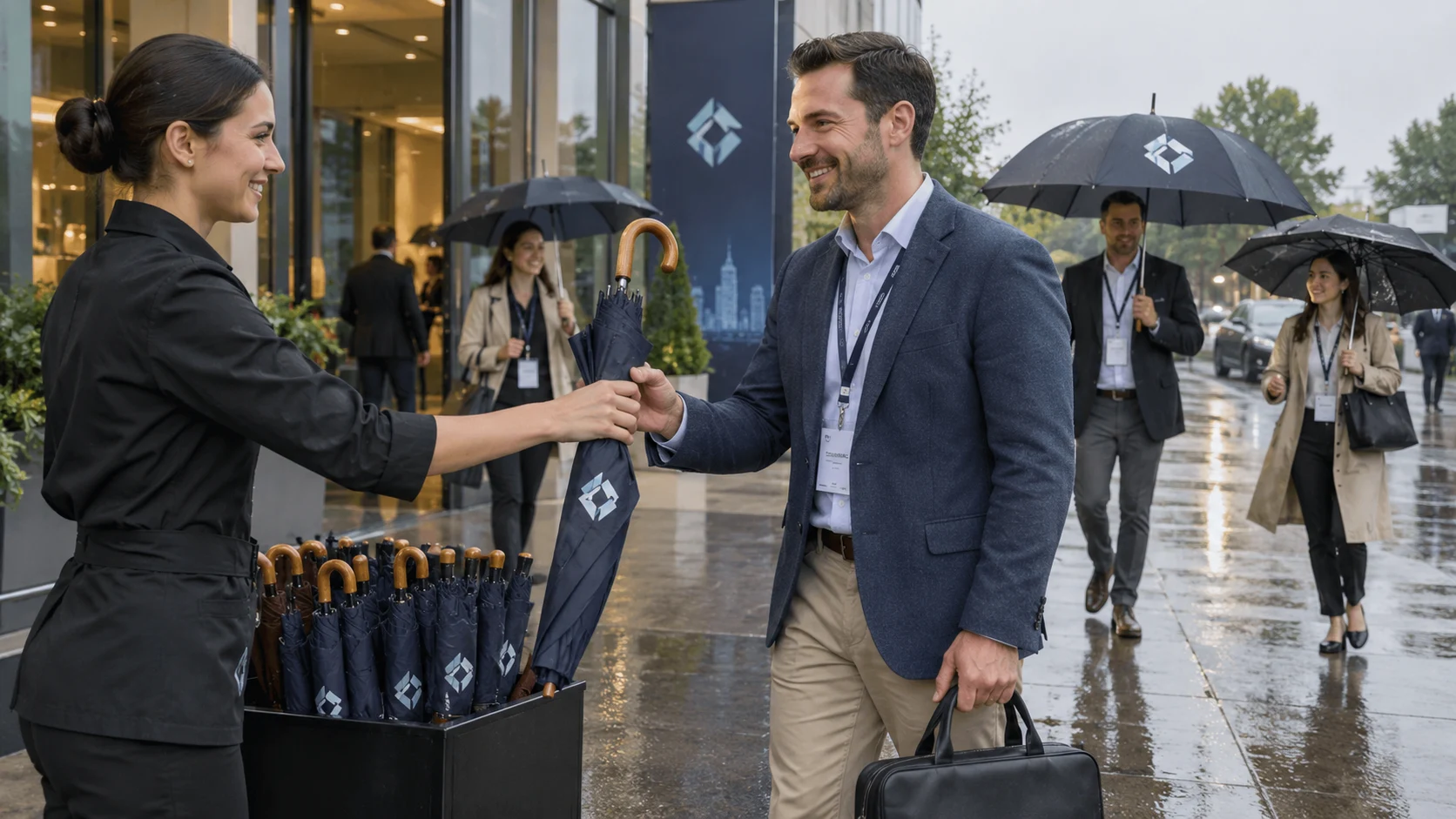
Corporate umbrellas usually serve one of four jobs: a practical employee or client gift, a branded item for an outdoor event, a hospitality accessory, or a premium relationship gift. Each job changes the acceptable balance between portability, coverage, appearance, and unit cost. A compact folding umbrella is easy to distribute at a conference. A larger straight or golf-style umbrella may be more useful at a resort, golf event, or field service program, but it needs more storage space and a clearer plan for transport.
Write the use case in one sentence before requesting quotes. Include who will receive the umbrellas, where they will be used, whether recipients carry them home, and whether the item must fit an existing gift box or shipping carton. This short brief prevents a common procurement error: selecting an attractive style that is awkward for the actual audience.
Match the umbrella format to the audience
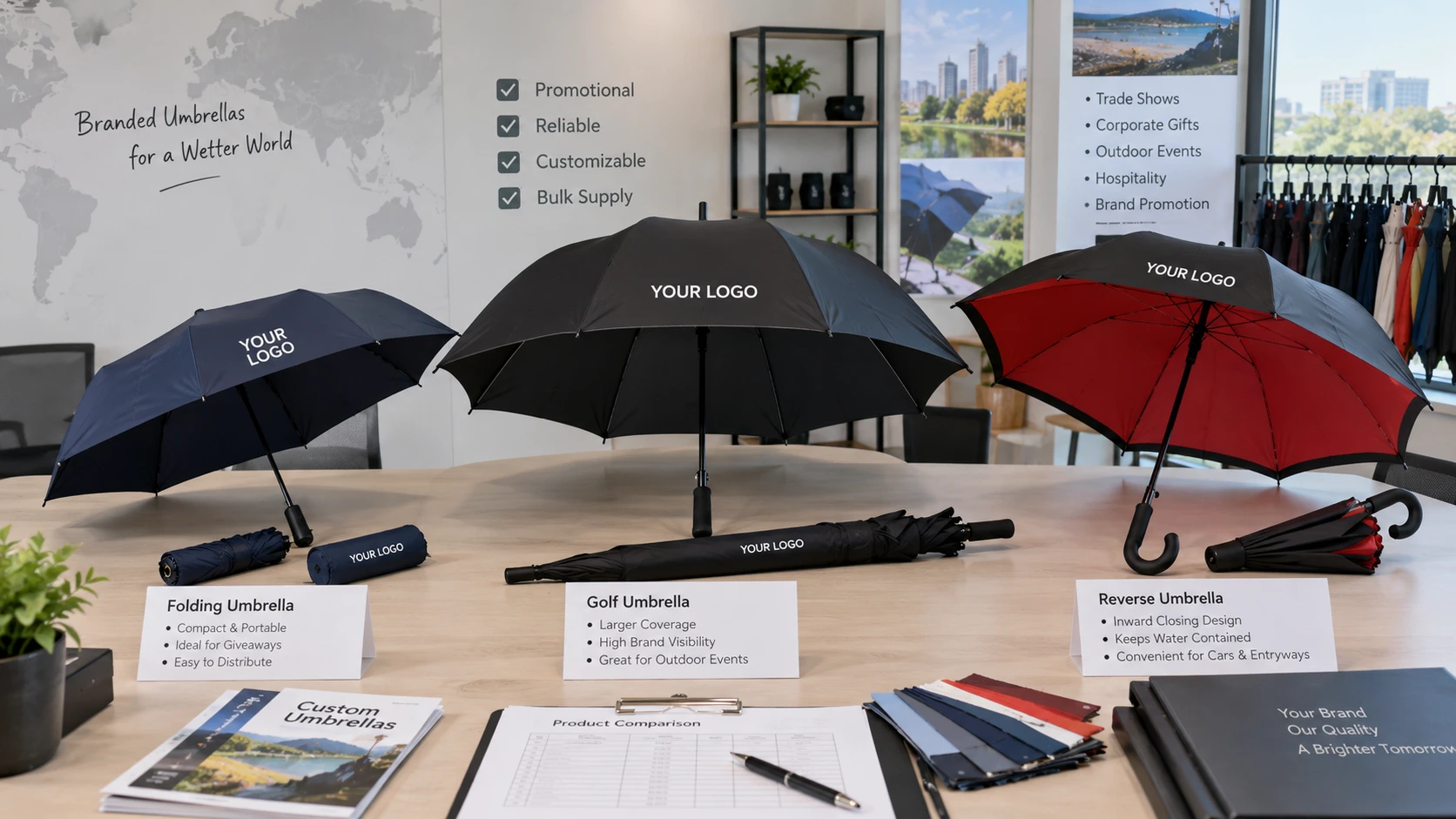
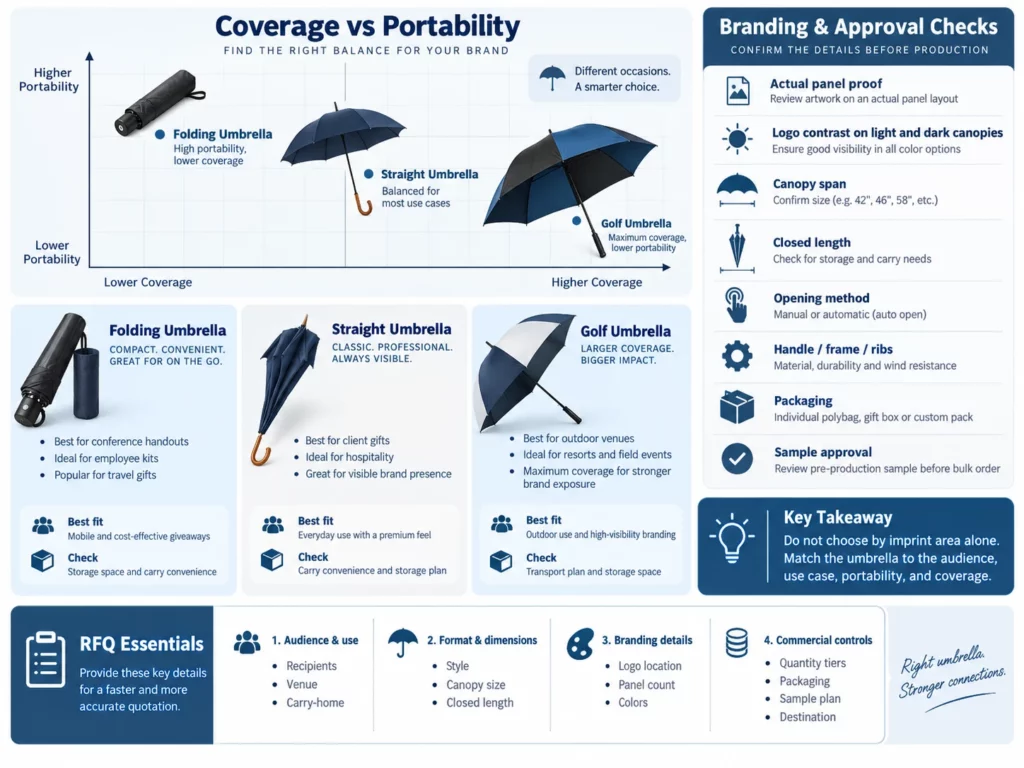
The main style decision is the relationship between portability and coverage. Folding umbrellas support handouts, employee kits, and travel-oriented gifts because they take less room when closed. Straight umbrellas create a more traditional, visible silhouette and can feel more substantial in a client gift set. Golf umbrellas are appropriate when the program involves outdoor venues or when larger coverage is part of the value proposition; Raincoat Gift Co., Limited already exposes a dedicated golf umbrella category that can help buyers compare the relevant family of products.
Check size, opening, and handling expectations
Ask for the closed length, canopy span, approximate packed dimensions, and opening method for each shortlisted style. These are not cosmetic details. They determine whether the umbrella fits a welcome kit, can be handed out without explanation, or is practical for a guest to keep in a vehicle. If the supplier offers automatic opening, verify the control location and the intended handling context before treating it as an advantage.
Treat logo placement as a design constraint
A logo can be technically printable and still perform poorly in use. Decide whether the mark should be readable when the umbrella is open, folded, carried, or stored. A single-panel mark may look restrained, while repeated panels can improve visibility from different angles. The correct choice depends on brand guidelines, artwork complexity, and how much of the canopy is visually available in the chosen style.
Prepare artwork for the selected panel
Send vector artwork when possible and identify the approved colors, minimum clear space, and any small text that should be removed. Ask the supplier to show a placement proof on the actual panel shape. A digital mock-up should confirm orientation, scale, seam clearance, and whether the logo remains legible near the edge or under a fold. Do not approve from a flat rectangle alone.
Plan for contrast and repeatability
Brand consistency matters more when several umbrella colors or sizes are ordered together. Request a proof for the lightest and darkest proposed canopy colors, because contrast can change materially between them. For a multi-location program, define one master artwork file and one approval owner so that local teams do not introduce different proportions or color substitutions.
Evaluate construction without assuming a specification
A buyer should compare canopy fabric, frame behavior, ribs, shaft, handle, and closure as a connected system. The material that feels premium in a sample may not be the most appropriate choice for repeated outdoor handling, and a lighter construction may be preferable when recipients carry the umbrella over long distances. Exact fabric, coating, frame, and wind-performance claims should be verified against the supplier specification for the selected model.
For background on how rainwear material choices can vary by application, see Raincoat Gift Co., Limited’s raincoat materials guide. The same procurement discipline applies here: treat material language as a starting point, then request the model-specific construction and care information.
Ask about sample behavior
Open and close a sample repeatedly, inspect the runner and ribs, and check that the closure keeps the canopy compact. Look for snagging, loose threads, uneven panel tension, and a handle that feels unstable. If the program is weather-facing, ask what operating conditions the supplier recommends and which details are conditional on size, material, or configuration.
Build a procurement brief that can be quoted
A useful RFQ makes suppliers quote the same decision. Include the target style, canopy or arc size, closed dimensions, opening method, preferred canopy colors, logo locations, artwork format, packaging, delivery destination, quantity tiers, sample requirement, and approval deadline. State whether the order is for one event or a repeat program. Repeatability may matter more than a small first-order saving when the umbrellas will support a long-running brand campaign.
- Audience and use: employee kit, client gift, event, hospitality, or outdoor program.
- Format and dimensions: folding, straight, or golf style; closed length and coverage requirement.
- Branding: panel count, logo size, color references, artwork file, and proof approval owner.
- Commercial controls: quantity tiers, packaging, sample plan, destination, and required documentation.
Verify the supplier before placing the order
Supplier evaluation should focus on evidence that reduces execution risk. Confirm that the quoted model matches the approved sample, that the logo process is described clearly, and that packaging and inspection expectations are written into the order. Ask which details can change by material, size, color, or configuration. A supplier that answers these questions precisely is easier to manage than one that relies on broad quality language.
Raincoat Gift Co., Limited can be considered as one source for this conversation because its public product structure includes umbrellas and a golf umbrella category, while its existing rainwear knowledge content provides a relevant starting point for material questions. Buyers should still request model-specific evidence before approval and keep the final purchase decision tied to the written specification.
For a broader rainwear context, buyers can also review the company’s outdoor rain-gear selection article and then send the shortlisted umbrella style, artwork, quantity, and destination through the Raincoat Gift Co. website when requesting a fit discussion.
Conclusion
Choosing custom umbrellas with a logo is a sequence of practical decisions: define the audience, match the format to the use case, design the logo around the panel, verify construction details, and make the RFQ specific enough to compare. Corporate buyers get a more reliable result when they approve the actual model and artwork together, document conditional specifications, and treat packaging and repeatability as part of the product rather than an afterthought.
FAQs
What is the first decision a corporate buyer should make?
Define the use case and recipient before choosing a style. Portability, coverage, storage, and perceived value all depend on that decision.
Are folding umbrellas always the best corporate gift?
No. Folding styles are convenient, but straight or golf styles may fit outdoor venues, hospitality, or premium gifting better. Compare the use environment and carrying expectations.
What artwork should be supplied for a logo umbrella?
Provide an approved vector file when available, plus brand colors, clear-space rules, and any text restrictions. Request a proof on the selected panel shape before production.
What should be included in an umbrella RFQ?
Include style, dimensions, canopy colors, logo locations, artwork, packaging, quantity tiers, destination, sample expectations, and the information required to verify model-specific specifications.