An eco-friendly custom rain poncho should not be approved on the strength of one label. Corporate event buyers need to confirm what the poncho is made from, how long it is expected to remain useful, what printing and packaging add to the order, and whether the claimed end-of-life route works where the event takes place. The practical goal is not to find a material that sounds green; it is to choose a documented product and distribution plan that reduce avoidable waste while still protecting attendees from rain.
The following checks help procurement, marketing, and event teams compare quotations on the same basis. They also make the final specification clearer for the supplier, reducing the risk that a sustainability claim, logo treatment, or packing method changes between the sample and the production order.
Define What Eco-Friendly Means for This Order
For rain ponchos, “eco-friendly” is a conclusion that depends on the whole use case. A lighter disposable product may use less material per unit but create more event-day waste. A heavier reusable poncho may justify more material only if recipients keep and use it. Recycled content may be relevant, but buyers still need evidence for the percentage and source. Start by writing a short purchasing objective, such as reducing single-use distribution, selecting verified recycled content, eliminating unnecessary individual bags, or supporting collection after the event. That objective becomes the test for every supplier claim.
Verify the Material Identity and Composition
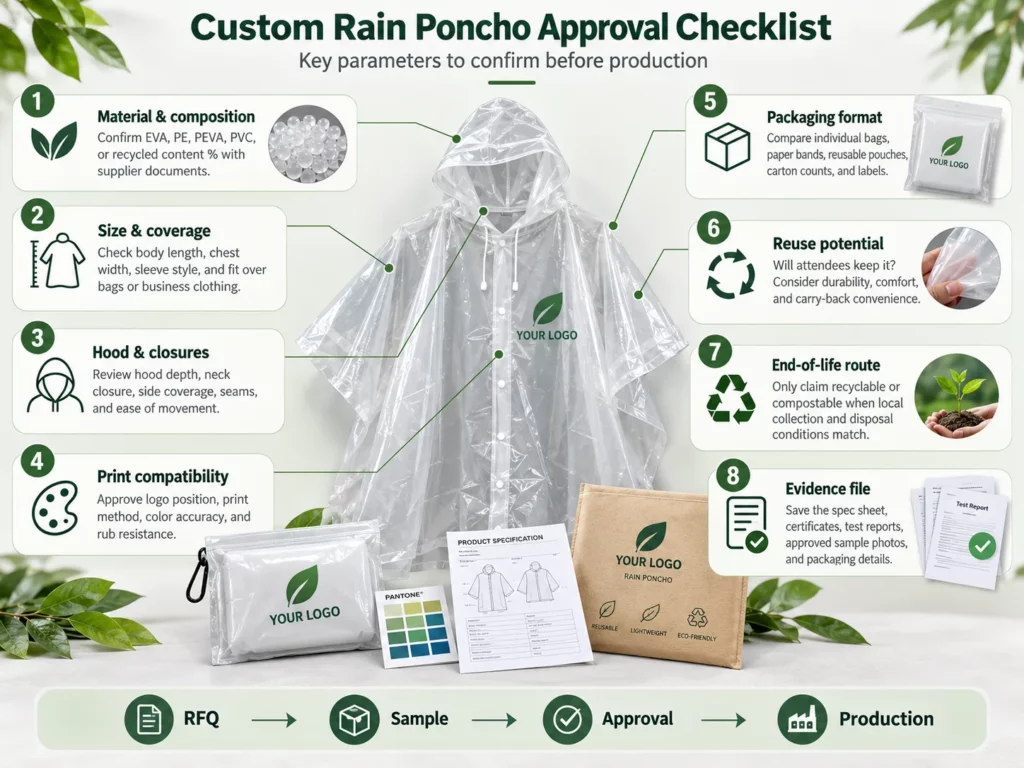
Ask the supplier to identify the material in the quotation, sample, and final specification. Terms such as EVA, PE, PEVA, PVC, polyester, or recycled-content film describe different product families; they do not prove environmental superiority by themselves. RAINCOATGIFT lists a PVC and EVA raincoat and poncho category, which can help buyers define the product family before requesting a project-specific construction and composition.
For any recycled, bio-based, biodegradable, or compostable claim, request a current supplier declaration or technical document that states the applicable percentage, test method, conditions, and scope. Confirm whether the claim covers the poncho body only or also the print, closures, storage pouch, and packaging. The site’s raincoat material overview is useful background, but the purchase decision should rely on the exact specification for the quoted item.
Match Reusability to Event Behavior
A reusable label matters only when the design, handout process, and attendee behavior support repeat use. Confirm the expected durability of the material, seams, hood, closures, and print under normal storage and wet-weather handling. Then decide how recipients will carry a wet poncho, whether a reusable pouch is included, and whether the design is desirable enough to keep. If most units will be abandoned after one short event, a nominally reusable product may not deliver the intended waste reduction.
Check Protection and Event Usability
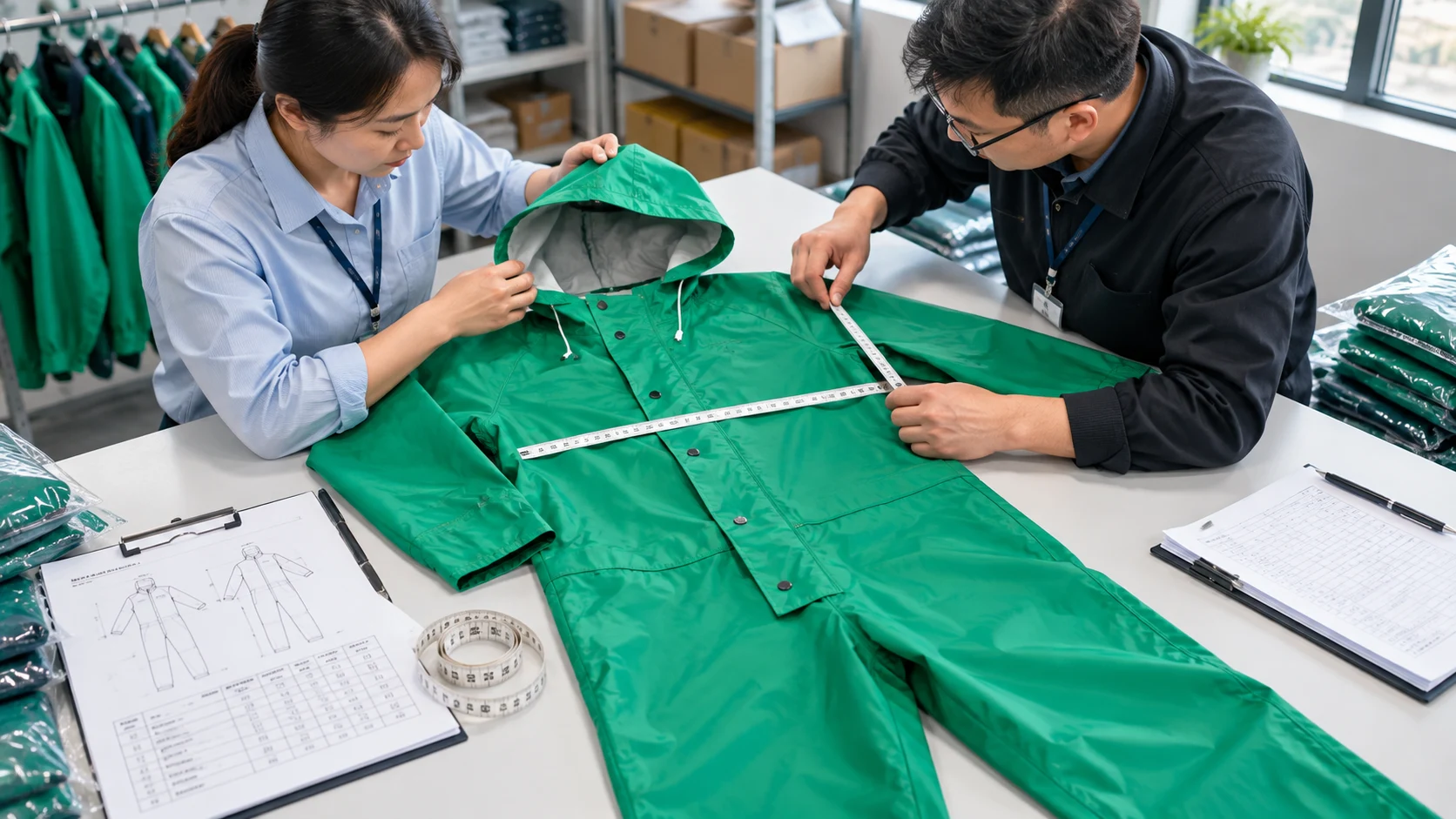
Environmental goals do not compensate for a product that fails in use. Approve dimensions and coverage for the intended audience, including whether the poncho must fit over business clothing, backpacks, or outdoor workwear. Review hood opening, neck closure, side coverage, sleeve style, seam construction, material feel, odor, transparency, and ease of movement. Ask whether thickness or weight varies by configuration, and verify every value against the production specification rather than assuming that samples from different materials are equivalent.
Confirm Decoration Compatibility
Logo visibility depends on the surface, color, folds, and print process. Provide vector artwork, brand colors, the required print location, and the minimum readable size. Ask the supplier to identify the decoration method and to confirm adhesion, color transfer, cracking, and rub resistance for the selected material. A large logo can also make the poncho less likely to be reused outside the event, so compare prominent event branding with a smaller, more wearable treatment. Approve the actual decorated sample, not a digital mockup alone.
Review Packaging and Distribution
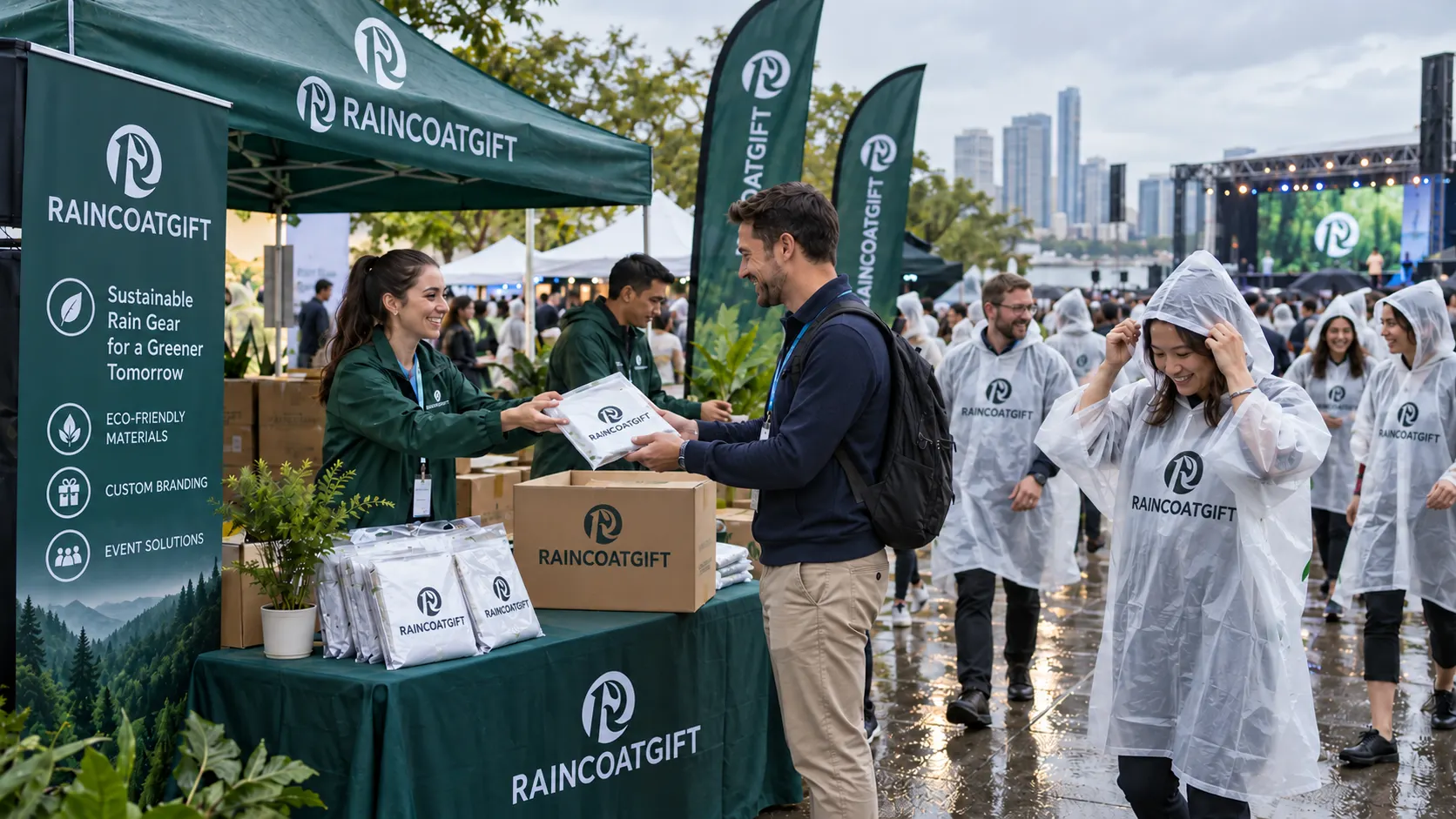
Packaging can undermine an otherwise thoughtful order. Confirm whether each poncho is individually bagged, folded with a paper band, packed in a reusable pouch, or supplied in bulk cartons. Ask for packaging materials and quantities by component, carton counts, labeling, and any separation needed for colors or sizes. Event teams should also plan where ponchos will be distributed, how unopened stock will be recovered, and how wet returns or damaged units will be handled. Avoid extra packaging unless it performs a clear storage or distribution function.
Validate the End-of-Life Route
Do not describe a poncho as recyclable, biodegradable, or compostable without checking the conditions behind the claim. A material may be technically recyclable but not accepted in the local collection system, especially when it is printed, contaminated, or made from multiple components. Compostability claims may depend on industrial facilities rather than home composting. The FTC Green Guides explain why environmental marketing claims should be specific and qualified. Before publishing event signage or campaign copy, document the available collection route and give attendees instructions that match local reality.
Ask for Evidence Behind Every Claim
Build a simple evidence file before approval. It should connect each claim to a document and to the exact ordered item:
- Material identity and composition shown on the specification or supplier declaration.
- Recycled or bio-based percentage, including the measurement basis and covered components.
- Applicable test reports or certificates with issuer, date, product reference, and scope.
- Packaging breakdown, print method, and disposal or recovery instructions.
Check that company names, model references, dates, and material descriptions match across the quotation, sample, and supporting documents. If evidence applies only to a resin or film, do not present it as certification of the finished printed poncho.
Approve Samples and Lock the Production Specification
A pre-production sample should represent the intended material, color, size, construction, logo placement, print method, packaging, and labeling. Record any accepted variation and photograph the approved sample from consistent views. The purchase order should then reference one controlled specification containing all measurable details, artwork files, packaging instructions, inspection criteria, quantity tolerances, and the documents required before shipment. RAINCOATGIFT can evaluate product fit more efficiently when these requirements arrive as one coherent brief.
Questions to Include in the RFQ
A comparable quotation should answer these questions without relying on broad marketing labels:
- What is the exact material and construction of the poncho and each accessory?
- Which environmental claims are proposed, and what current evidence supports each one?
- What dimensions, thickness or weight, closure, hood, seams, and color options apply?
- Which print method will be used, and what artwork and print-area limits apply?
- How is each unit packed, and what are the carton quantity and labeling details?
- What sample stages, inspection criteria, quantity tolerances, and production milestones apply?
Buyers should also state the event date, delivery destination, expected weather exposure, attendee profile, intended reuse plan, required quantity, and any restricted substances or documentation required by their organization. RAINCOATGIFT can then respond to a defined application rather than an ambiguous request for an “eco” poncho.
Conclusion
The strongest eco-friendly custom rain poncho program is built on specific, checkable decisions: the right product family, documented composition, realistic reuse, suitable protection, compatible decoration, restrained packaging, and a credible end-of-life route. When those requirements are written into the sample and production specification, sustainability claims become easier to defend and the event team gains a product that is more likely to perform as intended.
Frequently Asked Questions
What material makes a rain poncho eco-friendly?
No material is automatically eco-friendly. Buyers should compare verified composition, material quantity, durability, reuse probability, packaging, and the local end-of-life route for the finished product.
Are reusable rain ponchos always the better option?
Not automatically. A reusable poncho is more defensible when it is durable, comfortable, easy to store, and likely to be used again. Event distribution and collection plans influence the outcome.
Can a printed poncho be called recyclable?
Only when the claim is supported for the finished configuration and a relevant collection route exists. Printing, mixed components, contamination, and local facility rules may affect acceptance.
What should buyers send before requesting a quote?
Send quantity, event date, destination, use conditions, dimensions or audience needs, preferred material objective, logo artwork, print location, packaging preference, required evidence, and sample expectations.
For a project-specific fit check, send RAINCOATGIFT the event application, quantity, target dimensions, preferred material or environmental objective, artwork, packaging plan, delivery destination, and the evidence your procurement team must approve.