
A reserve rainwear program works only when stock is identifiable, usable, and available before a crew needs it. Procurement should define “ready to issue,” protect garments during storage, inspect them on a repeatable schedule, and replenish by size, role, and lead time. This guide turns those tasks into one practical cycle.
Define What Reserve Stock Must Do
Reserve stock is the controlled quantity held for new hires, size changes, damaged garments, weather spikes, temporary crews, or a second shift. Its purpose determines its specification. A crew working for several hours may need a reusable raincoat and pants set, while a short-duration task may need a lighter emergency item. Treat them as different stock-keeping units even when both are called rainwear.
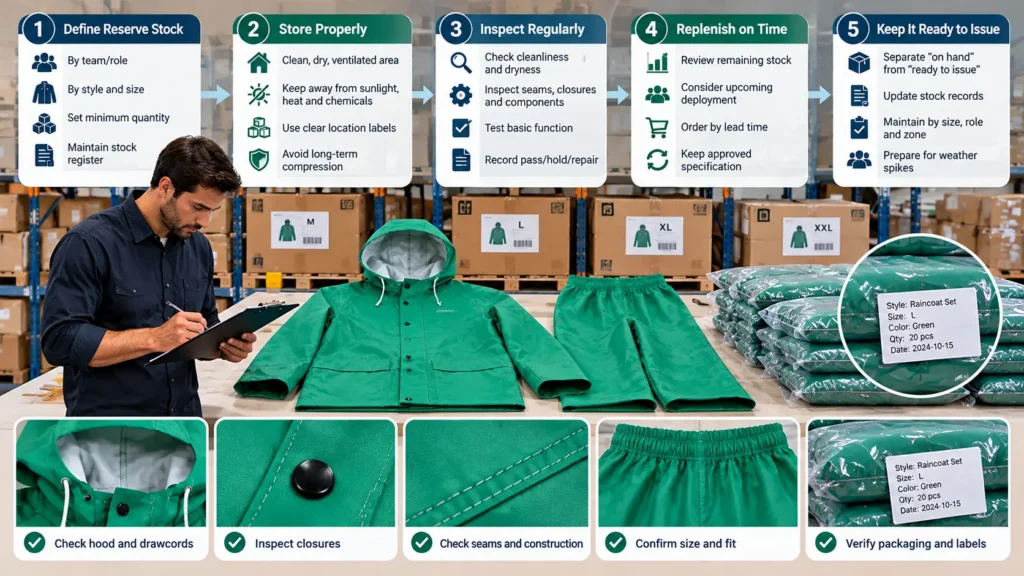
Start with a simple stock register for each style and size. Record the intended wearer group, material or product reference, color, logo version, packed quantity, storage location, received date, issued quantity, damaged quantity, and status. Separate “on hand” from “ready to issue”; cartons awaiting inspection or garments with missing components should not count as available reserve.
- Set a minimum quantity for each critical size and work role, not only one total number for the whole team.
- Keep a separate line for emergency ponchos or short-term coverage if they are not interchangeable with reusable workwear.
- Record the stock owner and next review date so the reserve does not become invisible.
Store Rainwear So It Remains Ready to Issue
Storage should protect the product and preserve the information needed to find it. Follow the product specification and supplier guidance for the material. In general, use a clean, dry, well-ventilated area away from sunlight, heat, sharp edges, chemicals, and standing moisture. A damp receiving area or outdoor container should not become the permanent warehouse.
Use location and packaging controls
Assign a location code to every carton, rack, bin, or kit. The outside label should show style, size range, color, logo version, quantity, receipt date, and destination team where relevant. If cartons contain mixed sizes, list the inner breakdown rather than relying on a closed-box count. Use the supplier’s packed format: the RAINCOATGIFT raincoat category includes different raincoat and poncho formats, so carton dimensions and inner counts should be confirmed for the selected item.
Avoid long-term compression if folding or pressure can distort closures, reflective elements, or coated surfaces. Keep heavier cartons from crushing lighter packs. Individual bags should still allow a quick visual check and should not trap moisture after field use.
Rotate stock by receipt date and specification
Use a first-received, first-issued routine when the same specification is still approved. Place newer cartons behind older cartons and record each movement. If the logo, color, material, or size chart changes, treat the new version as a separate stock line; do not mix it with an older approved issue simply because the garment looks similar.
For event or multi-site teams, a zone plan can be more useful than one central pile. The existing outdoor venue weather preparedness guide explains why stock may be assigned by gates, staff stations, or operating zones. Reserve stock management extends that idea by tracking what is still in each zone and what can be returned to central storage.
Run a Repeatable Reserve Stock Inspection
A reserve inspection is an in-use inventory check, not a substitute for production approval. It identifies garments that cannot be issued confidently and creates a replenishment signal before the next weather event. Set the interval according to use, storage conditions, and risk; quarterly, pre-season, and post-moisture checks are practical starting points.
Use one checklist for every style, recording pass, hold, repair decision, or replacement requirement. Sample high-volume cartons and check every carton after relocation, moisture exposure, or a recurring defect.
- Verify identity: compare the garment, size label, color, logo artwork, and packing label with the approved stock record.
- Check cleanliness and dryness: isolate odor, mildew suspicion, staining, or moisture and investigate the storage cause before reissue.
- Inspect construction: look over seams, cuffs, hood or collar areas, closures, pockets, drawcords, and any reflective elements included in the approved design.
- Test basic function: open and close zippers, snaps, hook-and-loop areas, and adjusters without forcing them or damaging the garment.
- Confirm size coverage: compare the remaining size mix with current crew assignments, recent hiring, and the next planned deployment.
- Document disposition: return to stock, hold for review, repair if an approved process exists, or remove from the available balance.
The supplier’s work rainwear sample inspection guide addresses approval before bulk production, including fit, seams, closures, and written measurements. Use it as a separate upstream reference. Once garments are in reserve stock, the inspection question becomes whether the approved item remains identifiable and usable after storage and issue cycles.
Replenish From Evidence, Not Guesswork
Replenishment should connect usage, defects, seasonal exposure, and supplier timing. Trigger an order when the available quantity for a style and size falls to the minimum needed for the next issue plus a defined contingency. The buffer depends on crew size, weather variability, replacement frequency, delivery risk, and substitution rules.
Build a practical reorder calculation
For each stock line, record opening balance, receipts, issues, returns, holds, removals, and available quantity. Separate routine consumption from one-off events, then set a reorder point that allows time for quotation, artwork confirmation, sample review, production, transport, receiving inspection, and distribution. Do not use a generic calendar date when your rainy season or supplier schedule differs.
A current RAINCOATGIFT PVC polyester listing identifies material, standard adult sizing, customized logo, a listed 500-piece MOQ, individual PE-bag packing, carton quantity, and a listed production time. These fields illustrate what should be checked before a replenishment order; they should be reconfirmed for the exact style, size run, artwork, and delivery basis rather than copied as assumptions into every purchase.
Use receiving checks to close the loop
When replenishment arrives, compare the shipment with the purchase record before it enters reserve stock. Count cartons and inner units, verify the size breakdown, inspect logo and color against the approved artwork, confirm packing labels, and place any discrepancy on hold. Update the register only after the receiving decision is clear. This prevents the system from showing stock that exists physically but cannot yet be issued.
Align the RFQ With Reserve Stock Requirements
A reserve-focused RFQ should describe the operating need, not only the product name. Ask for style, material, size range, colors, logo method and position, packing, carton configuration, quantity by size, sample needs, production timing, and delivery destination. Include the first issue date and replenishment scenario so constraints surface early.
For teams that need visibility in low-light conditions, a reflective option may be relevant. RAINCOATGIFT lists a polyester/PVC raincoat and rainpants set with S-XXXL sizing, customized color, reflective strips, logo and graphics printing, and custom packaging options. Those are useful procurement fields, but the final suitability still depends on the work environment, garment specification, and the organization’s own safety requirements.
For events or multiple locations, ask whether cartons can be divided by team, zone, or size group. For recurring programs, retain approved artwork, packing instructions, and the size schedule as the next RFQ reference, then update the model when workforce needs change.
Conclusion
A dependable rainwear reserve is managed through four connected records: what was approved, where it is stored, what condition it is in, and when the next order must be released. Procurement teams can start with a style-and-size register, protect cartons from damaging storage conditions, inspect stock on a defined cadence, and use issue data to set replenishment points. Product pages and supplier discussions then become inputs to a controlled process rather than a substitute for one.
For a style, size mix, logo, packaging, or replenishment fit check, contact RAINCOATGIFT with the intended use, quantity by size, storage plan, delivery date, and any approved artwork.
FAQs
How much rainwear should an outdoor team keep in reserve?
Set a minimum by style and size using crew coverage, recent issues, expected replacements, and reorder time. One headcount percentage can hide shortages in specific sizes or roles.
How often should reserve rainwear be inspected?
Use a schedule that matches storage conditions and issue frequency. Quarterly and pre-season checks are practical starting points, with additional checks after moisture exposure, relocation, or a recurring defect.
Can emergency ponchos and reusable work rainwear share one stock count?
They should normally be tracked as separate stock lines because coverage, duration of use, packaging, and replacement logic may differ. Combine them only when the operating procedure explicitly allows substitution.
What should a replenishment request include?
Include the product reference, material, quantity by size, color, logo artwork and position, packing, delivery location, required date, sample needs, and any condition that affects storage or distribution.