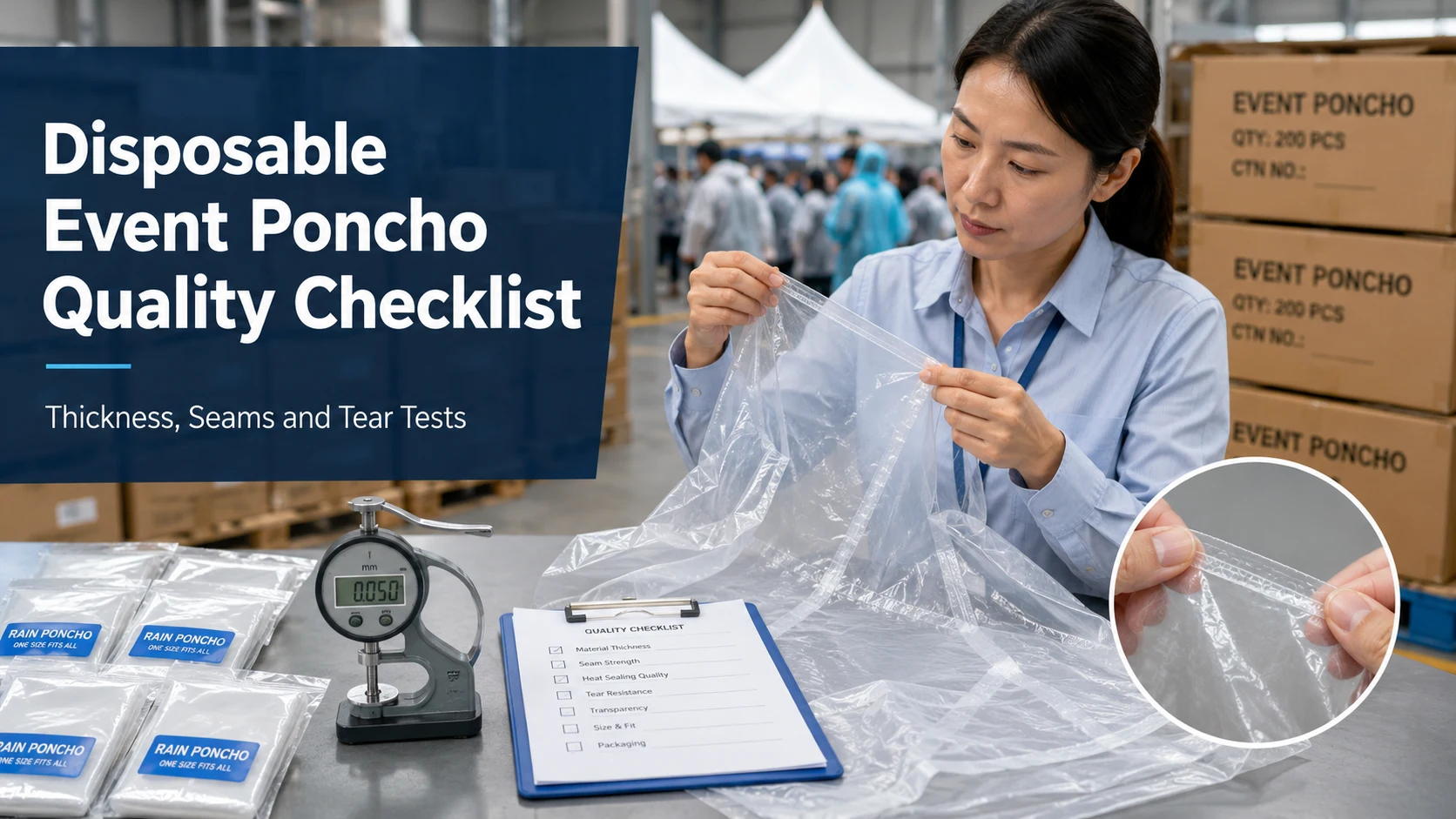
A disposable event poncho quality checklist should help buyers answer one practical question: will the poncho survive normal unpacking, dressing, movement, and rainfall during the intended event? Low unit price alone does not explain why disposable ponchos tear easily. Failures may result from inconsistent film thickness, undersized construction, poorly formed neck openings, weak heat-sealed seams, or differences between an approved sample and mass production.
Bulk buyers should therefore evaluate measurable specifications, finished-product construction, practical wear tests, and batch consistency before approving an order.
Why Disposable Event Ponchos Tear During Normal Use
Where the Poncho Tears and What the Failure Location Indicates
The location of a tear often provides the first clue about its cause. Buyers should record where failures occur, how many units are affected, and whether the same pattern appears across different cartons.
| Failure location | Possible cause | Buyer action |
| Neck opening | Opening too small, sharp cut geometry, or low initial tear resistance | Check the opening dimensions and test several people putting the poncho on |
| Underarm or side area | Insufficient width or movement allowance | Perform arm-raising, turning, and bending tests |
| Heat-sealed edge | Incomplete, narrow, brittle, or inconsistent sealing | Inspect seal continuity and apply controlled pulling force |
| Random pinholes | Film handling, folding, packaging, or transport damage | Unfold samples under strong light and inspect multiple cartons |
| Mixed failures within one shipment | Thickness variation or unstable production control | Compare unit weight, dimensions, and film thickness across the batch |
A tear around the neck does not automatically mean the entire film is too thin. Increasing thickness may not correct a small opening or a sharp corner that concentrates stress. Likewise, a poncho that splits along a side edge may have acceptable film strength but poor poncho seam quality.
Why Low Price Is Not the Only Cause of Poncho Failure
Cost pressure can encourage reductions in material, dimensions, or quality-control steps, but a lightweight poncho is not automatically unsuitable. A low-cost PE poncho may be appropriate for short-term emergency distribution when its dimensions, thickness tolerance, and construction match the application.
Risk increases when the quotation only states “thick,” “durable,” or “tear-resistant” without measurable criteria. Buyers should compare actual film thickness, finished unit weight, usable dimensions, seal construction, and sample performance—not price alone. A sample can also perform well while mass production varies, so the purchase order must restrict unapproved changes to materials, dimensions, and production methods.
How to Check Poncho Thickness, Seams and Tear Performance
Measure Actual Film Thickness and Batch Consistency
Disposable poncho thickness should be treated as a controlled specification rather than a marketing description. Confirm whether the quoted number is a nominal value, an average, or a minimum, and define an acceptable tolerance.
Measurements should be taken at several points on multiple ponchos selected from different cartons. Finished unit weight can provide a secondary consistency check when material, dimensions, and accessories remain unchanged. A noticeable reduction in weight may indicate changes that require further investigation, but weight alone cannot identify the exact cause.
A thicker film may improve durability under some conditions, but it does not by itself determine rain poncho tear strength. Material formulation, thickness uniformity, product dimensions, cut geometry, and sealing quality also affect performance.
Inspect Neck Openings, Heat-Sealed Edges and Stress Points
Heat-sealed poncho seams should appear continuous and reasonably uniform, without skipped areas, distorted edges, obvious brittleness, or local thinning. Inspection should focus on the neck, underarms, sides, and any corner where pulling force may concentrate during dressing.
A visual check is not enough. Ponchos should be unfolded and worn by users representing the expected size range. Raising the arms, turning, bending, and putting the poncho on quickly can reveal problems that remain hidden while the product is flat.
If repeated failures occur at the same point, the next action should address that feature. Depending on the cause, the correction may involve changing the opening, dimensions, seal construction, film specification, or production settings.
Run Practical Tear, Movement and Water-Leak Tests
A basic disposable poncho tear test can include controlled pulling at the neck and sealed edges, repeated movement while worn, inspection for pinholes, and a simple water-leak check around sealed areas. The buyer and supplier should agree on the method and pass/fail criteria before production.
Laboratory testing may be appropriate for large, recurring, or higher-risk programs. ASTM D1004 measures the force required to initiate a tear in flexible plastic film, while ASTM D1922 compares resistance to tear propagation in films of comparable thickness. ASTM D882 evaluates tensile properties of thin plastic sheeting. These methods measure different aspects of film behavior and should not be treated as interchangeable.
Bulk Event Poncho Quality Checklist Before Mass Production
Approve a Reference Sample and Measurable Tolerances
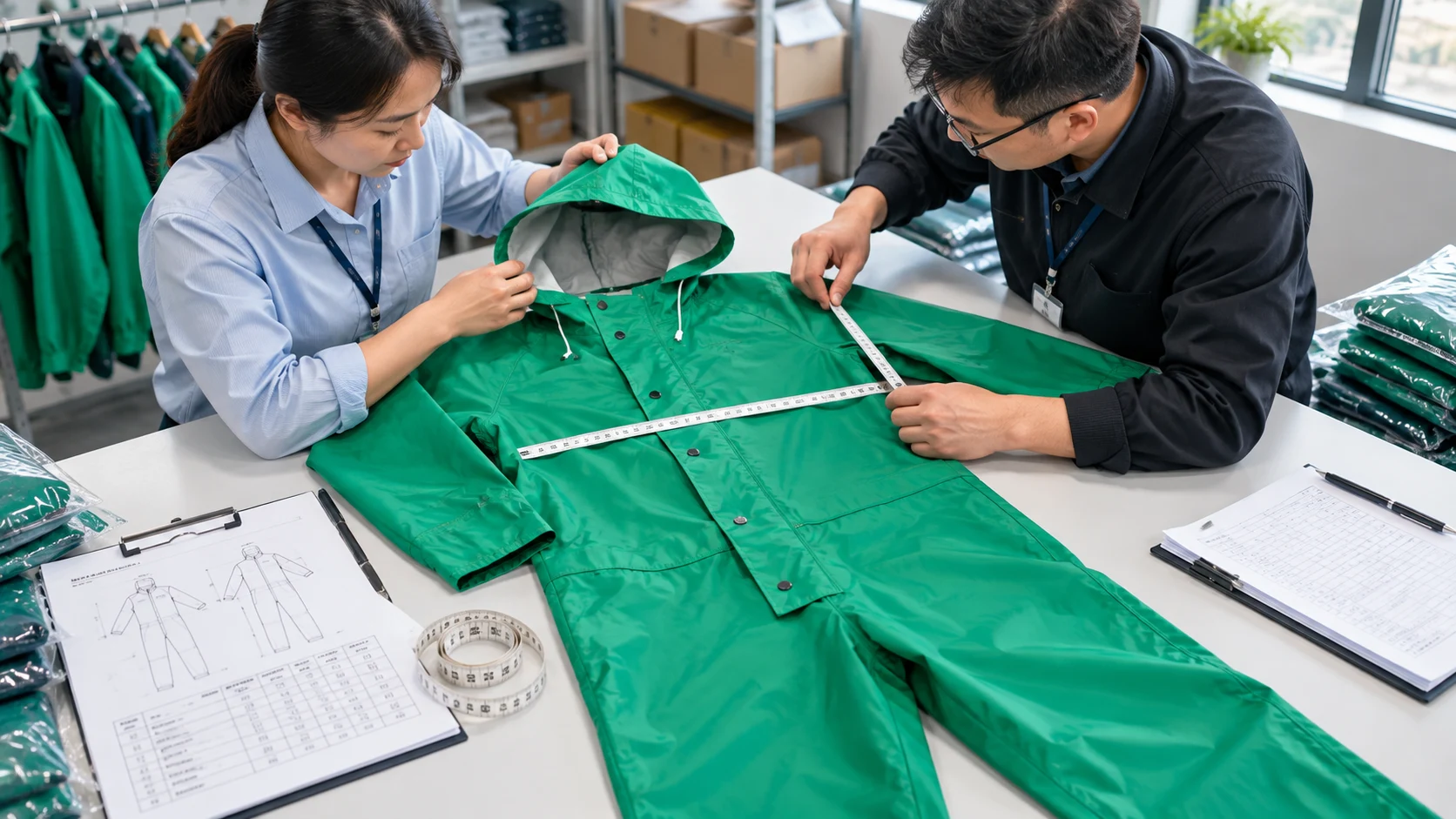
An approved reference sample should be retained by both parties. It should correspond to a written specification covering:
- Material and agreed film thickness
- Thickness tolerance or minimum requirement
- Finished dimensions and unit weight
- Neck-opening dimensions
- Seal type and construction
- Color, transparency, and printing
- Individual packaging and carton quantity
- Practical wear and tear-test criteria
Photographs cannot replace a physical sample because they do not demonstrate thickness, flexibility, opening size, or seam behavior. Any proposed change after approval should trigger written confirmation and, when relevant, a replacement sample.
Define Defects and Inspect the Shipment by Sampling
Bulk poncho quality control should separate defects by their effect on use. A poncho that tears during normal dressing, has an unusable opening, or leaks badly may be classified differently from a minor printing or packaging issue.
Samples should be drawn from multiple cartons and different positions within the shipment. The inspection record should state the number checked, the number that failed, defect locations, photographs, and the acceptance decision. ISO 2859-1:2026 describes single, double, and multiple acceptance-sampling plans for inspection by attributes, but the inspection level and acceptance criteria should reflect the order’s risks rather than an automatically selected AQL.
How to Prevent Quality Failures in the Next Bulk Order
Match Material and Construction to the Event Scenario
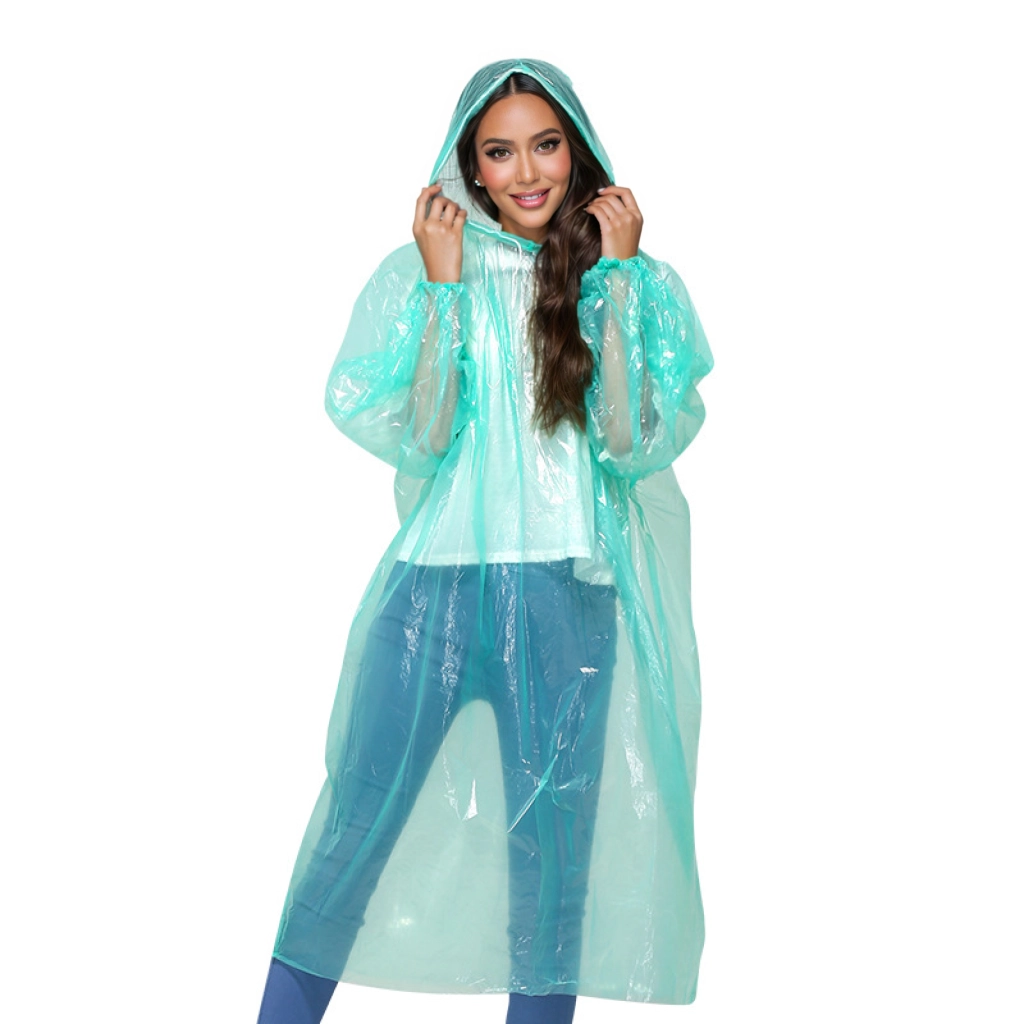
Economic disposable PE ponchos may suit stadium entrances, festivals, races, promotional events, or emergency distribution where compact storage and single-use protection are priorities. They may be unsuitable when users must wear the product repeatedly, move through demanding work conditions, or rely on it as industrial protective equipment.
Before selecting a specification, confirm the expected wearing time, user size range, weather exposure, movement level, distribution method, and consequences of failure. When durability and repeated use are more important than the lowest unit cost, a different construction or material may be more appropriate.
Write Quality Requirements into the RFQ and Purchase Order
Bulk poncho RFQ specifications should include the intended application, target quantity, material, dimensions, thickness requirement, tolerance, unit weight, neck opening, sealing construction, packaging, approved sample, inspection plan, and delivery requirements.
For a concrete product reference, the disposable PE rain poncho for bulk orders is listed in PE material with a standard adult size, customizable logo, individual PE-bag packing, bulk carton packing, and sample options. Final thickness, tolerances, testing requirements, and application suitability should still be confirmed in the quotation and approved specification.
How to Compare Disposable Event Poncho Suppliers
A suitable event poncho supplier should provide more than broad performance claims. Buyers should request a complete specification, representative samples, measurable production tolerances, packaging details, and a clear process for handling nonconforming goods.
RAINCOAT GIFT CO., LIMITED presents raincoats, ponchos, umbrellas, and bags through its Raincoat Gift rainwear manufacturing solutions website. Its company information identifies customizable rainwear and bulk-order support among its business activities.
The Raincoat Gift company and production profile can be reviewed when assessing product range and supplier background. Supplier qualification should still be based on the requirements of the specific order, including approved samples, written tolerances, inspection access, and corrective-action expectations.
When a shipment fails, buyers should retain the purchase specification, approved sample, carton numbers, photographs, defective units, and calculated failure rate. Packaging errors may be suitable for rework, while systematic thickness, sizing, seam, or normal-use tearing problems may require production replacement or shipment rejection.
Conclusion
Disposable poncho quality depends on more than a quoted thickness or low unit price. Buyers should examine failure locations, film consistency, dimensions, heat-sealed poncho seams, practical movement performance, and batch inspection results.
RAINCOAT GIFT CO., LIMITED can be approached through submit a bulk poncho specification request. A useful inquiry should include the application, material, dimensions, target quantity, packaging, printing requirements, approved sample needs, and intended inspection criteria.
Frequently Asked Questions
Q1: Does a thicker disposable poncho always resist tearing better?
A: Not necessarily. Thickness is important, but tear performance also depends on film consistency, dimensions, neck-opening design, stress points, and seam construction.
Q2: What thickness should a disposable event poncho have?
A: There is no universal thickness for every event. The specification should reflect wearing time, movement, weather exposure, user size range, budget, and the consequences of product failure.
Q3: Why do disposable ponchos tear around the neck?
A: Common causes include a small opening, sharp cut geometry, stress concentration during dressing, or insufficient initial tear resistance. The opening and film should be evaluated together.
Q4: How many ponchos should be checked before shipment?
A: The sample size should be based on the order quantity, inspection level, defect categories, and agreed acceptance plan. Samples should come from multiple cartons throughout the shipment.