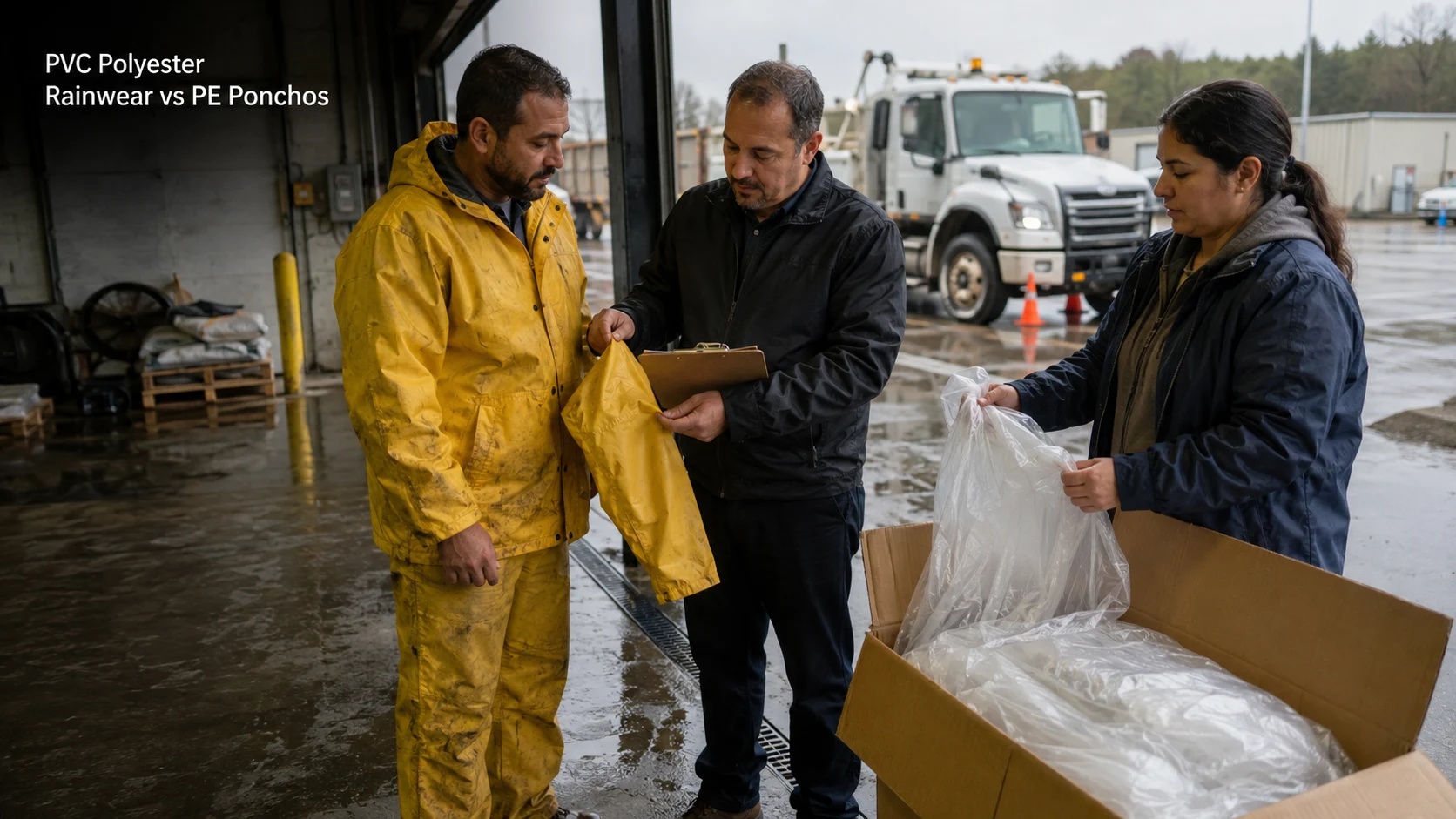
For distributors, choosing between PVC polyester rainwear and lightweight PE ponchos is not simply a material decision. It determines whether an end user receives reusable work rainwear that matches repeated outdoor exposure or a low-cost item intended for emergency distribution. The wrong choice can create avoidable replacement requests, poor wearer acceptance, excess inventory, or a quotation that does not match the customer’s operating conditions.
The practical question is straightforward: Does the customer need rain protection for regular work, or a compact solution for short-term distribution? PVC polyester rainwear is usually evaluated for repeated use in wet, dirty, or active work environments. Lightweight PE rain ponchos are generally considered when portability, broad distribution, and short-duration protection matter more than long-term wear. Distributors should start with the job, the expected frequency of use, and the way the product will be issued—not with the lowest unit price.
The Distributor’s First Decision: Reusable Work Rainwear or Lightweight Emergency Ponchos?
A bulk rainwear order should be classified before a product is quoted. Customers may use similar words—raincoat, poncho, rain suit, workwear—while expecting very different outcomes. A maintenance contractor may need a reusable jacket-and-pants solution for a crew that works outdoors several days each week. An event organizer or facility manager may need thousands of lightweight items for visitors, temporary staff, or emergency kits.
The key distinction is whether the rainwear is part of a working routine or a contingency supply. This is the starting point for a PVC polyester rainwear vs PE ponchos decision.
Classify the Order by Use Frequency, Exposure, and Distribution Model
PVC polyester rainwear for distributors is most relevant when workers are expected to wear the garment repeatedly, move around equipment or outdoor sites, and return it to storage after use. Construction support teams, sanitation crews, agricultural workers, logistics-yard personnel, and outdoor maintenance groups may all need a reusable work rainwear option rather than a light disposable cover.
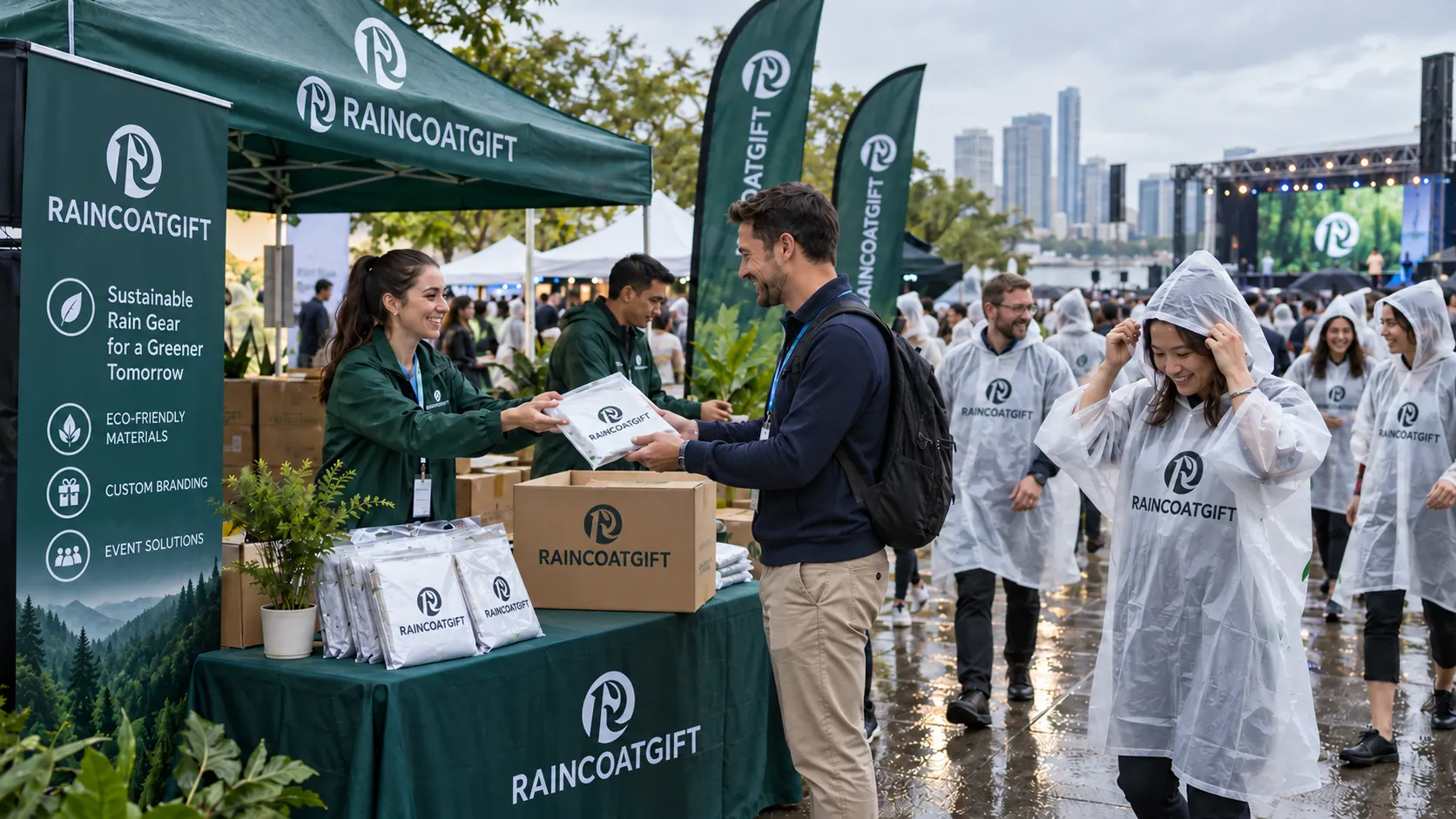
Lightweight PE rain ponchos are more appropriate when rain protection is issued quickly to a large group, often without detailed size management. Examples include emergency stock, visitor supplies, outdoor events, and short-duration operations where the product may be distributed once and not collected for regular reuse.
Before preparing a quotation, confirm:
- How many times each wearer is expected to use the rainwear.
- Whether workers will wear it over uniforms, hoodies, or other work clothing.
- Whether mud, frequent handling, or active movement is part of the job.
- Whether the order needs individual sizes or a simple one-size distribution format.
- Whether the buyer values reusability, compact packing, low initial cost, or all three.
The most common mistake is treating a disposable rain poncho as a substitute for work rainwear because both keep rain off the wearer. The products may overlap in basic purpose, but their purchasing logic is different.
When PVC Polyester Rainwear Is the Better Distribution Choice
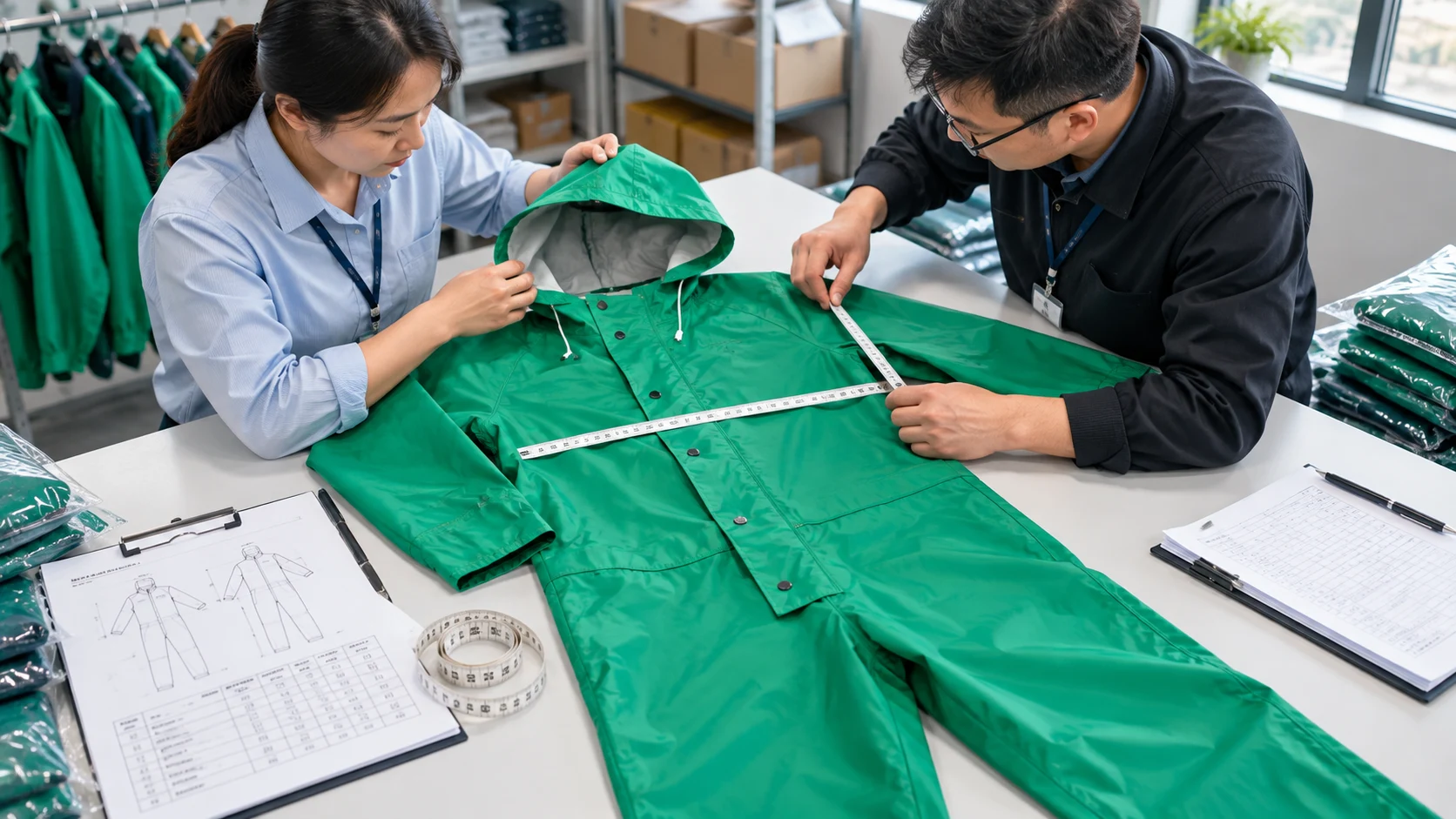
PVC polyester rainwear is typically selected when a customer needs more structured coverage for recurring outdoor work. A polyester base with PVC coating may provide a more work-oriented construction than a lightweight PE poncho, but the final suitability still depends on the product specification, garment design, work duration, and operating environment.
For distributors building a workwear offering, the category should be positioned around practical use conditions rather than broad claims about durability or protection.
Choose PVC Polyester for Repeated Outdoor Work, Mud, and Frequent Handling
A PVC polyester rain suit is usually a stronger fit when rainwear needs to be issued as part of a continuing work program. In these cases, the end user may need to put the garment on and remove it repeatedly, work around wet ground, and maintain a consistent supply by size.
This option is generally suitable when the customer needs rainwear for repeated outdoor work, expects garments to be cleaned and stored, or needs coverage that fits over normal work clothing. It may be less suitable for a one-time crowd distribution, a portable emergency kit, or any order where compact individual packing is the dominant requirement.
Distributors should ask how the rainwear will be used after the first rainy day. If the answer involves regular crew use, on-site storage, or replacement planning, a PVC polyester work rainwear program may be more appropriate than a lightweight poncho order.
The PVC polyester work rainwear options category can serve as a practical next step for buyers comparing work-oriented styles before selecting a specific configuration.
Evaluate Fit, Coverage, and Replacement Risk Before Quoting
Repeated-use rainwear creates purchasing questions that do not apply to most emergency ponchos. A buyer may need separate jackets and pants, a rain suit configuration, a hood arrangement, or sizing that allows workers to wear the garment over existing uniforms. These details influence whether a product is used in the field or remains in storage.
The right configuration depends on the application. A crew that frequently enters and exits vehicles may need a different fit and closure arrangement from a team that performs outdoor inspections or cleaning work. The distributor should also check whether the buyer needs size ranges, mixed-size carton planning, or ongoing replenishment.
Before submitting a PVC polyester rain suit bulk order, confirm the size breakdown, color requirements, packaging method, logo placement, and whether the customer expects samples. This reduces the risk of a quotation being based on one construction while the buyer expects another.
For a buyer that has already selected the reusable-workwear path, custom PVC polyester work rainwear can be presented as a product-level inquiry option. The listed product page includes PVC polyester material, customized logo options, and a stated MOQ, but final specifications should be confirmed for the actual order.
When Lightweight PE Ponchos Are the Better Bulk Option
Lightweight PE rain ponchos address a different purchasing problem. They are commonly considered when a distributor needs to supply rain protection quickly, carry a large quantity in limited storage space, or provide a low-complexity option for people who may not need a garment again after the immediate weather event.
The value is not that a PE poncho can replace every work rain suit. The value is that it can solve a short-term coverage problem without creating an unnecessary sizing, return, and maintenance program.
Use PE Ponchos for Emergency Stock, Events, and Short-Term Rain Protection
A PE rain poncho bulk order may fit customers that need emergency rain protection for visitors, temporary outdoor staff, event participants, or facility supplies. It can also be relevant when a customer needs a compact product that can be stored in bags, vehicles, reception areas, or emergency distribution points.
This approach is usually not appropriate when users must work outdoors every day, regularly encounter mud or rough surfaces, or require structured coverage over work clothing. In those cases, the buyer should reassess whether reusable work rainwear is the better category.
The distributor should confirm whether the customer plans to hand out the items once, keep them as contingency stock, or use them as part of a continuing crew program. That one question often clarifies whether lightweight PE rain ponchos or PVC polyester rainwear should be quoted.
For comparison-stage buyers, lightweight PE rain poncho options provides a category-level route to the available PE products without forcing a decision too early.
Prevent Low-Cost Poncho Orders From Becoming Service Problems
Low unit cost can be useful, but it can also lead to a poor product match. A customer may ask for a disposable rain poncho because it is inexpensive, then issue it to workers who need to perform repeated outdoor tasks. When that happens, complaints often concern coverage, fit, repeat use, or expectations that were never aligned at the quotation stage.
Distributors can prevent this by clearly identifying the product as an emergency or short-term rain solution when that is its intended use. The quote should describe the distribution model, expected duration of use, packaging, and whether the customer needs logo printing or individual units.
When the application is confirmed as large-scale temporary distribution, bulk disposable PE rain ponchos is the most relevant product-level path. It should not be presented as an equivalent replacement for reusable industrial rainwear unless the buyer’s actual use case supports that decision.
PVC Polyester Rainwear vs PE Ponchos: A Bulk-Order Selection Matrix
The following matrix helps distributors convert a general rainwear inquiry into a clearer purchasing recommendation.
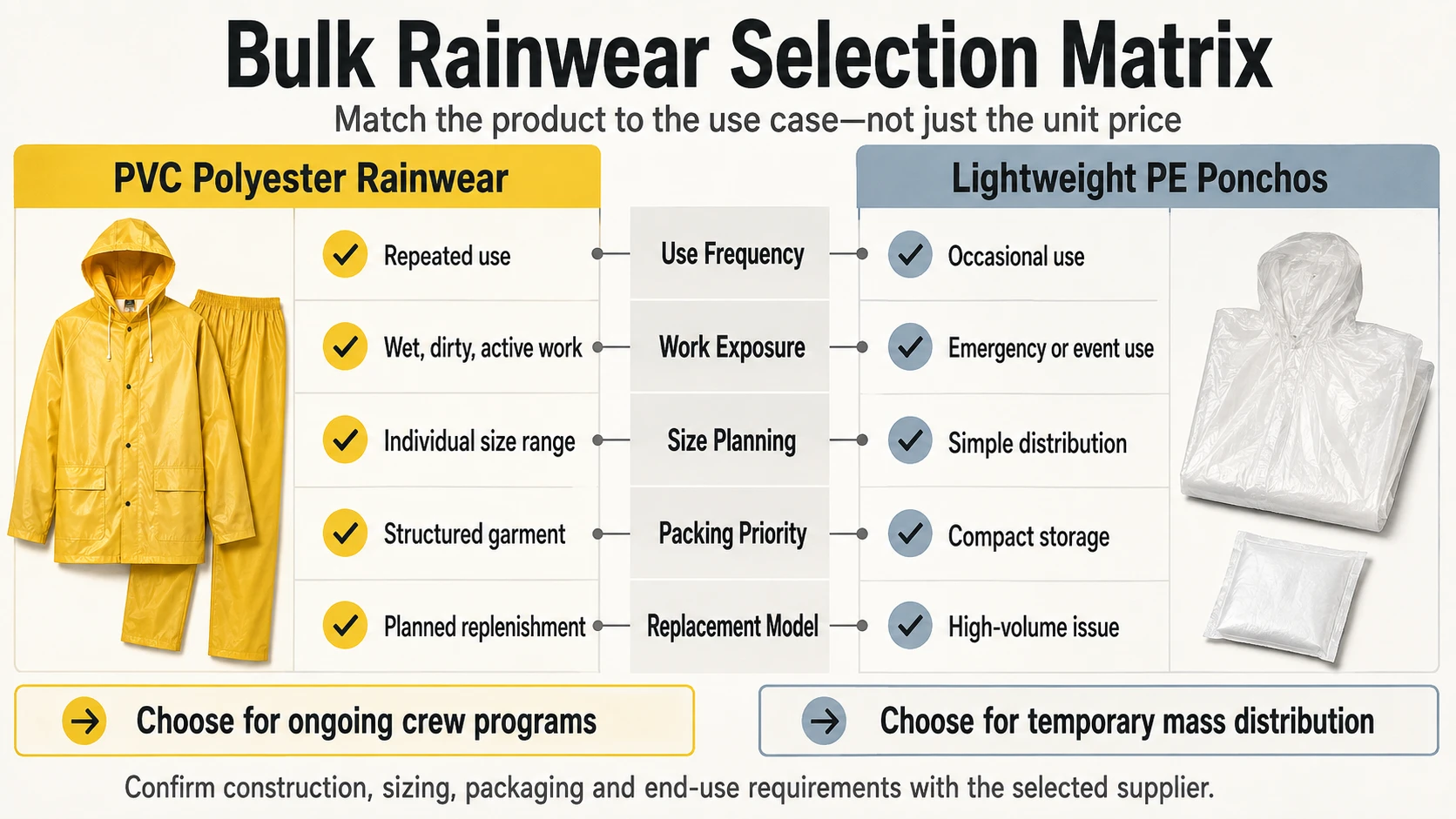
| Purchasing factor | PVC Polyester Rainwear | Lightweight PE Ponchos | Distributor’s next step |
|---|---|---|---|
| Typical need | Repeated outdoor work | Emergency or short-term distribution | Confirm end-user application |
| Expected use frequency | Multiple uses or ongoing program | Occasional or single-event use | Ask how often each wearer will use it |
| Size management | Often requires size planning | Usually simpler to distribute | Confirm size range and allocation |
| Coverage needs | May suit work-oriented configurations | Best for quick rain coverage | Ask what workers wear underneath |
| Inventory model | SKU control and replacement planning | High-volume, compact stock | Confirm packing and replenishment needs |
| Main risk | Wrong fit or incomplete specification | Wrong application or unrealistic reuse expectation | Request samples and clarify use limits |
This table is a selection tool, not a performance guarantee. Thickness, construction, closures, sizing, seams, and packaging may vary by product. Final suitability should be verified against the selected product specification and the customer’s use conditions.
How Distributors Should Build the Right Rainwear Assortment
Distributors that serve more than one buyer type should avoid presenting every rain product as a generic “raincoat.” A clearer assortment separates reusable work rainwear from lightweight emergency and event ponchos. This helps sales teams qualify inquiries faster and helps buyers understand why two rain products with similar visual functions may require different specifications.
Build Two Clear Rainwear Programs Instead of One Generic Offer
A practical assortment can include a workwear program for construction support, maintenance, sanitation, logistics, and agricultural applications, alongside an emergency-distribution program for events, visitor supplies, promotions, and weather contingency stock.
The workwear program should lead with repeated use, coverage, sizing, and replacement planning. The PE poncho program should lead with compact storage, simple distribution, quantity, packaging, and intended duration of use. This division helps avoid sending a workwear buyer toward a temporary product or overspecifying a short-term distribution order.
Raincoat Gift Co., Limited supplies raincoats, umbrellas, and bags, including PVC polyester rainwear, PE rain ponchos, and other rainwear categories for bulk purchasing and customization discussions. This product range gives distributors a way to separate these two programs while keeping sourcing under one supplier relationship.
Quote by Order Structure, Not Only by Unit Price
A rainwear quotation should compare like with like. A lower unit price may not represent a lower overall procurement cost if the products differ in material, garment structure, sizes, packaging, logo requirements, or sample needs.
For a reusable work rainwear order, confirm the required size split, color, logo, packaging, and whether the buyer needs a jacket-only, raincoat, or suit-style option. For a PE poncho order, clarify whether the product is for emergency stock, events, or promotional distribution and how many units are needed per location or attendee.
These details are especially important for distributors reselling to multiple customers. They determine whether the final order is manageable as stock, needs custom allocation, or should be produced for a specific project.
What to Confirm With a Rainwear Supplier Before Placing a Bulk Order
Supplier selection should focus on whether the supplier can convert an application description into a clear, comparable quotation. A useful supplier discussion should distinguish between the rainwear material, the garment format, the end-use environment, and any customization request.
Use an RFQ Checklist That Separates Product Need From Marketing Requirements
A rainwear distributor RFQ should include the end-use application, expected use frequency, target quantity, size requirements, color, logo needs, packaging, and target delivery schedule. If the buyer has a sample, image, or drawing, that information can help avoid assumptions about garment style or branding.
The RFQ should also state whether the order is for repeated work use or temporary distribution. This is the requirement that determines whether PVC polyester rainwear or lightweight PE ponchos should be quoted first.
Verify Product Claims and Samples Before Promising End Users
If an end user requires reflective details, special protective properties, particular material behavior, or compliance with a market-specific standard, those requirements should be verified for the exact product configuration. A bright color or reflective strip alone should not be treated as proof of a particular performance classification.
RAINCOATGIFT can be approached for PVC polyester and PE rainwear sourcing discussions, but the buyer should provide the intended application, desired configuration, quantity, and any documentation requirements before making downstream promises. For a project inquiry, discuss a bulk rainwear requirement with the relevant product details, size breakdown, logo artwork, packaging request, and sample expectations.
Conclusion
PVC polyester rainwear and lightweight PE ponchos should be treated as two different solutions within a distributor’s rainwear range. PVC polyester work rainwear may be the better fit for recurring outdoor work, repeated handling, and structured crew distribution. Lightweight PE ponchos may be the more practical choice for emergency stock, events, and short-term mass distribution.
The most reliable procurement decision begins with use frequency, jobsite conditions, coverage needs, size management, and the buyer’s intended distribution model. Provide those details when requesting a quote so the proposed rainwear category and product configuration can be assessed against the actual order requirement.
FAQs
Is PVC polyester rainwear better than a PE poncho for construction crews?
PVC polyester rainwear may be more suitable when construction crews need reusable rain protection for repeated outdoor work. A PE poncho may be better for temporary visitors or emergency distribution. The final choice depends on the work conditions, garment configuration, and expected frequency of use.
How do distributors choose rainwear for repeated outdoor work?
Start by confirming how often the wearer will use the product, what clothing it must fit over, whether the job involves mud or frequent movement, and whether individual sizes are required. These factors usually matter more than price alone.
Can lightweight PE rain ponchos be used for emergency stock?
Yes. Lightweight PE rain ponchos can be appropriate for emergency stock, short outdoor events, visitor distribution, and similar temporary needs. Confirm the packaging format, quantity, storage plan, and expected use duration before ordering.
What should be included in a PVC polyester rain suit bulk order inquiry?
Include the application, target quantity, size breakdown, color, logo requirement, packaging preference, sample request, and target delivery schedule. If special performance or compliance requirements apply, provide them for the exact product configuration.
Can a distributor stock both reusable work rainwear and disposable ponchos?
Yes. Maintaining separate workwear and emergency-distribution programs can help distributors match products to different customer needs without presenting one rainwear category as a substitute for the other.