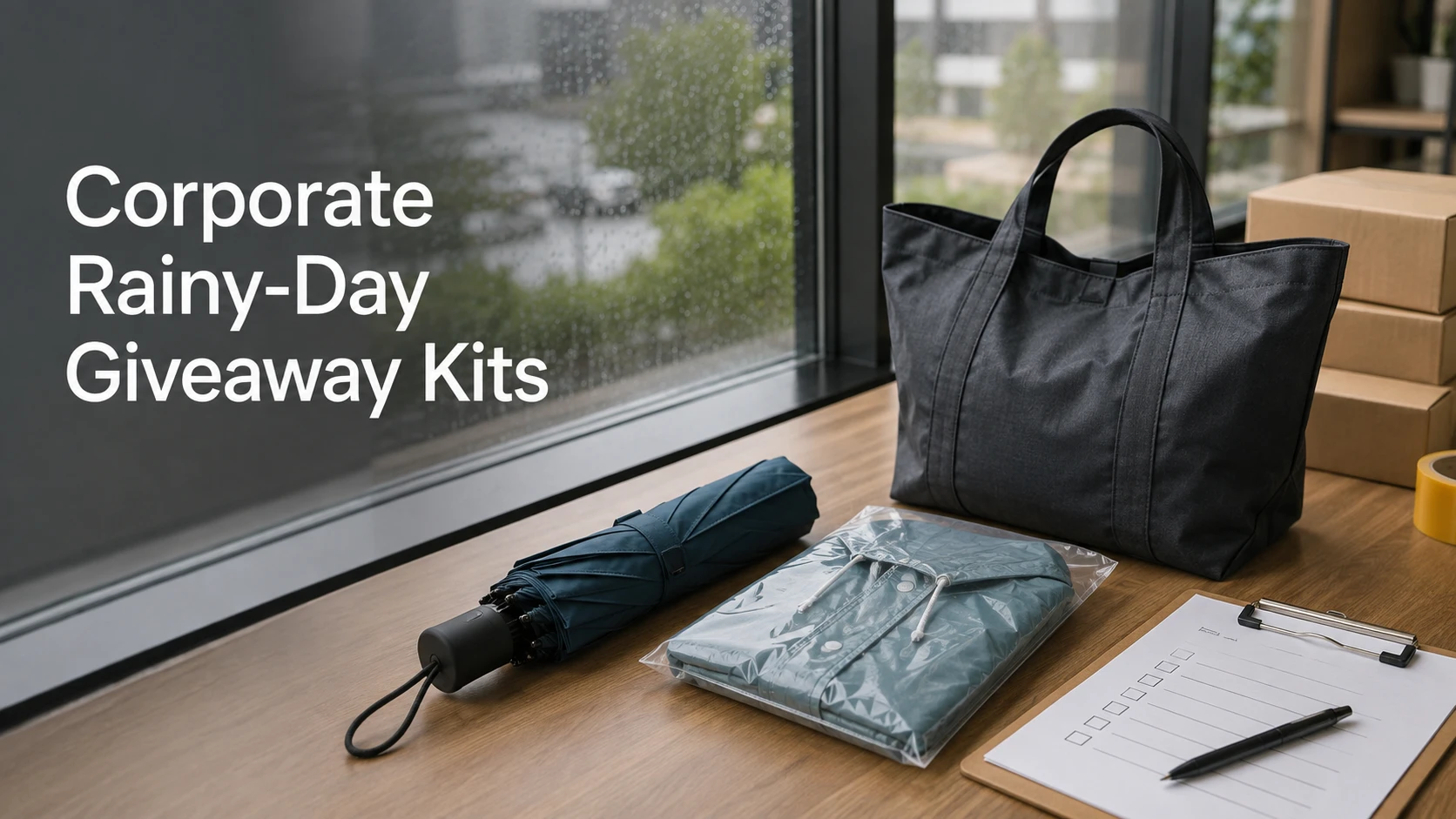
A corporate rainy-day giveaway kit should solve a practical problem for recipients, not simply combine three branded products. For procurement teams, the right mix of an umbrella, poncho, and tote bag depends on who will receive it, where it will be distributed, how often it may be used, and whether the project needs a single ready-to-hand-out set.
The strongest corporate rainy-day giveaway kits give each item a distinct job: an umbrella for everyday coverage, a poncho for weather backup, and a bag for carrying the kit or related event materials. This approach helps buyers control cost, avoid redundant items, and prepare a clearer bulk-order request.
Start With the Campaign, Not a Generic Gift List
A rainy-day kit is most useful when it supports a defined program, such as an outdoor corporate event, employee welcome package, tourism campaign, trade-show giveaway, or client gift. It is less useful when the products are selected only because they share a rain-related theme.
Match the Kit to the Recipient, Venue, and Rain Exposure
Start with the recipient’s day rather than the product catalog. Employees commuting to work may value a compact umbrella that fits into a work bag. Outdoor event attendees may need a lightweight poncho that can be handed out quickly if rain begins. Visitors at a trade show may need a tote bag that carries brochures, samples, and a folded rain item after they leave.
A three-item kit is suitable when recipients are likely to carry materials, travel between locations, or face uncertain weather over more than one day. It may not be appropriate for a short indoor meeting, a low-budget mass handout, or a project where only emergency rain protection is required. Before selecting products, confirm the event date, location, expected attendance, distribution point, recipient profile, storage space, and available budget.
Decide Whether a One-, Two-, or Three-Item Rain Kit Is the Better Buy
More products do not automatically create a better corporate gift. A one-item umbrella giveaway can be more useful than a bulky set if recipients primarily commute or travel. A poncho-only solution may be more practical when thousands of attendees need rapid rain protection at an outdoor gate. A tote bag becomes valuable when it carries the other items, event documents, welcome materials, or samples.
| Project objective | Suitable combination | Main purchasing checks |
|---|---|---|
| Employee welcome packs or client gifts | Umbrella + tote bag | Portability, branding, repeat use |
| Outdoor event weather backup | Poncho + simple individual packing | Distribution speed, quantity, storage |
| Trade shows or multi-day programs | Umbrella + poncho + tote bag | Bag capacity, packing method, color coordination |
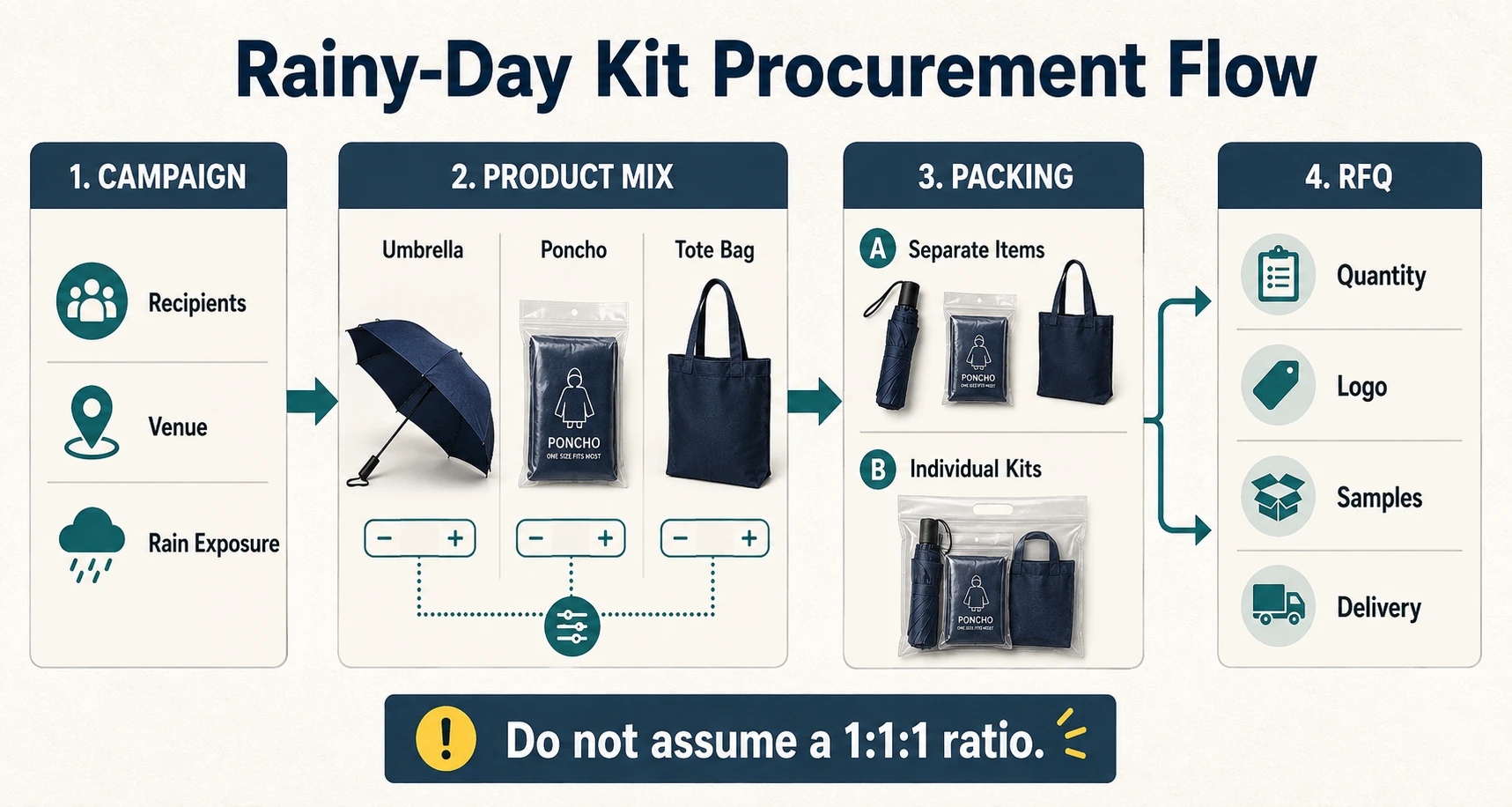
Decide whether every recipient needs every item. Umbrellas, ponchos, and bags do not always need to be ordered at a 1:1:1 ratio. A buyer may reserve ponchos as weather backup while assigning umbrellas and tote bags to pre-registered guests or staff.
Choose Each Item for Its Job in the Kit
The selection process should separate everyday use from contingency use. This is the practical difference between a branded event giveaway kit and a pile of unrelated promotional products.
Choose Umbrellas for Daily Carry, Event Use, or On-Site Coverage
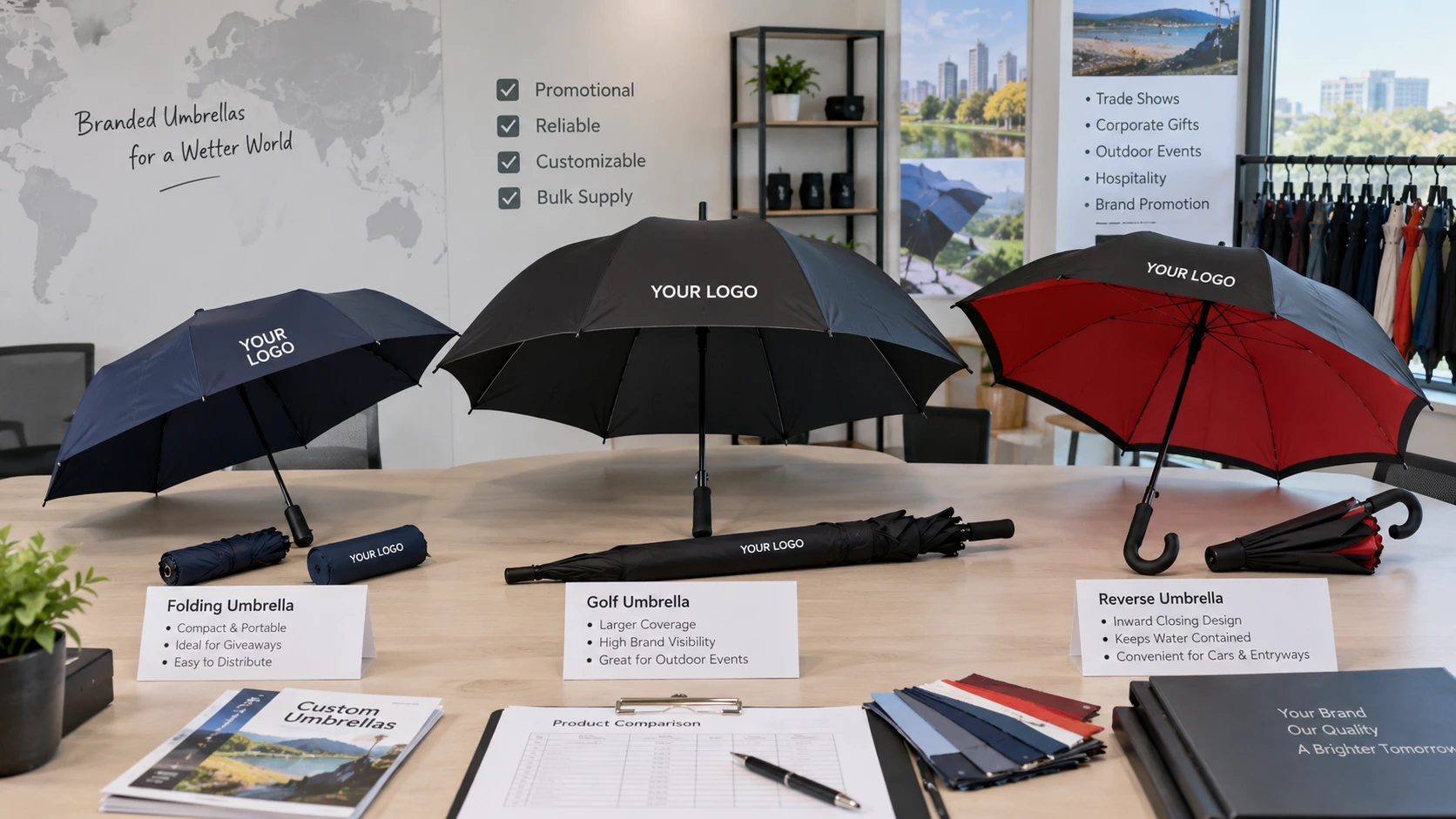
For employee gifts, client programs, and commuter-oriented campaigns, a folding umbrella is often easier to keep and reuse than a larger on-site style. Buyers should review the folded dimensions before choosing a tote bag, because the packed umbrella—not its open size—affects whether the kit is convenient to carry.
When an umbrella is intended to be the primary branded item, its logo area and color contrast deserve more attention than a small secondary logo on every product. A compact umbrella may be less suitable when the main purpose is shared coverage at an outdoor venue, while a larger style may be impractical for recipients who must carry it after the event.
The listed custom folding umbrellas for corporate giveaways provide a useful product-level reference for buyers considering custom colors, a compact format, and alternative packaging directions. Final logo placement, product size, and packing requirements should be verified against the approved specification before production.
Choose Ponchos for Weather Backup, Not as a Default Substitute for an Umbrella
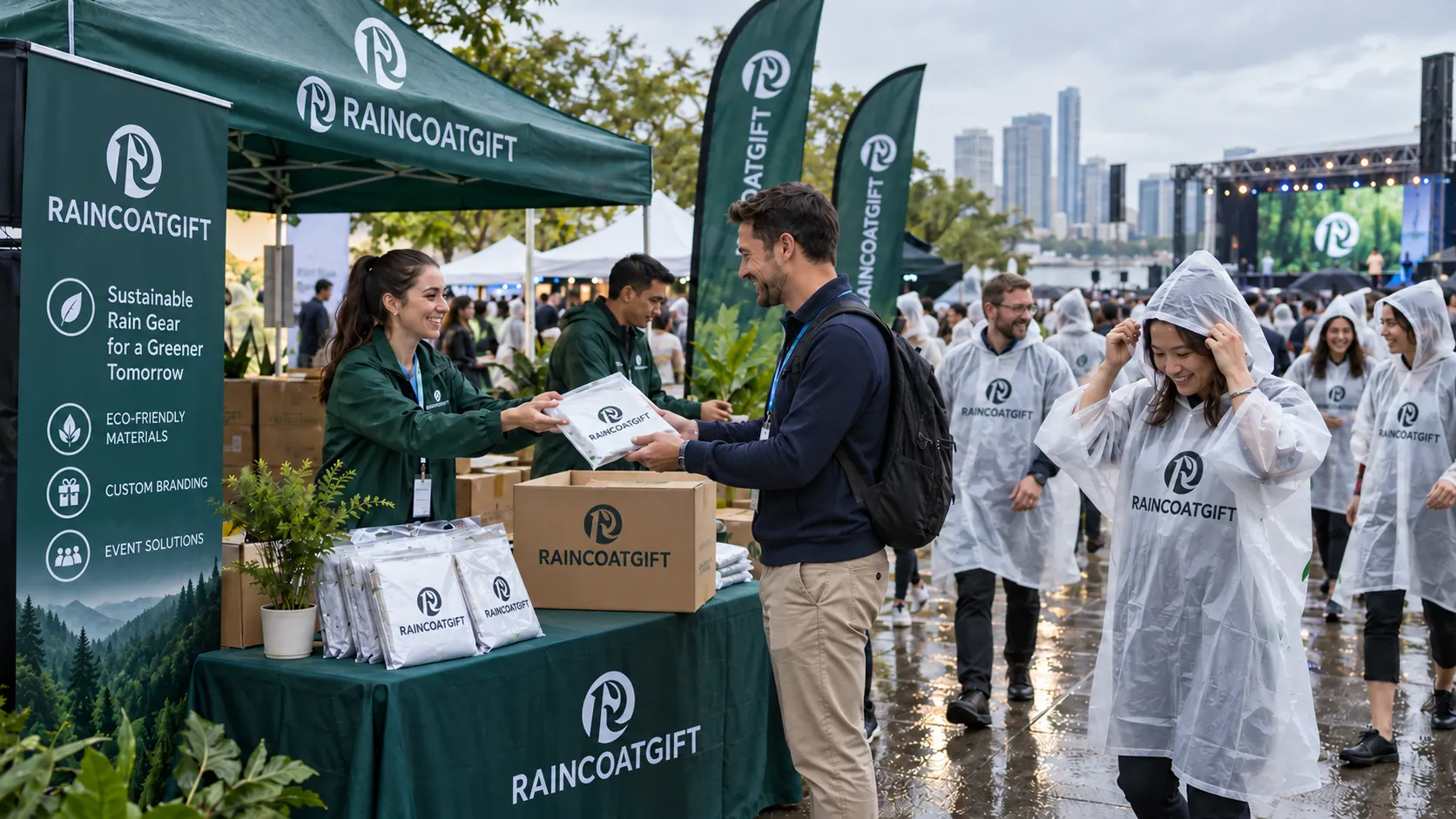
A poncho is usually a contingency item. It can work well for concerts, campus events, stadium programs, tours, charity walks, and other situations where weather changes quickly and distribution must be fast. For these projects, individual packing can matter as much as the poncho itself because staff may need to hand out products at several entrances.
Disposable styles are commonly considered for short-duration, high-volume rain backup. Reusable options may be more appropriate when the item is expected to remain with the recipient after a corporate event or multi-day program. The decision depends on expected wear time, storage, budget, branding purpose, and the likely consequence of a weather change.
The disposable PE rain ponchos for bulk events page can support buyers evaluating a compact, logo-customizable rainwear option. It should not be treated as a substitute for industrial workwear or as proof that every event requires a poncho. Confirm material, dimensions, packing, logo treatment, and intended use in the quotation.
Select a Tote Bag That Can Carry the Actual Kit and Event Materials
A tote bag should not be added merely to create another logo surface. Its value comes from what it can carry. Before choosing a bag, list the actual contents: the folded umbrella, poncho package, brochures, product samples, badge materials, or a welcome card. Then compare those contents with the bag’s usable dimensions, opening, handles, and packing format.
A folding bag can suit lightweight corporate giveaways, especially when the bag itself is intended to be stored and reused. A more structured tote may be a better choice for exhibitions or programs where recipients will carry printed materials. If the event only distributes a poncho at the gate, adding a bag may create cost and packing complexity without improving the recipient experience.
For programs that need a practical carrier, custom folding tote bags for event giveaways can provide a relevant starting point because the listed product supports size, logo, color, and printing customization. Buyers should still test whether the proposed bag holds the complete kit instead of approving it from photos alone.
Build One Consistent Brand System Across the Three Products
Brand consistency is a frequent challenge in promotional rain gear kits. Each item has a different surface, material, shape, and viewing distance. Copying the same artwork onto all three products can increase cost without improving recognition.
Assign One Primary Branding Surface and Two Supporting Surfaces
Choose one item to carry the main brand message. An umbrella may suit a large, simple mark intended for repeated public use. A tote bag may be the better primary surface when the campaign includes event information, a slogan, or a longer message. A poncho often works best with a clear, limited mark that remains recognizable in rain and at a distance.
This does not mean every product needs identical printing. The buyer should define a primary logo version, approved colors, placement rules, and any simplified mark used on smaller surfaces. Avoid approving artwork only from a digital presentation. Material color, transparency, print area, folds, and lighting can affect the final result.
Use Samples and Approval Checkpoints to Prevent a Mismatched Kit
A complete kit should be reviewed as a system. Procurement teams should check logo scale, color consistency, folded dimensions, bag capacity, individual packing, and the appearance of the products together. A product sample may be enough for a basic project, but a full kit sample is more useful when presentation, pre-packing, or client gifting is important.
Common failures include selecting a tote before confirming the folded umbrella size, approving three different logo versions, or discovering too late that the chosen packaging cannot accommodate all items. Record approved artwork, packing instructions, and inspection requirements in the purchase order.
Plan Packaging and Distribution Before Confirming Quantity
Packaging affects how the kit is received, stored, and handed out. It should be planned before quantities are finalized, especially for corporate event rain kits that may be distributed at several locations.
Choose Separate Item Packing or Individual Kit Packing
Separate packing is suitable when staff will distribute items only as needed. For example, ponchos may remain in reserve while umbrellas and bags are given to registered guests. Individual kit packing can suit welcome packages, VIP gifts, employee programs, or pre-event distribution where every recipient should receive the same set.
Buyers should ask whether mixed-item packing, individual set packing, labels, carton markings, and destination-based sorting are available. Do not assume a supplier that sells three product categories also provides kit assembly or fulfillment. If that service is not confirmed, the buyer may need to arrange local packing after receiving the individual items.
Add Quantity Buffers Without Creating Excess Stock
A quantity buffer should reflect the event plan, not a generic percentage. Consider late registrations, damaged items, staff requirements, multiple entrances, weather uncertainty, and whether products can be reused after the event. Keep separate records for individual-item quantities, reserve stock, display samples, and completed kit quantities.
This distinction prevents a common purchasing error: ordering enough umbrellas, ponchos, and bags individually but not enough components to create the planned number of finished kits.
Turn the Product List Into a Clear Bulk-Order RFQ
A usable RFQ reduces revisions and helps suppliers identify gaps before production. For bulk corporate gift kits with logo, include:
- Campaign purpose, recipients, event date, and destination;
- Required umbrella, poncho, and tote bag quantities;
- Whether the order is separate items or assembled kits;
- Preferred product style, material direction, and dimensions;
- Logo files, branding colors, placement, and approval process;
- Individual packing, kit packing, labels, and carton requirements;
- Samples, inspection expectations, and requested delivery milestone.
The RFQ should state what the tote bag must carry and whether the poncho is for temporary backup or repeated use. Those details are more useful than a broad request for “promotional rain gear kits.”
Select a Supplier for Coordination, Not Just Individual Unit Price
A supplier for a multi-product project should be evaluated on clarity as well as price. Buyers need accurate information for each category, clear sample approval, packaging confirmation, and a defined responsibility for quantity checks.
Confirm Kitting, Inspection, and Delivery Responsibilities in Writing
A suitable supplier should be able to clarify what is included in each product quotation and what requires separate confirmation. Ask whether the supplier can coordinate artwork across the umbrella, poncho, and tote bag; whether mixed packing is available; and how quantities, packaging, and product appearance will be checked.
RAINCOATGIFT publicly presents product categories for raincoats, umbrellas, and bags, including promotional-oriented product options. That product breadth can help buyers begin a coordinated sourcing discussion. However, projects requiring individual kit assembly, special labeling, or location-based distribution should request written confirmation of those services before treating them as part of the order.
Conclusion
The right corporate rainy-day giveaway kit begins with recipient use, not with a fixed three-product formula. Select an umbrella for daily protection, a poncho for weather backup, and a tote bag only when it improves carrying or distribution. Then confirm branding, samples, quantities, and packing as one coordinated bulk project.
For a quotation discussion, buyers can contact RAINCOATGIFT with the intended recipients, target quantity, preferred product combination, logo artwork, packing method, destination, and required event date.
FAQs
Do corporate events need both umbrellas and ponchos?
Not always. Umbrellas suit repeat everyday use and planned corporate gifts, while ponchos are useful for rapid rain backup at outdoor events. Use both when recipients may benefit from a reusable item plus on-site emergency protection.
What tote bag size is suitable for an umbrella and rain poncho?
The suitable size depends on the folded umbrella, poncho package, and any brochures or samples included. Confirm the packed dimensions of all contents and, when possible, perform an actual fit check before approving the tote.
Can umbrellas, ponchos, and tote bags be packed as one corporate gift kit?
They can be requested as one kit, but buyers should confirm whether mixed packing, individual kit assembly, labeling, and carton configuration are available. These services should be written into the order rather than assumed.
What should be included in a corporate rainy-day giveaway RFQ?
Include the campaign use, recipients, quantity by item, product combination, branding files, packing method, samples, inspection requirements, destination, and event deadline.
Which item should carry the main logo in a branded rainy-day giveaway kit?
Choose the item with the strongest expected visibility and repeat use. An umbrella may suit a simple, prominent mark; a tote bag may suit a broader event message. The final choice should reflect the audience, artwork, and approved product specification.