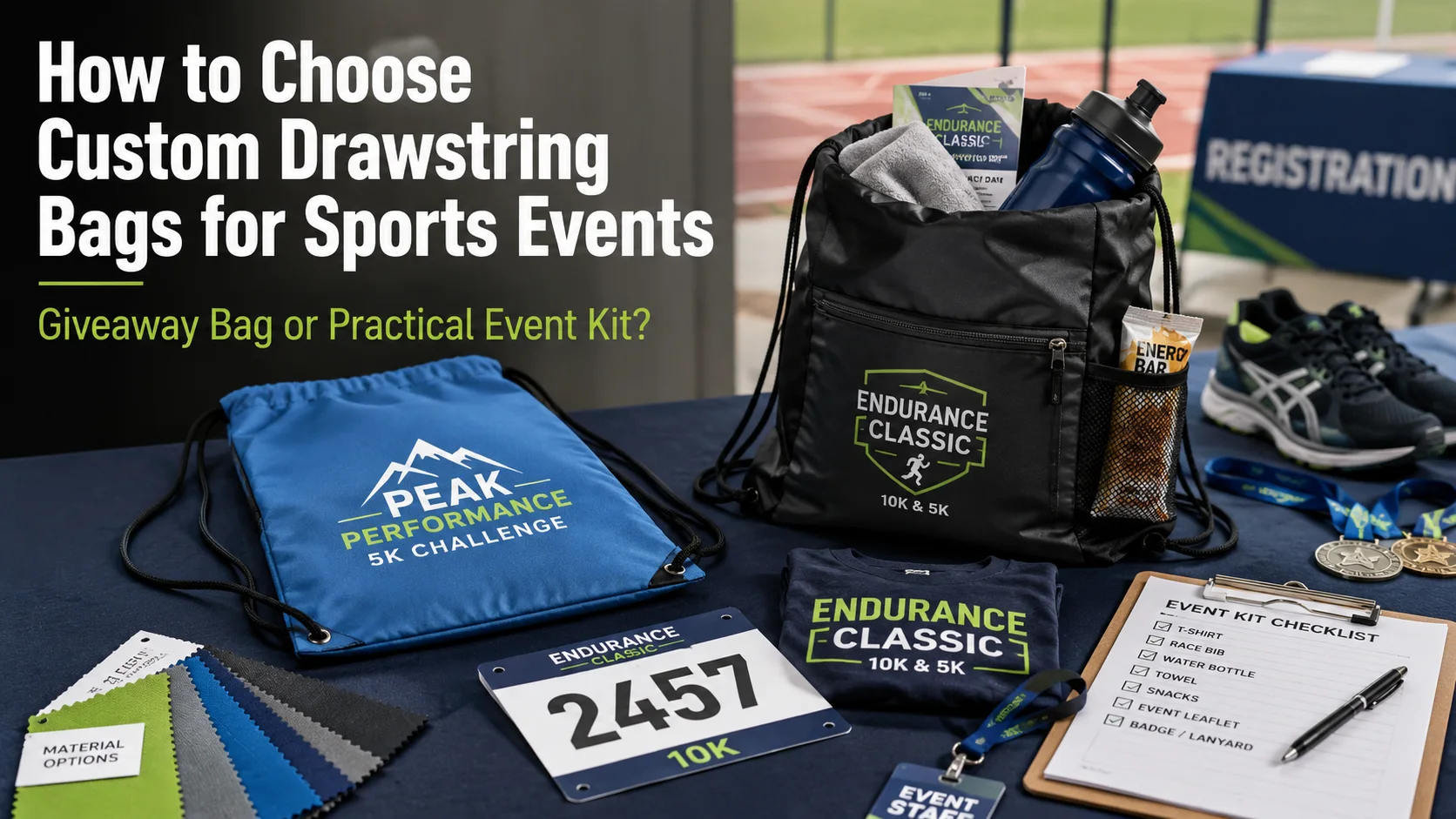
Choosing custom drawstring bags for sports events starts with a practical question: will the bag hold a few lightweight giveaways, or must it carry a complete event kit throughout the day? Selecting by unit price, fabric name, or appearance alone can result in bags that are unnecessarily expensive, too small for the contents, uncomfortable to carry, or unsuitable for the distribution location. Buyers should define the recipients, kit contents, carrying time, venue rules, branding requirements, and packing process before approving a material or design.
Giveaway Bag or Practical Event Kit: Which Does Your Sports Event Need?
A lightweight promotional bag and a practical sports event kit bag serve different purposes. The correct choice depends on what goes inside, how long recipients will carry it, and whether the bag is expected to remain useful after the event.
When a Lightweight Giveaway Bag Is Enough
A basic sports event giveaway bag may be suitable when it only needs to hold a race bib, printed schedule, coupons, sponsor leaflets, or several small promotional items. This approach is often appropriate for large-volume distribution where recipients collect the bag at registration and use it for a limited period.
The buyer should still confirm the usable dimensions, drawcord arrangement, logo area, and packing method. “Lightweight” should not mean that the bag is selected without checking its actual contents. A low-cost model that cannot close around a folded T-shirt or develops excessive strain around the lower corners may create more operational problems than it solves.
If event organizers expect to add water bottles, towels, apparel, samples, or boxed merchandise later, the original specification should be reviewed before production. Expanding the kit without reviewing the bag is a common reason a simple giveaway becomes unsuitable.
When to Specify a Practical Event Kit Bag
A practical event kit bag is more appropriate for marathon participants, sports teams, volunteers, staff members, or corporate activity groups who must carry several items for hours. The contents may include a shirt, towel, water bottle, snacks, documents, personal items, or branded merchandise.
In these applications, buyers should look beyond the bag’s empty appearance. Drawcord comfort, lower-corner construction, seam placement, opening size, and optional storage features may affect usability. A zipper pocket can separate keys or credentials, while a more substantial cord and reinforced connection area may be worth considering for repeated carrying. These features are not necessary for every project, so they should be selected according to the kit rather than added automatically.
| Decision factor | Lightweight giveaway bag | Practical event kit bag |
|---|---|---|
| Typical contents | Printed materials and small giveaways | Apparel, bottle, towel, samples, or staff supplies |
| Carrying period | Short-term distribution | Several hours or repeated use |
| Main recipients | General attendees | Participants, teams, volunteers, or staff |
| Main priority | Low weight and efficient distribution | Capacity, comfort, and construction |
| Sample approval | Size and artwork check | Filled-sample carry test |
Start With Recipients, Contents, and Distribution Conditions
The same sports event may require more than one bag specification. Participant kits, volunteer supplies, team equipment, and spectator giveaways can involve different contents and restrictions.
Match the Bag to Participants, Teams, Staff, or Volunteers
Race participants may need room for apparel and refreshments, while volunteers may carry schedules, credentials, stationery, and personal items. Staff members could require separate storage for radios, documents, or access passes. A general-attendee giveaway may only contain sponsor materials.
Identify each recipient group before requesting quotations. Consider whether adults and children require different dimensions or drawcord lengths, whether colors will identify teams or roles, and whether labels are needed for pre-assigned kits. Using one design for every group can simplify purchasing, but it may also produce an oversized giveaway bag or an underspecified staff bag.
When requirements differ substantially, a tiered approach may be more practical: a simple model for mass distribution and a more functional configuration for staff, teams, or selected participants.
Build a Contents and Filled-Weight Profile Before Choosing Size
To determine what size drawstring bag is suitable for a race kit, list every item first. Record the quantity, dimensions, approximate weight, and whether each item must lie flat or remain upright. A folded shirt, race bib, towel, bottle, snack package, and product sample occupy space differently even when their total weight appears moderate.
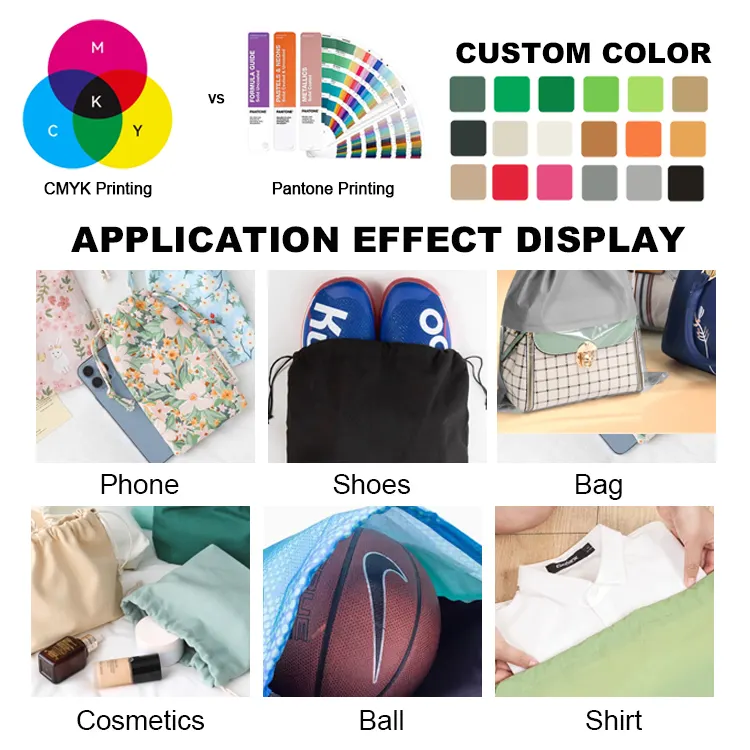
Test the full kit rather than relying on nominal bag dimensions. The opening must allow fast packing, and the drawcord should close without excessive strain. Check the filled shape for sharp pressure points, severe sagging, or distortion around the logo.
This process also helps prevent unnecessary over-sizing. A bag that is much larger than its contents may swing during walking, distribute the load poorly, and reduce the visibility of printed artwork.
Check Venue Bag Rules Before Planning Spectator Distribution
A participant bag distributed outside a venue is not automatically suitable for spectators entering a stadium. Some venues restrict bag dimensions, transparency, hardware, compartments, or logo placement.
For example, the NFL’s current clear bag policy permits clear cinch bags within specified dimensions and prohibits larger non-clear cinch bags. It also directs spectators to check individual team and stadium guidance.
Before describing a product as stadium-ready, confirm the current policy with the event organizer or venue. Save the applicable rule with the project specification and review it before artwork approval, because a material or decoration change may affect compliance.
How to Choose the Right Size, Material, and Features
There is no single material or standard size that suits every sports event. The specification should follow the contents, environment, carrying period, budget, and expected reuse.
Choose Size and Construction From the Complete Kit
Ask the supplier to confirm finished dimensions and clarify how the construction affects usable internal space. A flat bag that appears large in a product photo may provide less practical capacity once it is filled and closed.
For lightweight leaflets and promotional pieces, a simple flat construction may be sufficient. Clothing, bottles, or rigid samples may require more space and closer examination of the bottom corners and seams. Outdoor use may justify discussing a material or coating suited to likely exposure, but any water-resistance requirement should be verified against the selected product specification.
The website’s existing material guidance distinguishes short-term non-woven promotional use from more reusable polyester applications, but the final decision still depends on the actual bag configuration and project requirements.
Match Drawcords, Reinforcement, and Pockets to Real Use
Drawcords perform as both a closure and carrying system. Buyers should confirm their material, length, routing, attachment points, and comfort under the intended load. Inspect the lower connection area and nearby fabric for distortion when the sample is filled.
Additional pockets or zippers can be useful for staff credentials, keys, small personal items, or documents that should remain separate. They may be unnecessary for a one-time giveaway and can increase project complexity. The decision should be based on actual contents and distribution needs.
A custom 210D polyester drawstring sport bag can be considered when a project requires configurable dimensions, colors, logos, cords, reinforcement, or added storage features. The relevant RAINCOAT GIFT product page lists polyester as the primary material and notes that size, thickness, color, and logo can be customized; suitability must still be confirmed for the final configuration.
How to Test a Drawstring Bag Sample Before Bulk Production
A digital proof can confirm artwork, but it cannot show how the bag performs when packed. Projects involving complete sports event kits should include a physical sample review.
Run a Realistic Filled-Sample Carry Test
Pack the sample with the intended event items. Close it, lift it, wear it, walk with it, set it down, reopen it, and repeat the handling expected during distribution. Check whether the contents fit without forcing the opening and whether the drawcords remain comfortable.
Inspect seams, cord connections, lower corners, fabric around stress points, and the bag’s overall shape. Watch for stitch movement, severe stretching, tearing, cord slippage, or permanent deformation. Also check whether a bottle or rigid package creates a concentrated pressure point.
Do not apply a universal weight limit or pass/fail cycle to every drawstring bag. The test method should match the selected material, size, construction, contents, and procurement requirements.
Approve Artwork, Packing, and Distribution Workflow Together
A logo that looks centered on an empty bag may appear distorted once the kit is filled. Review the printed area under realistic loading and confirm that artwork does not cross severe folds, seams, or reinforcement points.
Packing workflow also affects the specification. Bags may be shipped in bulk, packed individually, sorted by team, labeled by participant type, or filled at the event location. Confirm where kit assembly will occur and whether the packaging needs to identify colors, groups, sizes, or contents.
Approve the physical sample, artwork, packing instructions, and written specification as a connected set. If one element changes, review whether the others must be updated.
How to Compare Suppliers for Custom Sports Event Drawstring Bags
Supplier comparison should begin with a common specification. Quotations are difficult to compare when one supplier assumes a basic non-woven giveaway while another prices a larger polyester bag with reinforcement or pockets.
Compare Written Specifications, Not Only Unit Price
A usable quotation should define the proposed material, finished dimensions, drawcord construction, printing scope, accessories, packing, sample process, quantity, destination, and required delivery date. Terms such as “durable” or “heavy-duty” do not replace measurable project details.
Buyers still deciding between different structures can review custom drawstring backpacks for sports events before requesting a project-specific sample. RAINCOAT GIFT’s drawstring backpack category includes polyester sports and Oxford-cloth directions for sports, travel, school, promotional, and event applications.
The broader RAINCOAT GIFT product range includes customizable bags alongside rainwear and umbrellas for promotional and corporate-event applications. This product breadth can support a discussion of coordinated event items, but every bag requirement should remain tied to the confirmed specification.
Ask for a Representative Sample and Production Evidence
Confirm that the physical sample uses the material, dimensions, drawcords, reinforcement, accessories, and printing method proposed for production. Request clear views of the opening, seams, lower corners, cord attachment areas, and printed surface.
A digital mockup may be enough for an initial artwork discussion, but it is not a substitute for a filled-sample check when fit, carrying comfort, or construction matters. Keep an approved sample and written record for comparison with bulk goods.
Before issuing the purchase order, provide a consistent RFQ containing:
- Event type and recipient group
- Distribution location and any venue restrictions
- Full kit contents and estimated filled weight
- Required bag dimensions or reference sample
- Material and expected reuse
- Drawcord, reinforcement, pocket, or zipper requirements
- Logo artwork, colors, size, and placement
- Quantity and packing method
- Destination and required event date
- Digital-proof and physical-sample requirements
Conclusion
The right custom drawstring bag should be selected from the event backward. First determine whether the project needs a lightweight giveaway or a practical event kit. Then use the recipient group, contents, carrying period, distribution location, and packing workflow to define the size, material, drawcords, features, and sample requirements.
For a project review, prepare the event type, kit contents, estimated filled weight, preferred dimensions, material direction, artwork, quantity, packing method, destination, and event date. These details can be submitted through contact RAINCOAT GIFT to discuss a suitable product direction, sample, and quotation without treating an unverified configuration as a performance commitment.
Frequently Asked Questions
Are Drawstring Bags Good for Sports Events?
Yes, when the bag is matched to the intended use. Lightweight designs may suit printed materials and small giveaways, while participant, team, or staff kits may require additional capacity, reinforcement, or storage features.
What Size Drawstring Bag Is Suitable for a Race Kit?
There is no universal size. Pack the intended shirt, bib, towel, bottle, snacks, and samples into a physical sample, then check closing, carrying comfort, artwork distortion, and usable space.
Is 210D Polyester Suitable for Sports Event Bags?
It can be considered for promotional sports bags and practical event kits, but suitability depends on the finished dimensions, construction, contents, environment, expected reuse, and project budget.
Can Custom Drawstring Bags Be Taken Into a Stadium?
That depends on the venue. Some stadiums require clear bags within specified dimensions and restrict non-clear cinch bags, hardware, or logo placement. Confirm the current venue policy before design approval.
How Do I Compare Custom Drawstring Bag Suppliers?
Provide every supplier with the same RFQ. Compare materials, finished dimensions, drawcords, reinforcement, accessories, printing, sample evidence, packing, and production scope rather than comparing unit prices alone.