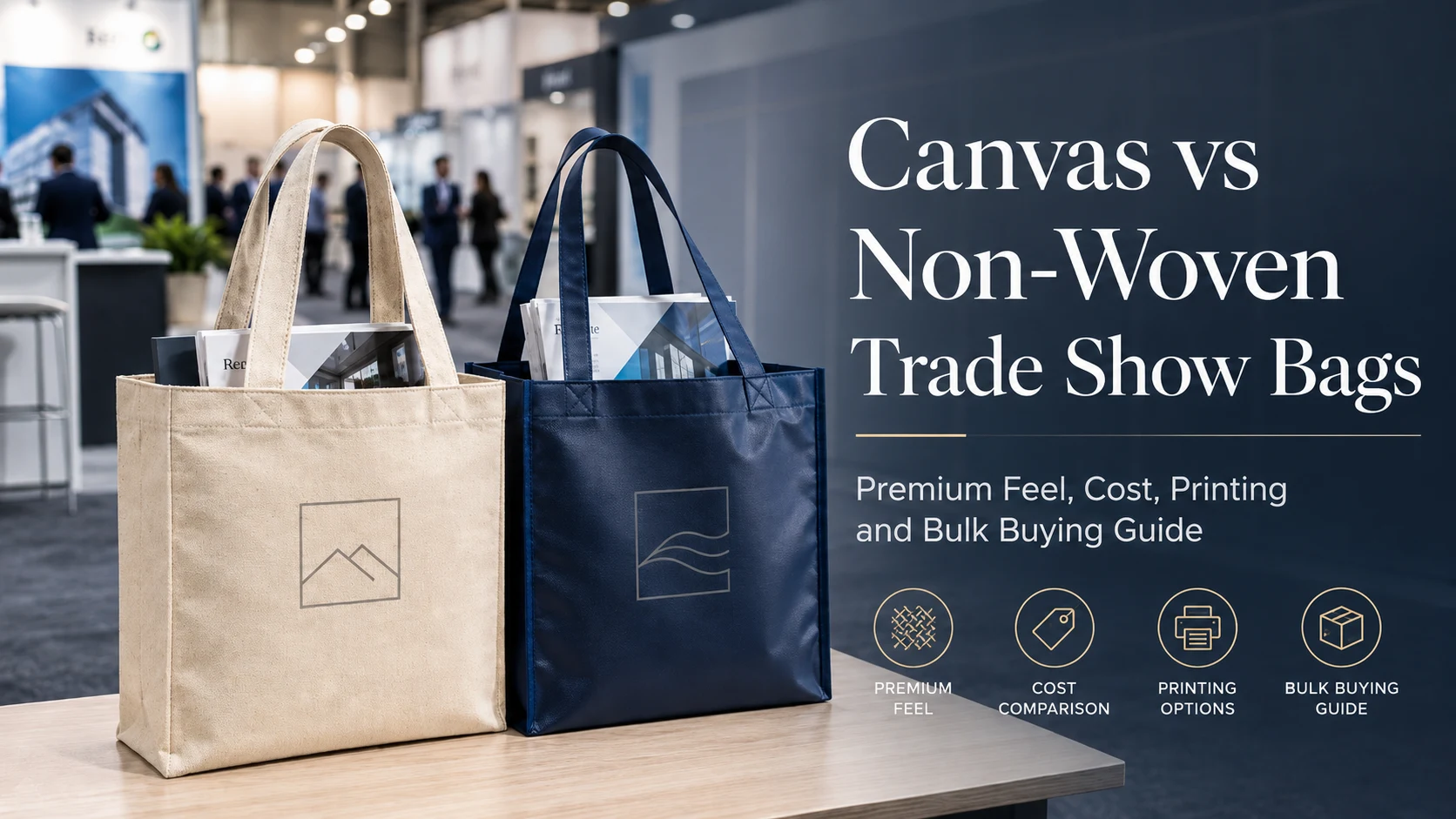
Canvas vs non-woven trade show bags serve different purchasing priorities. Canvas usually creates a heavier, more durable, and higher-value impression, making it suitable for VIP gifts, product launches, and campaigns where recipients are expected to reuse the bag. Non-woven bags are generally more practical when an event requires large quantities, controlled unit costs, lighter shipping weight, and fast distribution.
The correct choice is not determined by the material name alone. Buyers must also compare fabric weight, construction, handles, gussets, printing, expected contents, packaging, and delivery requirements. A lightweight canvas bag may feel less substantial than expected, while a laminated or reinforced non-woven bag may present a cleaner appearance than a basic giveaway bag.
Quick Decision: Canvas or Non-Woven for Your Trade Show?
The first decision should be based on the recipient, the contents, and the purpose of the giveaway. A bag intended for a key account has a different job from one handed to several thousand general attendees.
| Trade show scenario | Recommended starting point | Main reason |
|---|---|---|
| General attendee distribution | Non-woven | Lower-cost, lightweight bulk distribution |
| VIP, media, or key-account gifts | Canvas | Stronger perceived value and reuse potential |
| Brochures and lightweight documents | Non-woven | Basic carrying function may be sufficient |
| Product samples or heavier contents | Canvas or reinforced non-woven | Structure and handle strength become critical |
| Premium product launch | Canvas | Natural texture and substantial construction support premium positioning |
| Mixed attendee groups | Two-tier program | Different materials can match different recipient values |
Choose Canvas for Higher-Value Recipients and Longer Brand Exposure
Canvas is usually the stronger choice when the bag is part of the gift rather than simply packaging for other materials. Its woven surface, visible texture, and potential for a more substantial structure can support premium promotional tote bags for executives, distributors, media contacts, and important customers.
However, buyers should not assume that every canvas bag will look premium. Thin fabric, narrow handles, weak seams, poor shape retention, or a low-quality print can reduce the perceived value. Before requesting a quotation, define the expected contents, desired finished shape, handle style, print area, and whether the bag should remain useful after the event.
A buyer comparing custom cotton and canvas bags should evaluate actual samples rather than selecting by product photograph alone. The website’s canvas category includes several tote styles, including standard, printed, and heavier canvas configurations, so the final specification should be matched to the event rather than copied from a generic listing.
Choose Non-Woven for High-Volume, Cost-Controlled Distribution
Non-woven trade show bags are suitable when the primary requirement is distributing catalogs, leaflets, small gifts, or registration materials to a large audience. Nonwoven materials can be designed for different functions and properties, including strength, softness, resilience, and liquid repellency, so performance varies according to the material and construction selected.
Basic non-woven bags may be appropriate for short-duration use and lightweight contents. They are less suitable when the giveaway must communicate exclusivity, carry heavy samples, or remain presentable through repeated use. Buyers should confirm the fabric GSM, whether the bag is laminated, whether the construction is stitched or heat-sealed, and how the handles are attached.
The custom non-woven shopping bags category provides a more relevant next step than a general bag catalog because it keeps the buyer within the material already under consideration.
Use a Two-Tier Bag Strategy When One Material Cannot Serve Every Attendee
A single material may not fit every recipient at a large event. A two-tier program can use non-woven bags for general attendees and canvas bags for VIPs, distributors, speakers, staff, or selected prospects.
This approach can improve budget control without treating every contact as equally valuable. It also introduces operational risks. Procurement teams must decide how many units belong in each tier, how staff will identify recipients, and whether the two designs will use the same logo treatment and brand colors.
The next step is to create a recipient allocation sheet before requesting quotations. It should list the expected number of general attendees, priority contacts, reserve quantities, contents for each bag, and required delivery location. This prevents over-ordering the premium version or running out of the standard giveaway during the event.
Why Canvas Usually Feels More Premium—and Why Material Name Is Not Enough
“Premium feel” is the combined result of weight, texture, shape, construction, print quality, and how the bag behaves when loaded. Buyers should convert this subjective requirement into specifications that suppliers can quote and samples that purchasing teams can compare.
Fabric Weight, Surface Texture, and Shape Retention
Canvas weight may be stated in ounces or GSM, while non-woven materials are commonly specified by GSM. A higher number may indicate a more substantial material, but it does not independently prove that the finished bag will meet the application.
For canvas, buyers should inspect the tightness of the weave, surface consistency, stiffness, and whether the bag holds its shape with the expected contents. For non-woven bags, the evaluation should include GSM, surface texture, lamination, fold recovery, and how the material behaves around seams and handle attachment points.
The correct question is not simply, “What canvas weight is best for promotional bags?” It is, “What material and structure are suitable for the intended load, appearance, printing method, and expected reuse?” Those factors should be recorded in the RFQ and verified using a sample.
Handles, Seams, Gussets, and Finishing Details
Construction failures often affect perceived quality more than the base material. Narrow handles can become uncomfortable when the bag contains catalogs. Weak heat seals may separate. Poorly aligned seams can distort the print, and a bag without a gusset may not accommodate boxed samples or thicker documents.
Buyers should confirm handle material, width, length, and attachment method. A short handle may be acceptable for hand carrying but inconvenient for attendees who expect to carry the bag over a shoulder. When heavier contents are involved, reinforcement at the handle connection and bottom corners should be reviewed in the physical sample.
Gussets also influence capacity and appearance. A flat bag may suit brochures, while a bottom or side gusset can improve usability for boxed promotional items. The risk is ordering a larger-looking bag without confirming its finished internal capacity or loaded shape.
Canvas vs Non-Woven Cost: Compare Total Program Cost, Not Unit Price Alone
Canvas vs non-woven bag cost should be evaluated at the program level. Unit price is important, but it is only one part of the purchasing decision.
Unit Cost, Quantity, and Customization Complexity
Material grade, dimensions, handle construction, printing colors, artwork coverage, accessories, packaging, and order quantity can all affect the quotation. Buyers comparing bulk giveaway bags should send the same functional requirements to each supplier. Otherwise, one quotation may be based on light fabric and basic construction while another includes lamination, reinforcement, or more complex printing.
Canvas may justify a higher unit cost when the recipient value and expected reuse are high. It may be unnecessary for a one-day mass distribution program where the bag only carries a brochure. Conversely, choosing the lowest-cost non-woven option may create complaints if it cannot support the actual contents.
An apples-to-apples quotation sheet should specify identical dimensions, print requirements, handle length, expected load, packing method, and delivery terms for every supplier.
Shipping Weight, Carton Volume, and On-Site Handling
A bag that costs less to manufacture may not always cost less to deliver and distribute. Canvas is generally heavier and thicker, which may increase carton weight and storage requirements. Non-woven bags are lighter, but certain folding or packing methods may create visible creases, especially on laminated surfaces.
Ask suppliers to provide the number of bags per carton, carton dimensions, gross weight, packing method, and whether the bags will be delivered flat or folded. These details affect freight planning, warehouse receiving, movement into the venue, and storage behind the booth.
Event teams should also consider how quickly staff can distribute the bags. Individually packed bags may remain cleaner but take longer to open. Large cartons may reduce packaging but become difficult to handle in a restricted exhibition space.
Which Material Gives Better Logo Printing Results?
The better material depends on the artwork. A simple one-color logo has different production requirements from a photographic image, full-coverage design, fine text, or embroidered mark.
Match the Printing Method to the Material and Artwork
Screen printing is often considered for simple logos and solid colors on both canvas and non-woven bags. More detailed artwork may require digital, transfer, sublimation, laminated, or other printing methods, depending on the exact material and product configuration.
Canvas texture can remain visible beneath the print, which may suit a natural brand style but reduce the sharpness of very fine details. Non-woven surfaces vary, and lamination may provide a smoother area for certain full-color designs. The print method should be verified against the selected material, artwork dimensions, number of colors, and order quantity.
A custom logo canvas tote bag offered by RAINCOAT GIFT can be customized in size, logo, color, and printing, with the product page listing several possible printing methods. Final compatibility should still be confirmed for the actual artwork and fabric specification.
For buyers seeking a cleaner surface or a more graphic presentation, a laminated non-woven tote bag may be considered. The listed product uses non-woven material with lamination and supports customization of size, logo, color, and printing.
Prevent Print Defects Before Bulk Production
A digital mockup does not show how ink will react with the real material. Buyers should request a printed pre-production sample when color, placement, or fine detail is important.
The sample should be checked for logo dimensions, position, Pantone matching, edge definition, ink coverage, adhesion, distortion around seams, and appearance when the bag is loaded. The approved sample should then serve as the reference for production.
Common risks include color variation between batches, artwork placed too close to a seam, print cracking along a fold, lamination damage, and a logo that appears correctly sized on a flat bag but becomes distorted when the bag is filled. These risks should be addressed before mass production, not after the goods reach the exhibition venue.
Prevent the Most Common Bulk-Order Failures
Bulk trade show bag problems usually result from incomplete specifications, unrealistic load assumptions, or insufficient sample approval.
Material and Construction Failures to Check in the Sample
Load the sample with the same catalogs, products, and gifts planned for the event. Carry it by hand and over the shoulder where applicable. Check whether the handles stretch, the seams open, the bottom deforms, or the bag becomes uncomfortable.
For non-woven bags, inspect heat-sealed areas, stitching, lamination, and fold lines. For canvas, inspect the weave, seams, handle reinforcement, and dimensional stability. If the sample fails, the solution may involve changing the material weight, adding a gusset, reinforcing the handles, reducing the bag dimensions, or lowering the intended load.
The approved construction should be documented clearly so that the supplier does not substitute a different material, handle, or reinforcement method without written approval.
Production and Delivery Risks to Control Before the Event
Trade shows have fixed dates, which makes delays more costly than they may be for ordinary stock orders. The purchasing schedule should include artwork approval, material confirmation, sample production, sample review, bulk production, inspection, transportation, customs clearance where applicable, and a delivery buffer.
Inspection should check finished dimensions, quantity, material consistency, handle attachment, seams, printing, color, accessories, packing, and carton marks. Reserve units may also be appropriate when bags will be shipped to several venues or distributed over multiple event days.
Environmental claims require similar care. Terms such as “green,” “eco-friendly,” “recyclable,” or “recycled” should be supported and qualified rather than used as broad promises. The U.S. Federal Trade Commission advises marketers to make environmental claims specific and substantiated.
How to Build a Clear RFQ for Canvas and Non-Woven Trade Show Bags
A clear RFQ allows suppliers to quote comparable products and helps prevent later disputes. It should include:
- Event type and intended use
- Recipient group
- Total quantity and reserve quantity
- Preferred material
- Canvas weight or non-woven GSM
- Lamination requirement
- Finished width, height, and gusset
- Expected contents and estimated load
- Handle material, width, length, and attachment
- Stitched or heat-sealed construction
- Logo size, location, colors, and printing method
- Pantone references
- Accessories such as zippers, pockets, closures, or bottom inserts
- Individual and carton packing requirements
- Blank sample and printed pre-production sample requirements
- Inspection criteria
- Required arrival date
- Delivery destination and commercial terms
Include photographs or drawings when a specific structure is required. However, a reference image should not replace a written specification because visual examples rarely show material weight, seam construction, tolerances, or packing details.
How to Choose a Reliable Trade Show Bag Supplier
Supplier selection should focus on the ability to interpret the application, provide suitable samples, document the specification, control production, and meet the event schedule.
Compare Capabilities, Samples, and Quality Controls
A supplier offering both materials can help a buyer compare canvas and non-woven options under the same project brief. However, the recommendation should still be supported by samples and written specifications.
Ask whether the supplier can provide blank material samples, printed samples, similar construction examples, and a clear description of the production method. Confirm how dimensions, material, print color, seams, handles, and packing will be checked. A quotation that only states “canvas bag with logo” or “non-woven bag” is not detailed enough for a controlled bulk order.
RAINCOAT GIFT promotional product range includes rainwear, umbrellas, and bags, with separate cotton/canvas and non-woven bag categories. The company is based in Yiwu, China, and presents customizable promotional products for applications that include advertising and exhibitions.
Confirm MOQ, Lead Time, Packaging, and Delivery Terms
MOQ and lead time may vary by material, size, printing, accessories, and production configuration. Buyers should obtain written confirmation rather than assuming the terms for one product also apply to another.
The quotation should identify sample charges, tooling or setup costs where applicable, printing costs, packaging, inspection arrangements, freight basis, and payment terms. The production schedule should state when artwork and samples must be approved and when the goods are expected to be ready for shipment.
RAINCOAT GIFT’s listed canvas and laminated non-woven products both allow customization of size, logo, color, and printing. Those options make the pages useful starting points, but each trade show project still requires a project-specific specification and quotation.
Conclusion
Canvas is generally the stronger choice when premium appearance, longer reuse, heavier contents, or higher-value recipients are the priority. Non-woven is often more suitable for high-volume trade show giveaways where unit cost, low weight, and distribution efficiency matter more. A two-tier strategy can serve both needs within the same event.
Before ordering, compare physical samples under the intended load, approve the actual print, and issue one consistent RFQ to every supplier. Buyers preparing an inquiry can contact RAINCOAT GIFT with the event type, quantity, intended recipients, bag dimensions, material preference, contents, artwork, packaging needs, sample requirements, and required arrival date. The company’s contact page accepts purchasing inquiries and provides direct contact details.
Frequently Asked Questions
Which feels more premium, canvas or non-woven trade show bags?
Canvas usually creates a more substantial and natural appearance, particularly when the fabric, handles, seams, and printing are specified appropriately. Laminated or reinforced non-woven bags can provide a cleaner presentation, but they are generally selected when bulk cost and distribution efficiency are stronger priorities.
Can non-woven trade show bags look premium?
Yes. Higher material weight, lamination, stitched construction, reinforced handles, gussets, and controlled printing can improve the appearance. Buyers should review a physical sample because the material name alone does not show stiffness, surface finish, loaded shape, or print quality.
What canvas weight is suitable for trade show giveaway bags?
The appropriate weight depends on the contents, bag dimensions, expected reuse, desired hand feel, and printing method. Instead of selecting by a single standard number, test the proposed fabric and finished construction with the actual brochures, gifts, or samples.
What GSM should buyers specify for non-woven promotional bags?
There is no single GSM that fits every application. GSM should be evaluated together with lamination, stitching or heat sealing, handle attachment, gussets, and expected load. Request samples representing the exact proposed specification before approving bulk production.
Should buyers request samples before ordering bulk trade show bags?
Yes. At minimum, review the material, dimensions, handles, seams, loaded shape, and print area. When brand colors or detailed artwork matter, approve a printed pre-production sample and retain it as the production reference.