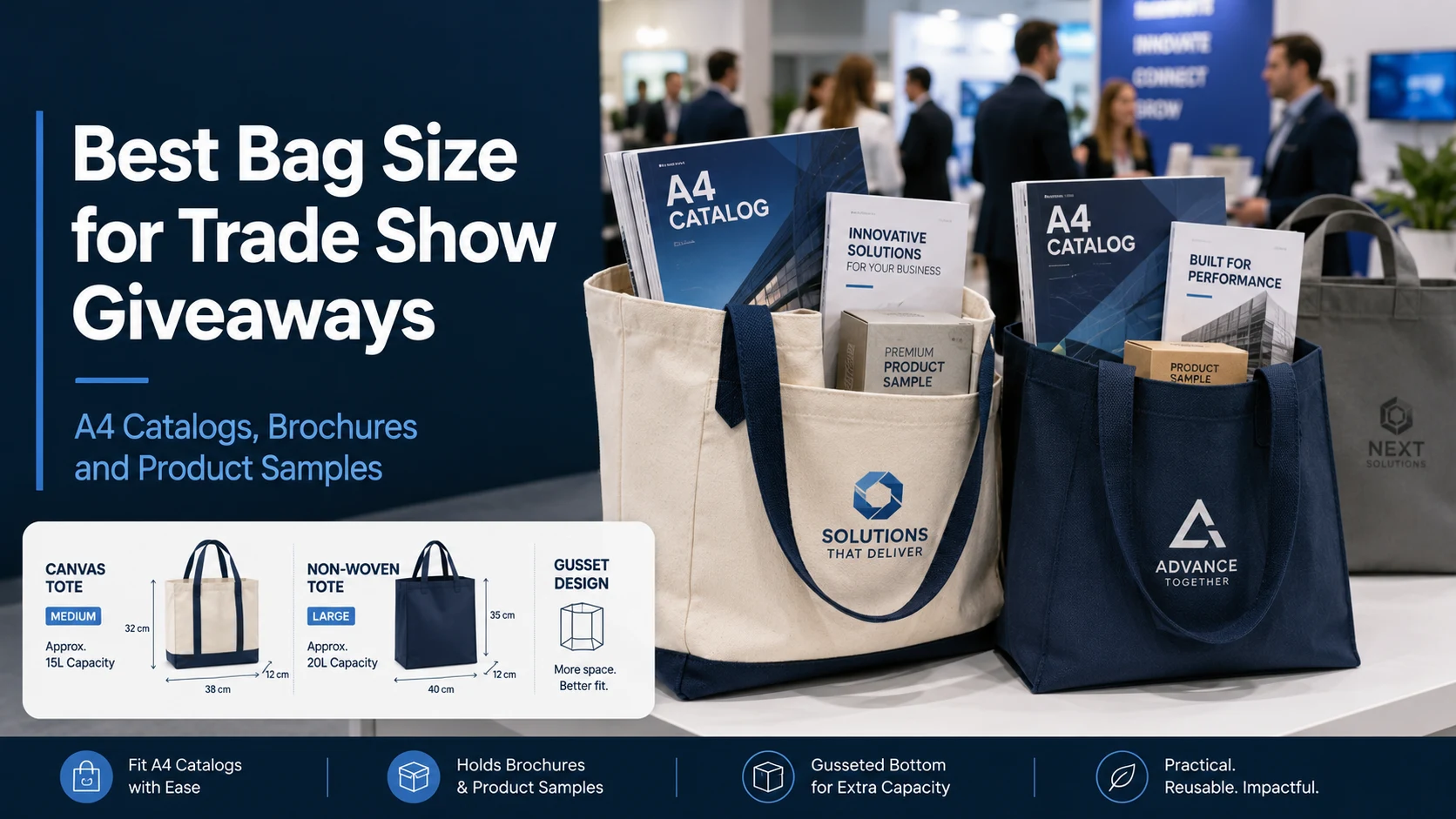
The best bag size for trade show giveaways depends on what attendees must carry—not on a generic “standard tote” label. A bag holding only A4 brochures requires a different width, height, and depth from one packed with thick catalogs, notebooks, bottles, or boxed product samples. Buyers should measure the complete giveaway kit, account for the usable internal space, and test the proposed bag before approving bulk production.
A correctly sized bag protects printed materials, improves booth distribution, keeps the logo visible, and avoids unnecessary material and shipping costs.
Quick Answer: What Size Trade Show Bag Should Buyers Choose?
Start with the largest item and the total packed thickness. Flat portrait totes generally suit brochures and thin A4 materials. A light bottom gusset becomes useful when several catalogs or notebooks are packed together. Bottles, sample boxes, and mixed giveaway kits usually require a deeper gusset and a wider opening.
| Giveaway contents | Recommended starting structure | Main purchasing check |
|---|---|---|
| Flyers and thin brochures | Flat portrait tote | A4 fit and easy loading |
| A4 folder or thin catalog | Flat tote or shallow gusset | Opening width and usable height |
| Several catalogs and notebooks | Bottom-gusseted tote | Total packed thickness |
| Bottles or boxed samples | Gusseted tote | Item depth and base stability |
| Mixed promotional kit | Structured gusseted tote | Largest item and total load |
| VIP gift set | Structured tote | Shape retention and presentation |
These are starting points, not fixed specifications. The final dimensions should be confirmed with real event materials.
Choose Bag Dimensions by What the Giveaway Must Carry
Size Bags for A4 Brochures, Folders, and Thin Catalogs
A4 paper measures 210 × 297 mm, or approximately 8.3 × 11.7 inches. However, a tote made to those exact dimensions will usually be too tight because folders, catalog covers, seams, and top finishing require additional space.
When asking what size tote bag fits A4 catalogs, measure the finished catalog rather than the nominal paper format. Check whether it will be loaded vertically or horizontally and whether staff can insert it without bending the corners. A flat portrait bag may suit lightweight document packs, while a wider opening may be necessary for folders.
After the dimensions are established, buyers can review custom-sized canvas tote bags for printed catalogs and branded event materials. The referenced product supports customized size, logo, color, and printing for applications that include exhibitions and promotions.
Add Space for Thick Catalogs, Notebooks, and Multiple Handouts
A bag that fits one A4 brochure may fail when several catalogs, a notebook, and other handouts are stacked together. Measure the complete set in the arrangement used during the event. The total thickness may require a shallow gusset even when every individual item is flat.
Avoid solving the problem only by increasing width and height. An oversized flat bag may use more material, look empty, and become awkward to carry while still bulging at the center. A shallow bottom gusset often provides a more stable shape for thicker document packs.
Buyers comparing custom cotton and canvas bags should specify the packed contents along with the required finished dimensions. This gives the supplier enough information to discuss structure rather than quoting only a generic small, medium, or large tote.
Use Gusseted Bags for Boxed Samples, Bottles, and Mixed Kits
The answer to “what size trade show bag holds product samples?” depends mainly on the depth and shape of the largest item. A sample box may fit the bag’s stated width and height but still fail to pass through the opening or sit flat on the base.
Measure each rigid item’s length, width, and height. Then arrange the complete kit and record the maximum packed depth. A bottom gusset may be sufficient for slim boxes, while bulkier or irregular products may require side and bottom depth.
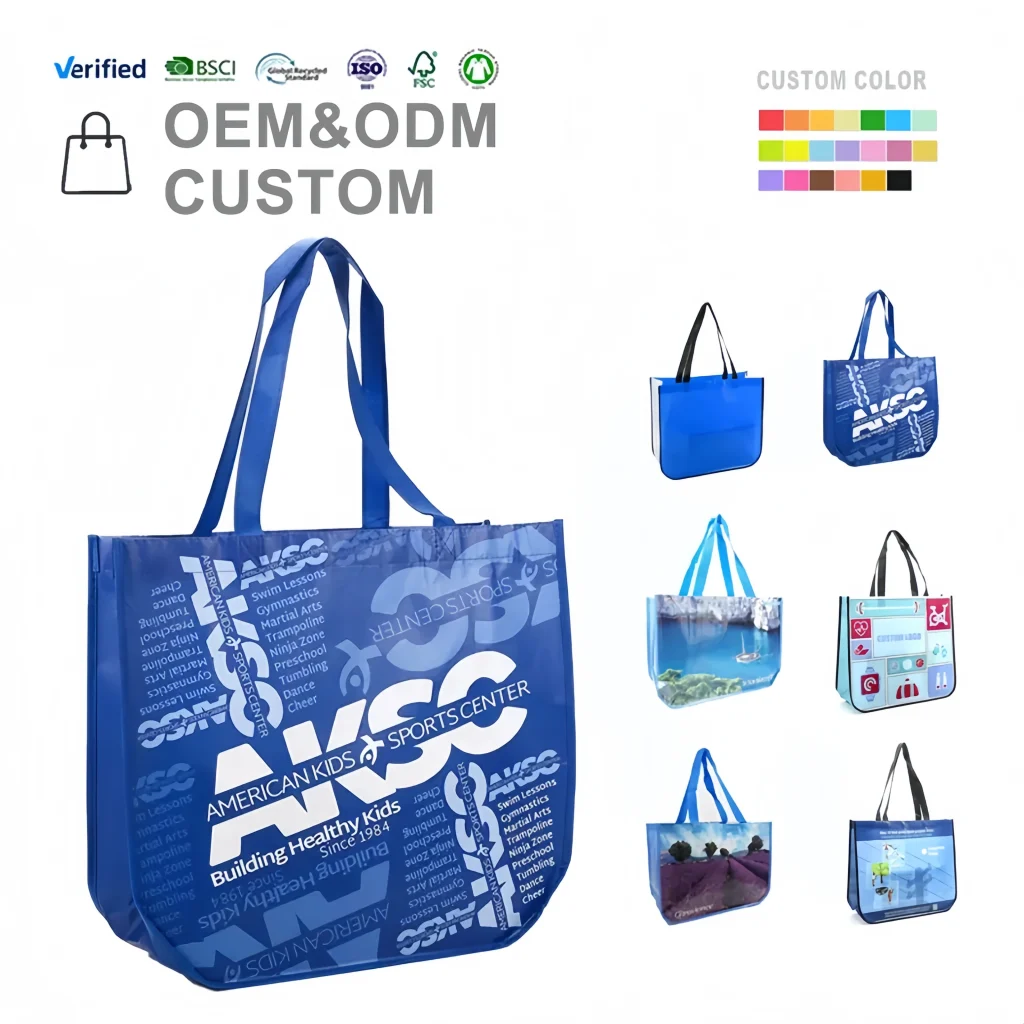
A flat bag is unsuitable when it forces samples to tilt, pushes the side panels outward, or distorts the printed logo. For high-volume projects, custom-size non-woven trade show bags may be considered when the size, opening, construction, and loaded shape are verified using the actual giveaway kit. The listed laminated non-woven product supports customized size, logo, color, and printing for exhibition and promotional use.
How to Measure A4 Catalogs and Product Samples Correctly
Measure the Largest Item and the Complete Packed Kit
Buyers should measure both the largest single item and the complete package. Begin by laying out everything an attendee will receive: brochures, folders, catalogs, samples, notebooks, bottles, and smaller promotional products.
Record the maximum width and height, then stack or arrange the items as they will be placed in the bag. Measure the total thickness and weigh the finished kit. Test both portrait and landscape orientations when the contents allow either option.
This process answers several practical questions at once: how to measure products for a giveaway bag, how to choose bag depth for boxed samples, and whether a standard flat tote is sufficient. It also provides the supplier with useful RFQ data instead of a vague request for a “large trade show bag.”
Distinguish Finished Size, Opening Width, and Usable Internal Space
A supplier’s finished dimensions do not necessarily equal the internal usable space. Seams, binding, lamination, zippers, closures, linings, and folded edges may reduce the area available for catalogs and samples.
Opening width requires separate attention. A rectangular sample may fit inside the bag once inserted but still be too wide to pass through the top. Ask the supplier how width, height, and gusset are measured and whether the quoted measurements refer to external or internal dimensions.
When comparing custom bag sizes from different suppliers, use the same measurement sequence and units. Include a drawing if necessary. Confirm the opening, finished body, gusset, and handle drop separately so that quotations and samples remain comparable.
Portrait, Landscape, Flat, or Gusseted: Choose the Right Structure
Choose Portrait or Landscape Based on Loading and Access
Portrait bags usually work well for vertically oriented A4 documents and can be convenient in crowded exhibition aisles because the body is narrower. Landscape bags provide a wider opening and may be more suitable for wide folders, sample boxes, or giveaway kits that staff must load quickly.
Neither orientation is automatically better. Compare the largest item, loading direction, logo proportions, and how the attendee will carry the finished bag. A wide landscape tote can become uncomfortable if it extends too far from the body, while a narrow portrait tote may be too deep for staff to retrieve smaller items easily.
Request photographs or a sample showing the bag both empty and fully packed. This reveals whether the selected orientation supports the contents and maintains a presentable shape.
Choose Flat or Gusseted Construction by Packed Thickness
Flat trade show tote bags are generally appropriate for flyers, brochures, and thin document packs. They use space efficiently and provide a simple front panel for printing. They are less suitable for bottles, rigid samples, or several thick catalogs.
When deciding whether a trade show bag should have a gusset, focus on the total packed depth. A gusset creates usable volume, but excessive depth can let items move, increase carton volume, and reduce the continuous front area available for printing.
The choice between a flat or gusseted tote for brochures should therefore reflect the full giveaway kit. Test both structures when the project sits between categories. The better option is the one that allows easy loading, stable carrying, and acceptable presentation without unnecessary size.
Match Bag Size to Load, Handles, and Logo Printing
Confirm Load, Handle Drop, and Carrying Comfort Together
Larger bag dimensions often encourage teams to add more items, which increases stress on the handles and connection points. Handle length should be selected together with the expected packed weight and carrying method.
A short handle may work for hand carrying but become inconvenient during a long exhibition day. A shoulder-length handle can improve comfort, but the drop must leave enough clearance when the bag is full. Buyers should confirm handle width, material, attachment method, and any required reinforcement.
Conduct the test with the intended contents rather than an empty sample. Check whether the bag hangs evenly, whether rigid items press against the user, and whether the handles remain comfortable. Any load capability should be verified against the final material, dimensions, construction, and approved sample.
Protect the Imprint Area When the Bag Is Filled
The usable imprint area may be smaller than the front panel. Seams, gusset folds, handles, closures, and bottom shaping can limit where a logo can be printed without distortion.
Ask for the maximum recommended print area for the selected construction. Then inspect the design on a filled sample. A logo that appears centered on a flat bag may move visually when the bottom expands, while artwork positioned near a gusset may fold or curve around the contents.
Bag dimensions and artwork should be approved together. For portrait bags, a taller layout may fit naturally; landscape bags may favor a wider design. Do not simply reuse the same artwork size across several bag structures without checking proportion, visibility, and clearance from seams.
Prevent Common Trade Show Bag Sizing Failures
Test the Complete Giveaway Kit, Not an Empty Bag
An empty bag can look correctly sized even when it fails in actual use. The pre-production test should recreate the event-day pack, including every brochure, sample, notebook, and promotional item.
Check whether A4 materials slide in without bending, whether rigid samples pass through the opening, and whether the bag stands or hangs as intended. Walk with the loaded sample, place it on the floor, and test the staff loading process. Look for stretched handles, distorted panels, unstable contents, and hidden brochures.
This is the most reliable way to test trade show bag capacity. When the sample fails, adjust the dimensions, gusset, opening, handles, material, or giveaway contents before bulk production begins.
Confirm Dimensional Tolerances and Carton Packing
Once the sample is approved, the purchase specification should identify which dimensions must remain controlled during production. Width, height, gusset, opening, and handle drop may all affect whether the bag functions as intended.
Ask the supplier to state the measurement method and proposed production tolerances. The packing method also matters. Folding may create creases, change how a laminated surface appears, or require event staff to reshape bags before distribution.
Confirm the quantity per carton, carton dimensions, gross weight, and whether bags will be packed flat or folded. These details help the buyer estimate freight, warehouse space, booth storage, and handling requirements before the shipment arrives.
RFQ Checklist for Custom Trade Show Bag Dimensions
A clear RFQ should contain enough information for a supplier to quote and sample the same functional product:
- Event type and intended application
- Recipient group and expected quantity
- Complete list of giveaway contents
- Largest item’s width, height, and depth
- Total packed thickness and estimated weight
- Preferred portrait or landscape orientation
- Finished bag width and height
- Bottom or side gusset requirements
- Required opening width
- Handle length, drop, width, and attachment
- Preferred material or material options to compare
- Logo size, location, colors, and print method
- Closure, pocket, lining, or bottom insert requirements
- Flat or folded packing preference
- Quantity per carton requirements
- Blank fit sample requirement
- Printed pre-production sample requirement
- Critical dimensions and acceptable tolerances
- Required arrival date and destination
The RFQ should also include a photograph, layout drawing, or physical sample when the product kit has an unusual shape. Written specifications should remain the final reference because photographs alone do not define usable internal space or measurement methods.
How to Choose a Supplier for Custom-Sized Trade Show Bags
Compare Measurement Methods and Sample Support
A suitable supplier should be able to discuss the bag in relation to the actual contents, rather than recommending a stock dimension without reviewing the application. Ask how width, height, gusset, opening, and handle drop are defined.
Sample support is particularly important for custom A4 tote bags and product-sample kits. The supplier should be able to work from a content list, dimensions, photographs, or physical reference items and provide an appropriate blank or printed sample for review.
The RAINCOAT GIFT promotional product range includes separate cotton/canvas and non-woven bag categories, along with customizable bag products. The company website identifies bags, umbrellas, rainwear, and outdoor advertising products within its product offering.
Confirm Production Control, Packing, and Event Delivery Requirements
A quoted sample is only useful if its approved dimensions and construction are documented for production. Request a final specification sheet that records the material, finished measurements, gusset, handles, logo placement, packing, and critical tolerances.
The supplier should also provide the sequence for artwork confirmation, sample approval, production, inspection, packing, and shipment. Exact timing depends on the order configuration and should be confirmed in writing for each project.
RAINCOAT GIFT’s listed canvas and laminated non-woven products both state that size, logo, color, and printing can be customized. Buyers should still verify each requested feature against the final quotation and product specification.
Conclusion
The correct trade show bag size begins with the real contents. Flat portrait totes may suit A4 brochures and thin catalogs, while thicker document packs may need a shallow gusset. Bottles, boxed samples, and mixed kits require dimensions based on the largest item, total packed depth, opening width, and expected load.
Before approving a bulk order, measure the complete kit, test the loaded sample, confirm the imprint area, and document every critical dimension in the RFQ. Buyers can review custom non-woven shopping bags or canvas options after determining the required structure and use case.
For a project-specific review, contact RAINCOAT GIFT with the event application, target quantity, content dimensions, preferred material, artwork, sample requirements, packing needs, and required arrival date. The contact page provides an inquiry form and direct contact details.
Frequently Asked Questions
What size tote bag fits A4 catalogs?
Start with the catalog’s finished dimensions, not only the 210 × 297 mm A4 paper size. Add space for the cover, seams, opening, and loading. Test the actual catalog in a sample before approving production.
Should a trade show bag have a gusset?
A flat bag may suit brochures and thin document packs. A gusset should be considered for thick catalogs, notebooks, bottles, boxed samples, or mixed kits. Select the depth from the complete packed contents.
How much extra space should a giveaway bag have?
There is no universal allowance. The required space depends on the opening, seams, total thickness, loading method, closure, and whether items must be removed frequently. Excess space may increase material and shipping costs.
What bag size is suitable for product samples?
Measure the largest sample’s width, height, and depth, then measure the complete packed kit. Confirm that rigid items pass through the opening and sit securely inside the gusseted base.
Should buyers request a sample before ordering bulk trade show bags?
Yes. A blank fit sample can confirm dimensions and structure, while a printed pre-production sample can confirm artwork, color, placement, and the bag’s appearance when loaded.