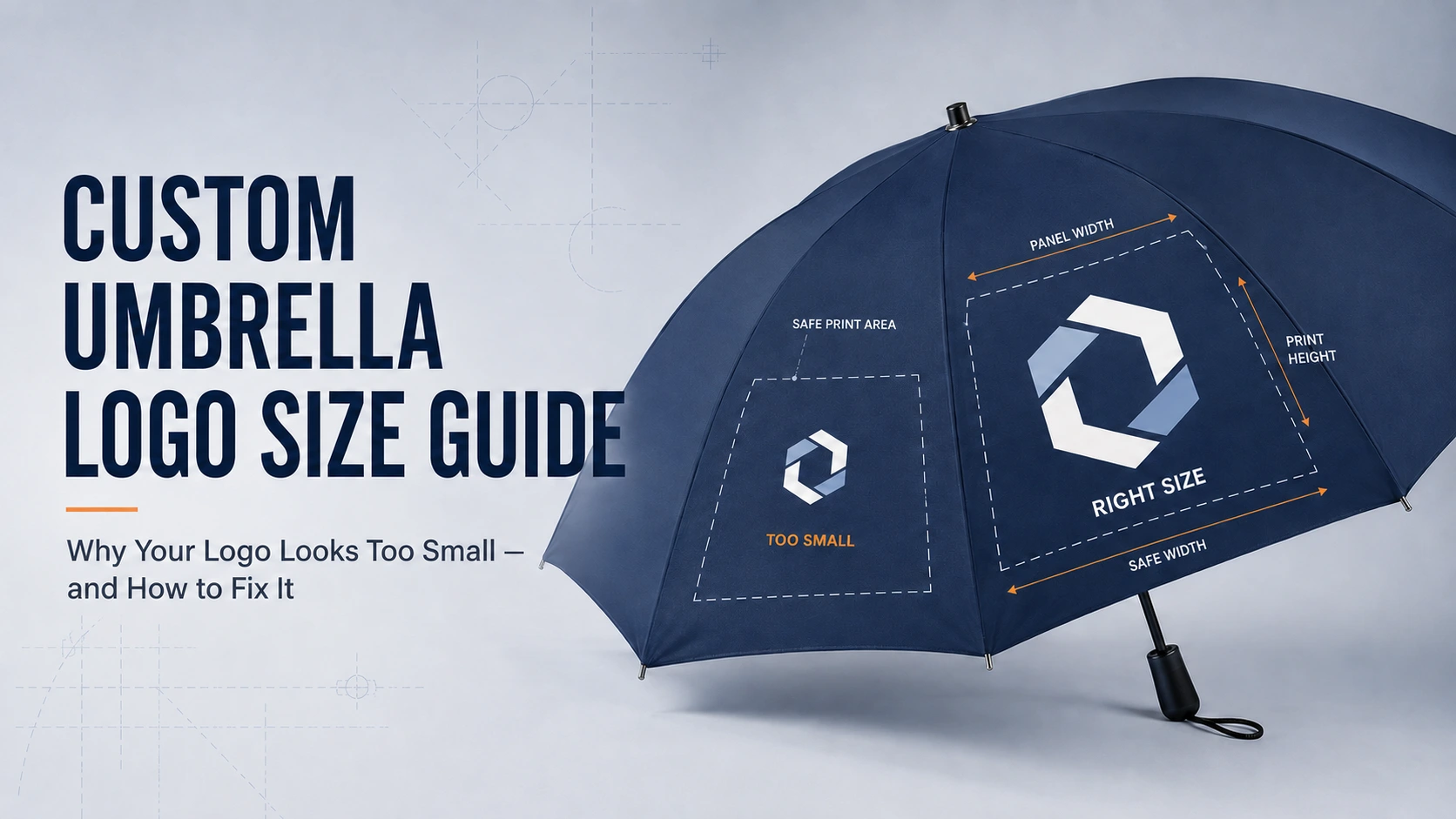
A custom umbrella logo size can look acceptable on a flat artwork proof yet appear surprisingly small when the finished umbrella is opened. The problem is rarely caused by scale alone. Panel geometry, seams, ribs, logo proportions, contrast, printing method, and viewing distance all affect the result. For B2B buyers, the practical goal is to identify the limiting factor before bulk production, specify the print dimensions clearly, and approve the logo on the exact umbrella model rather than relying on a generic mockup.
Why Does Your Logo Look Too Small on a Custom Umbrella?
Buyers often ask why a logo looks too small on an umbrella even though it appeared prominent on screen. The answer usually lies in the difference between a digital layout and the usable surface of a physical canopy.
The Printable Area Is Smaller Than the Umbrella Canopy
The advertised canopy size describes the overall umbrella, not the available logo printing area. A canopy is divided into panels by ribs and seams, and only part of each panel may be suitable for a conventional single-panel imprint. The area near the crown is narrower and more curved, while edges, vents, folds, and tip pockets may further restrict placement.
For that reason, the standard logo size for a custom umbrella cannot be determined from canopy diameter alone. Buyers should request the panel template for the exact model and confirm both the maximum printable area and the supplier’s recommended print area. These figures may differ because a design that technically fits can still sit too close to a seam or become distorted when the umbrella opens.
Logo Shape, Taglines, and File Margins Reduce the Visible Mark
Logo proportions can be as important as the available panel width. A long horizontal wordmark must be reduced until its full width fits the panel, which may leave the letters visually small. A tall stacked logo may use the same panel more effectively. Long taglines, registration marks, or legal copy can force the entire design to shrink.
Invisible space inside the artwork file is another common cause. If the logo occupies only part of a large transparent canvas, a supplier may scale the complete artboard rather than the visible mark. The proof can show the correct overall dimensions while the actual logo remains undersized.
Before changing the umbrella, buyers should check the artwork boundary, remove unnecessary margins, and decide whether a compact brand lockup, symbol-only version, or simplified tagline is permitted.
Low Contrast and Viewing Distance Create a False Size Problem
A logo can meet the specified dimensions and still look too small because it lacks contrast. Dark artwork on a dark canopy, thin lettering, gradients, and fine outlines tend to lose visual weight outdoors. The problem becomes more obvious when the umbrella is moving or viewed from several yards away.
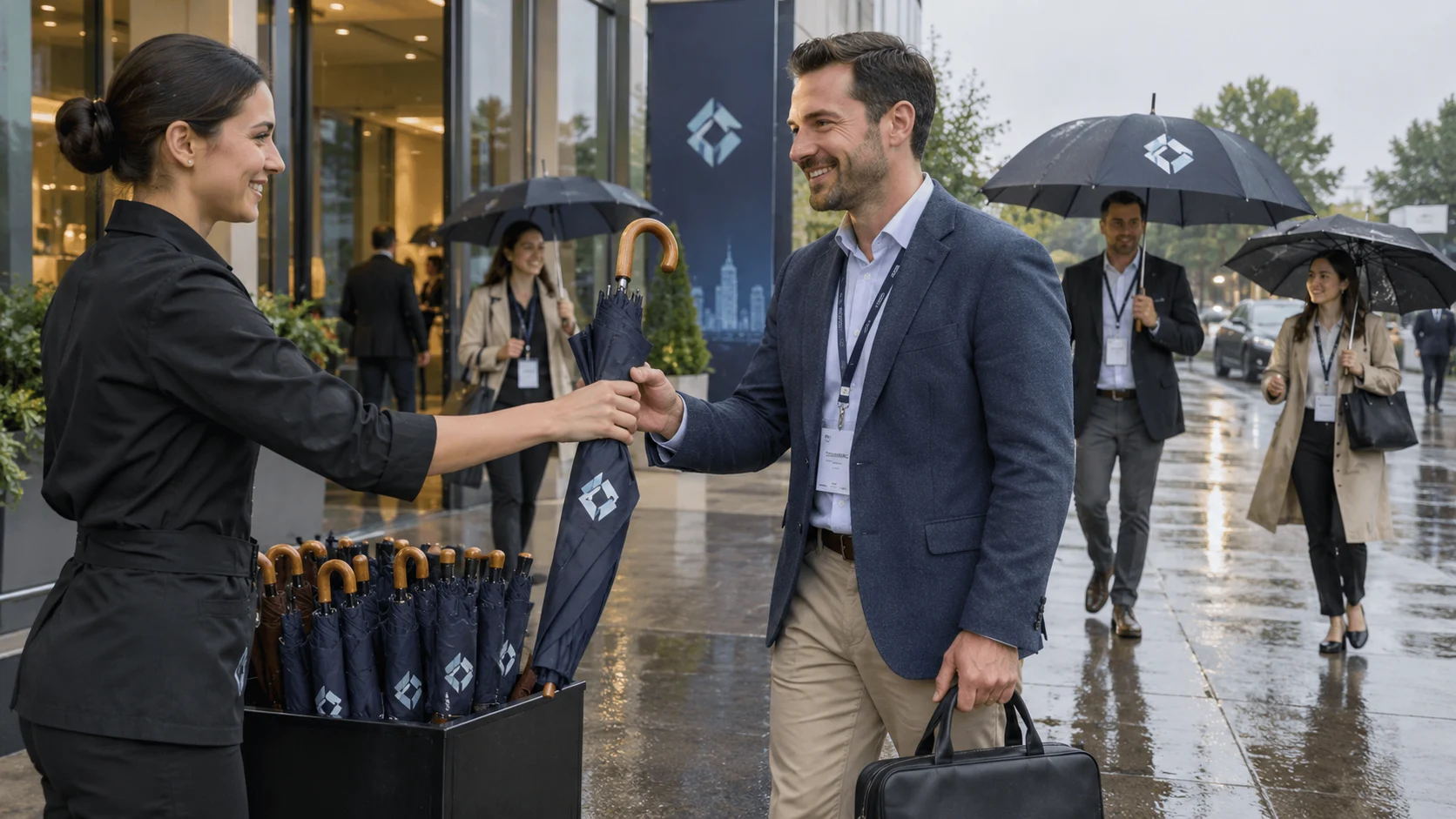
Artwork proofs are normally reviewed close to a screen. Promotional umbrellas are seen in very different conditions: at corporate events, on sidewalks, outside hotels, or across a golf course. Buyers should review the open-umbrella mockup at a reduced scale and, for important programs, examine a physical sample from the expected viewing distance.
If the logo is large enough but difficult to recognize, increasing contrast or simplifying fine details may work better than enlarging the complete design.
How to Determine the Right Logo Size for an Umbrella
There is no universal answer to “How big should a logo be on a promotional umbrella?” The appropriate dimensions depend on the selected model, panel geometry, logo shape, material, printing process, and intended viewing conditions.
Measure the Exact Panel Template and Define a Safe Print Area
The correct process begins with the actual production template. It should show the panel outline, seams, ribs, crown area, vents where applicable, and any zones the printing process cannot reach reliably.
Logo width and height should be specified in millimeters or inches. A note such as “cover 60% of the panel” is too subjective for production and makes repeat orders difficult to control. The artwork proof should also identify the printed panel and the logo’s position relative to a clear reference point.
A useful rule is to accept the smallest limit created by three factors: usable panel area, printing-equipment capacity, and artwork-detail requirements. If any one of these limits is exceeded, a larger logo may introduce distortion, poor registration, or unreadable fine elements.
Compare Folding, Straight, and Golf Umbrellas
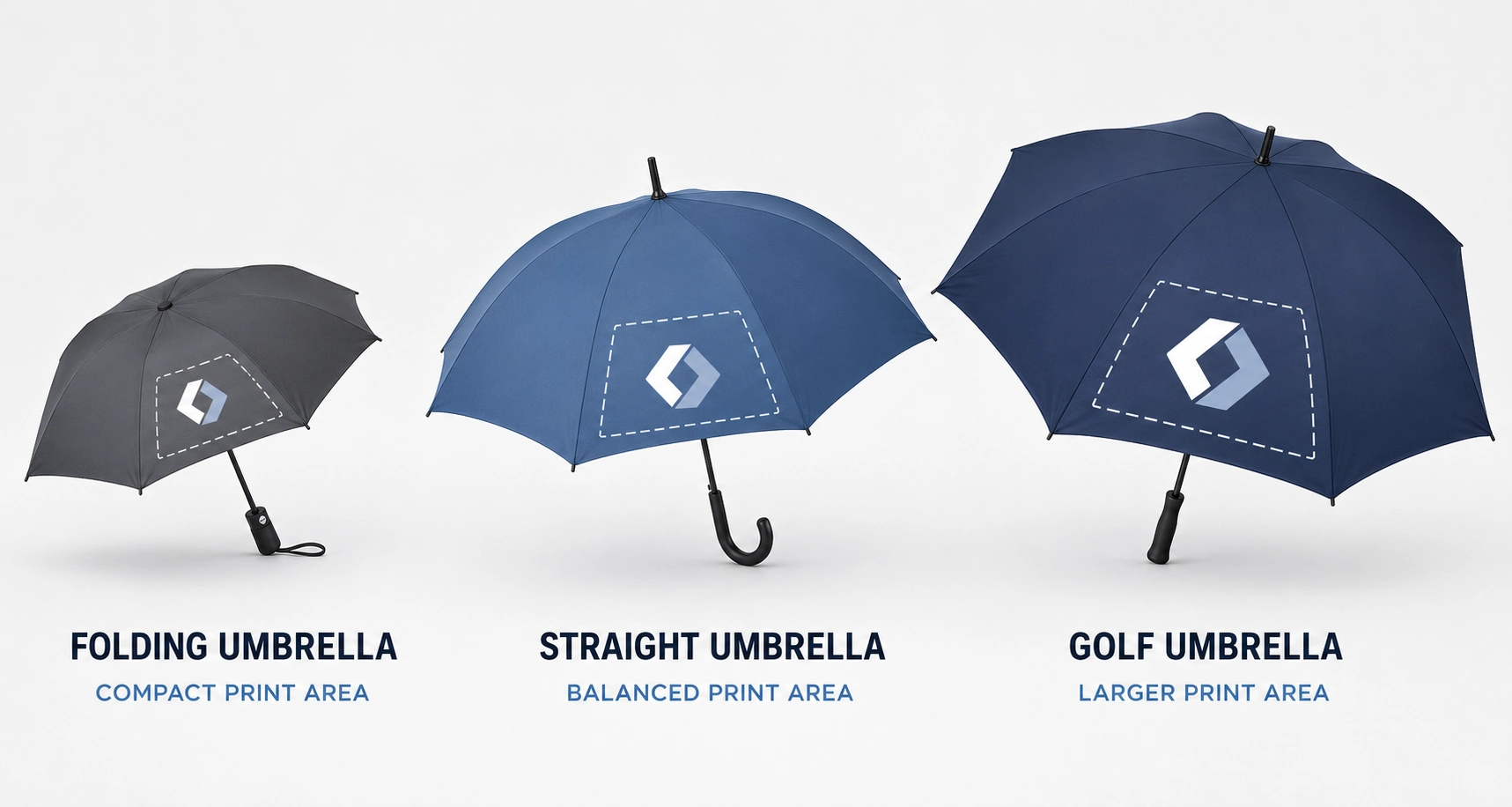
Different umbrella types create different branding opportunities. Buyers should compare uninterrupted panel space rather than assuming that overall canopy size tells the full story.
| Umbrella type | Typical B2B application | Logo-space characteristics | Main risk | Recommended buyer action |
|---|---|---|---|---|
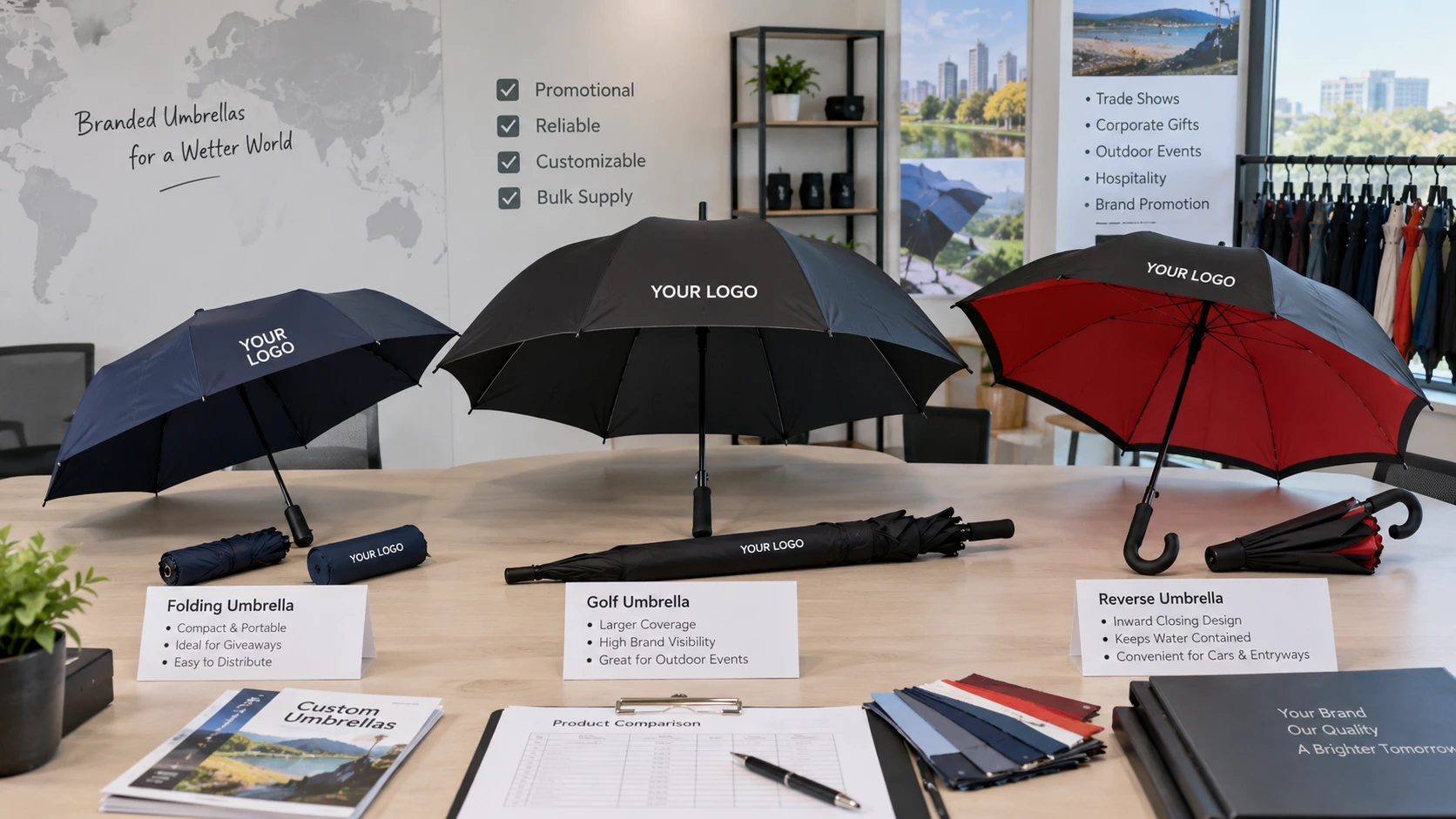
| Folding umbrella | Corporate gifts, campaigns, travel and daily carry | Compact and portable, but panels may contain more fold lines | Fine text or wide logos may become too small | Use a compact logo and approve the exact open-panel proof |
| Straight umbrella | Hotels, offices and premium giveaways | Longer panels may support a clean single-panel layout | Oversized marks can reduce the premium appearance | Balance logo visibility with the intended brand presentation |
| Golf umbrella | Outdoor events, sponsorships and high-visibility promotions | Larger canopy generally provides more branding space | Vents, extra ribs or multiple panels can interrupt artwork | Confirm the exact rib count, vent structure and print location |
Buyers comparing custom folding umbrellas should prioritize portability and artwork simplicity. Projects that require a larger mark or longer viewing distance may be better matched with custom golf umbrellas with larger print areas. Each umbrella type should receive its own scaled proof, even when the same vector logo file is used.
Check How the Printing Method Limits Size and Detail
Printing method affects the practical logo size as well as cost and appearance. Screen printing is commonly suited to simple marks and limited colors, but very fine details or complex registration may be difficult. Heat-transfer processes may support more detailed artwork, although placement near folds and seams requires careful review. Digital or full-panel printing can accommodate complex designs, but availability, setup, color treatment, cost, and minimum order quantity depend on the product and supplier.
The question is not simply which process can create the largest logo. Buyers should ask which process is appropriate for the canopy material, design complexity, number of colors, order quantity, and intended use. The quotation should state the selected method, printed dimensions, number of panels, setup charges, and any limitations that may affect the approved design.
How to Fix a Logo That Looks Too Small
A small-looking logo does not automatically require a different umbrella. The least disruptive correction should be tested first, followed by product or process changes only when the existing panel cannot meet the visibility goal.
Enlarge, Simplify, or Reposition the Logo
Begin by checking whether the visible mark can be enlarged inside the existing safe area. If the logo is already close to the panel limit, remove unnecessary file margins, reduce secondary text, or use an approved compact brand version. A stacked arrangement can sometimes use a triangular or tapered panel more effectively than a long horizontal wordmark.
Placement also matters. Moving the logo away from the narrow crown area or an obstructing seam may make it appear larger without changing its dimensions. However, artwork should not be moved until the supplier confirms that the proposed area can be printed consistently.
Every revision should produce a new proof with the exact width, height, panel number, position, color reference, and artwork version clearly identified.
Use More Panels, a Larger Umbrella, or a Different Print Route
When a single panel cannot provide enough visibility, buyers can repeat the logo on multiple panels, choose a larger umbrella, or consider full-panel printing. Repetition improves visibility from more directions, but it can increase setup costs and requires consistent placement around the canopy.
A larger model may be appropriate for outdoor sponsorships, golf events, or programs where the umbrella functions as mobile signage. It may be less appropriate when compact storage, shipping volume, or everyday portability is the priority.
Changing the printing route may allow larger or more complex artwork, but the effect on unit cost, MOQ, sampling, and production schedule should be reviewed before approval. The broader range of custom promotional umbrellas can be used to compare these options before committing to one construction.
How to Prevent Logo Size Errors Before Bulk Production
Preventing an error is less expensive than correcting a completed order. A controlled approval process should connect the artwork file, umbrella model, sample, purchase order, and bulk quality requirements.
Approve Exact Dimensions and Placement on the Artwork Proof
A useful artwork proof should include more than a visual mockup. It should identify:
- Umbrella model and canopy color
- Panel count and printed panel number
- Logo width and height
- Position relative to the panel
- Artwork filename and version
- Color reference
- Printing method
- Number of printed panels
Procurement and brand teams should approve the same document. If the buyer’s end customer must authorize the branding, that approval should also refer to the marked proof rather than an unmeasured image.
Version control is important. A revised logo size should receive a new proof number or date so an earlier file cannot be released to production accidentally.
Verify a Pre-Production Sample and Set Bulk QC Requirements
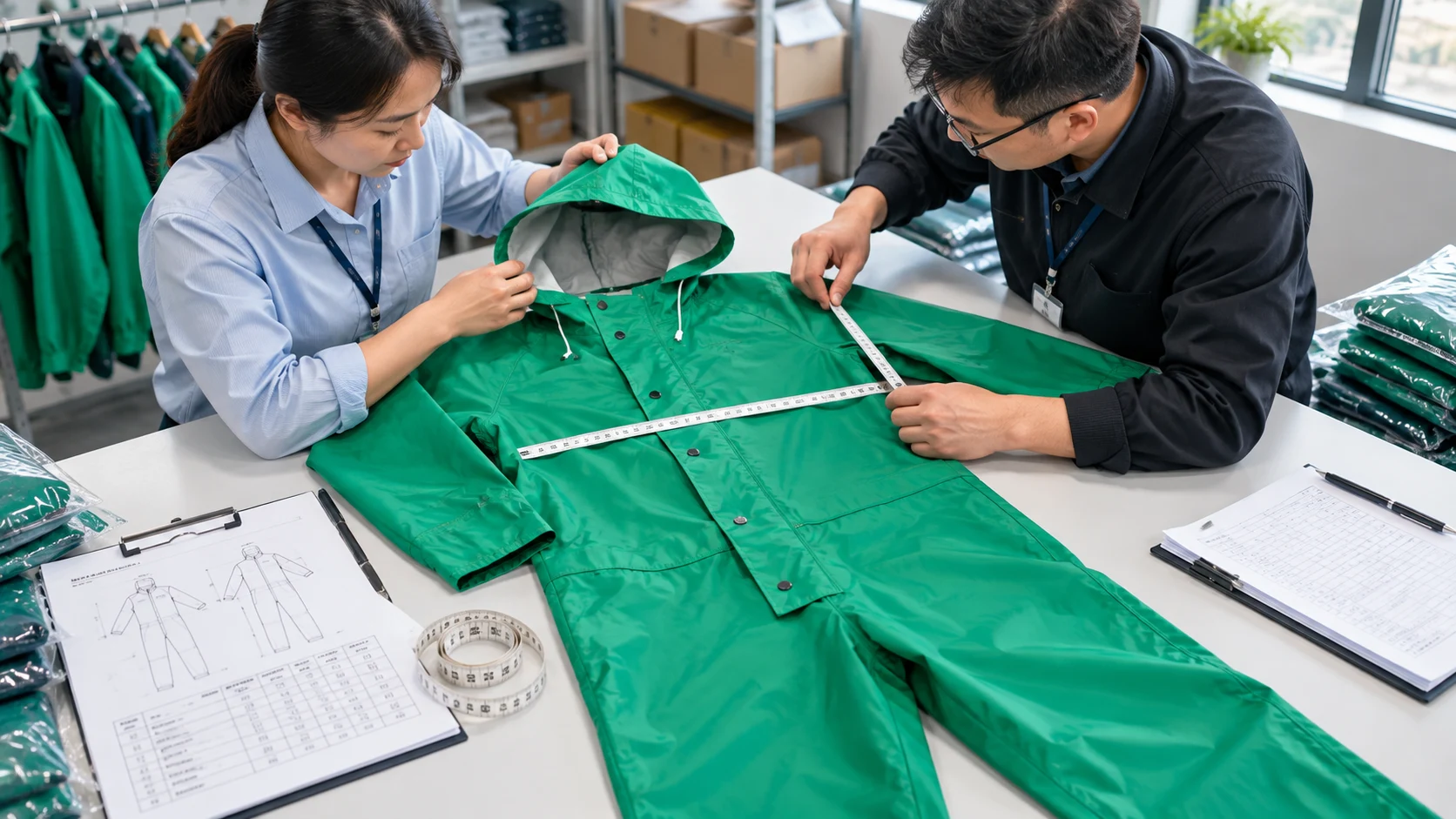
A physical sample is particularly valuable for large orders, complex logos, multiple printed panels, strict brand colors, or repeat programs. It allows the buyer to assess the logo with the umbrella open, closed, carried, and viewed from a realistic distance.
The review should cover position, centering, color appearance, edge definition, registration, adhesion, distortion, and interference from seams or ribs. The approved sample can then act as a reference for bulk production.
Acceptable placement variation and other print criteria should be documented before manufacturing begins. These requirements may vary by umbrella construction, material, and printing process, so tolerances should be confirmed with the supplier and recorded in the purchase order or quality sheet.
How B2B Buyers Should Evaluate a Custom Umbrella Supplier
A qualified supplier should help translate a brand file into a production specification. Price alone does not show whether the supplier can control scale, placement, sampling, and repeat-order consistency.
Check Artwork, Sampling, and Printing Capabilities
Buyers should ask whether the supplier can provide a panel template for the selected model, mark the usable print area, recommend a suitable logo size, and explain the limits of the proposed printing method. The supplier should also distinguish between folding, straight, golf, vented, and other constructions rather than applying one generic layout to every product.
Warning signs include proofs without dimensions, inconsistent product specifications, unclear print locations, or an inability to explain how ribs and seams affect the design.
Based in Yiwu, China, RAINCOATGIFT supplies custom umbrellas alongside rainwear and bags. Its umbrella catalog includes folding and golf styles with customized-logo options. Published product information also addresses order minimums, samples, and production details for selected models, although final terms and printable areas should be verified for each project. Additional product categories are available through RAINCOATGIFT.
Send a Complete RFQ and Compare Like-for-Like Quotations
An RFQ should state the umbrella type or model, quantity, canopy size, panel count, canopy color, logo dimensions, artwork colors, number of printed panels, preferred printing method, packaging, destination, and required delivery date. When the model has not been selected, the application should be described clearly—for example, compact corporate gifts or high-visibility outdoor event use.
Quotations should be compared using the same logo size and panel configuration. A low price based on one small imprint is not equivalent to a quotation covering four larger panels.
RAINCOATGIFT can evaluate the request more accurately when the logo file and intended application are submitted together. Buyers should still confirm the marked proof, sample requirements, MOQ, production schedule, packaging, and shipping terms before placing an order.
Conclusion
A logo that looks too small on a custom umbrella is usually a specification problem, not simply a design problem. The most reliable solution is to measure the exact panel template, account for seams and structure, simplify artwork where necessary, and approve dimensions on the correct umbrella model before bulk production.
For a project review, provide the umbrella type or intended application, target quantity, canopy preferences, logo file, desired print locations, delivery destination, and required schedule. Buyers who have not yet selected a model can request an umbrella artwork review and ask for a suitable panel template before finalizing the quotation.
Frequently Asked Questions
What is the standard logo size for a custom umbrella?
There is no universal standard logo size for umbrellas. The correct dimensions depend on the umbrella model, panel shape, rib count, printing method, logo proportions, and required viewing distance. The size should be confirmed on the exact production template.
Can the same logo size be used on folding and golf umbrellas?
Usually not without adjustment. The same vector file can be used, but folding and golf umbrellas have different panel dimensions and structural interruptions. Each model should receive a separately scaled artwork proof.
Can a logo be printed across an umbrella seam?
It may be possible with certain full-panel or pre-assembly printing processes, but conventional single-panel logos are normally kept clear of seams. Crossing a seam can interrupt letters, complicate alignment, and increase production risk.
Should umbrella logo size be approved before or after sampling?
The dimensions should first be approved on a marked artwork proof. A pre-production sample can then confirm how the logo looks on the opened umbrella. Large, complex, or brand-sensitive orders benefit most from both approval stages.
What artwork file is best for umbrella logo printing?
A vector file such as AI, EPS, SVG, or vector-based PDF is generally preferred because it can be resized without losing edge quality. Raster artwork should be checked at the actual intended print dimensions, and all production requirements should be confirmed with the selected supplier.