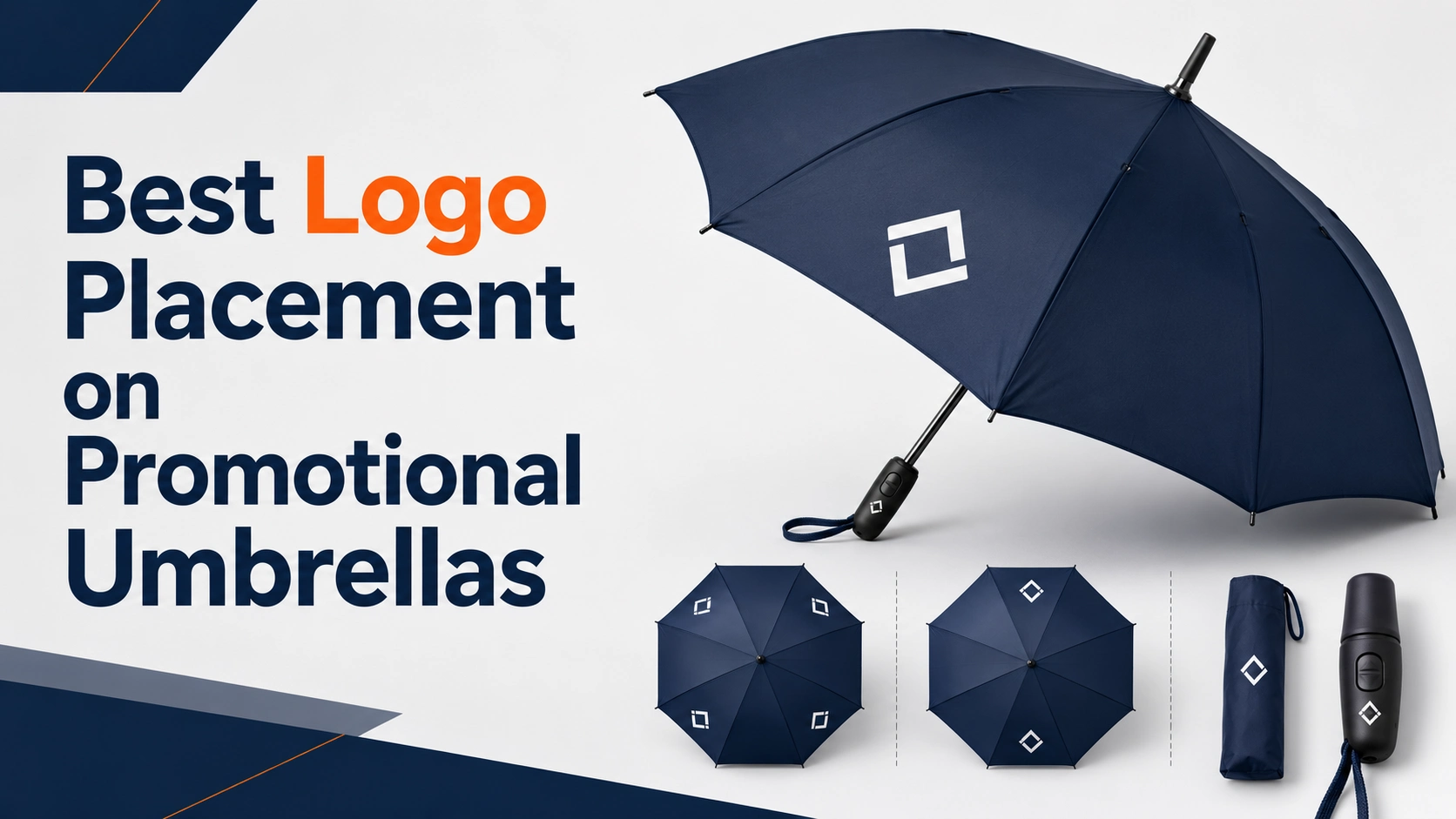
The right umbrella logo placement depends on when the brand needs to be visible, who will see it, and how the umbrella will be used. A one-panel logo may suit a focused corporate gift, while opposite or multiple panels provide broader visibility at outdoor events. Sleeve printing supports presentation when the umbrella is closed, and handle branding creates a subtler, user-facing detail. Before approving a bulk order, buyers should compare viewing angles, umbrella construction, printing cost, artwork orientation, and sample requirements—not simply select the largest available print area.
Quick Comparison: Which Umbrella Logo Placement Is Right for the Project?
A placement decision should begin with the primary viewing condition. Will the umbrella be carried through a crowded event, handed to a hotel guest, displayed in retail packaging, or presented as an executive gift? Buyers exploring custom promotional umbrellas can use the following comparison as an initial specification guide.
| Placement | Visibility when open | Visibility when closed | Suitable applications | Main limitation | What to confirm |
|---|---|---|---|---|---|
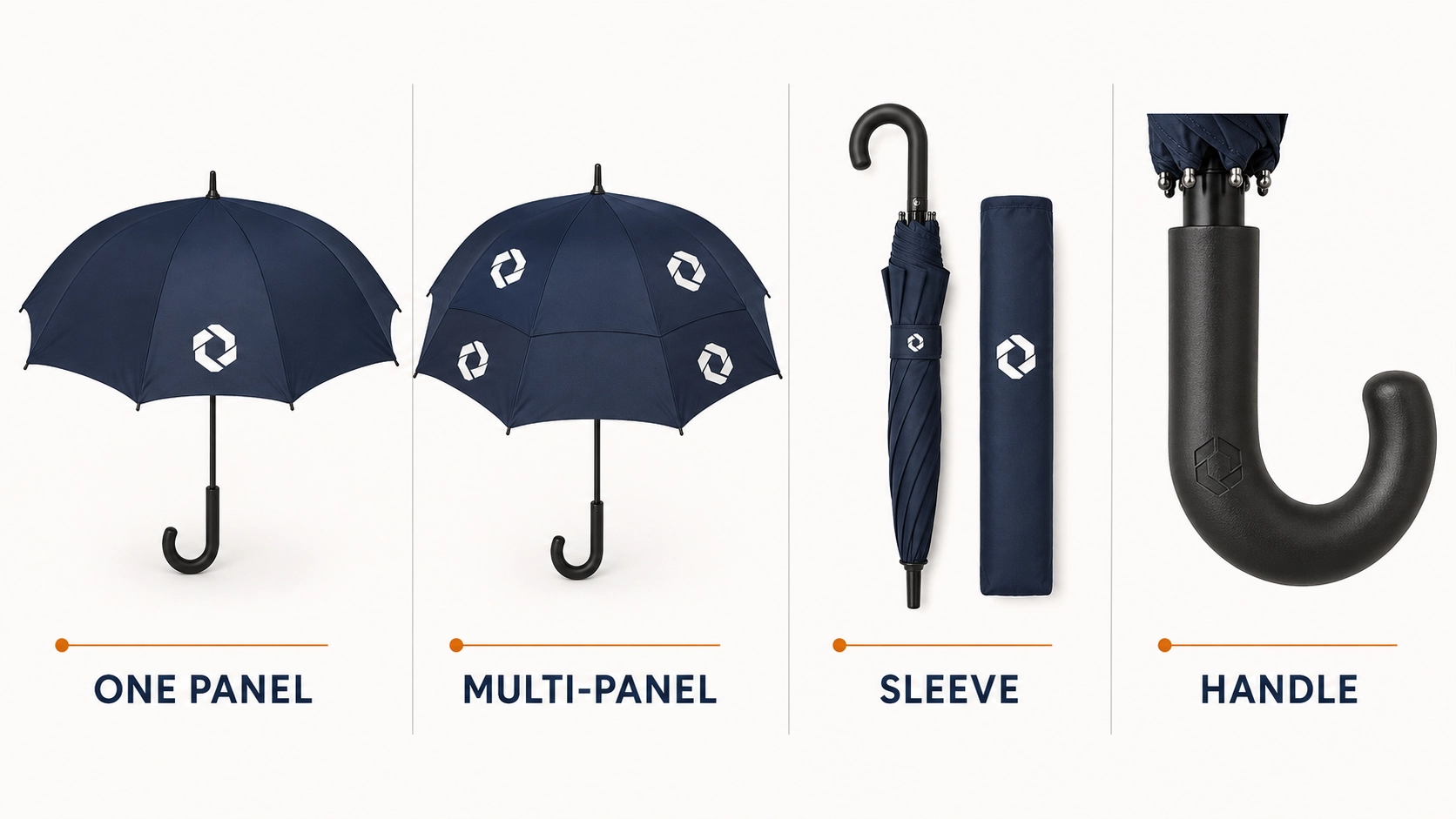
| One canopy panel | Moderate | Low | Corporate gifts, internal events, controlled budgets | Visible from limited directions | Main viewing direction and panel number |
| Opposite panels | High | Low | Events, campaigns, pedestrian traffic | Additional print position | Panel orientation and symmetry |
| Multiple panels | High from several angles | Low | Golf events, sponsor programs, public campaigns | Higher cost and greater alignment risk | Artwork assigned to each panel |
| Umbrella sleeve | Low | High | Gift presentation, hospitality, retail display | May be removed or lost | Fit, logo direction, and packed sample |
| Handle | Low at a distance | Moderate for the user | Executive gifts and understated branding | Small decoration area | Handle material and process compatibility |
This table is a starting point rather than a universal specification. Final placement may vary by umbrella model, canopy construction, fabric, artwork, printing method, quantity, and intended use.
Why Umbrella Logo Placement Fails in Real Use
A digital layout shows the canopy as a flat shape, but the finished product is curved, divided by ribs, joined by seams, and viewed from changing angles. A logo can therefore look balanced in a proof yet appear too high, tilted, interrupted, or difficult to see when the umbrella is opened and held normally.
Canopy Structure, Viewing Angle, and Logo Orientation
Each canopy panel forms part of a three-dimensional surface. A logo placed too close to a seam may look compressed by the canopy curve, while artwork near a rib can become less readable from an angle. Vented umbrellas introduce overlapping fabric sections that may hide part of a design. Folding models add crease lines that affect how the artwork appears when stored.
The artwork proof should identify the canopy top, lower panel edge, panel number, and intended reading direction. This is particularly important when text is included. Buyers should also confirm whether a design remains inside one panel or crosses a sewn boundary. Continuous artwork across several panels may require different artwork preparation and closer sample evaluation than a centered, single-panel logo.
When Placement Does Not Match the Viewing Scenario
A technically accurate print may still perform poorly if its position does not match the application. Handle branding is visible to the person holding the umbrella but contributes little to distant event exposure. A printed sleeve may look polished during delivery, yet it disappears once the umbrella is opened. One canopy panel can be effective in a controlled display but may rotate away from viewers in moving crowds.
The practical test is to define three conditions: who should see the logo, from what distance, and whether the umbrella will be open or closed. Public campaigns usually prioritize canopy visibility from several directions. Corporate gifts may combine a restrained canopy logo with packaging or sleeve branding. The placement should follow the real viewing scenario rather than the layout that looks most attractive on a screen.
One Panel vs. Multi-Panel Umbrella Logo Printing
The number of branded panels affects visibility, visual balance, production complexity, and cost. It should be selected according to exposure requirements instead of treating more printed panels as automatically better.
When Is a Single-Panel Logo the Better Choice?
A one-panel umbrella logo is suitable when the design needs a clean focal point, the audience usually approaches from one direction, or the project has a controlled decoration budget. It can work well for employee gifts, conference materials, reception use, and branded merchandise where the umbrella is viewed at close range.
Single-panel placement is less suitable when umbrellas will move through crowds, appear in photographs from several directions, or be used as prominent outdoor campaign materials. Before ordering, buyers should identify the primary display panel and confirm how the logo faces when the handle is held in its normal position. Color contrast, seam clearance, and the relationship between the logo and the lower panel edge should also be reviewed on the actual model.
When Should a Logo Be Printed on Multiple Panels?
Multi-panel umbrella printing is appropriate when visibility from several directions has measurable value. Opposite panels support two-way exposure without covering the entire canopy. Adjacent panels can create a stronger visual block from one side, while alternating panels distribute repeated branding around the umbrella. Multiple panels may also accommodate separate sponsors or campaign messages.
The main risks are visual crowding, inconsistent orientation, and unclear quotation terms. Buyers should specify whether each panel carries the same logo or different artwork, whether the positions are opposite or adjacent, and whether decoration is priced by color, artwork, or imprint location. If several logos are involved, a numbered panel diagram is more reliable than instructions such as “print on four sides.”
Sleeve and Handle Branding: Primary Placement or Secondary Detail?
Sleeve and handle branding can support a canopy design, but they serve different viewing conditions. Their value should be judged by presentation, user interaction, and product compatibility.
When Does a Branded Umbrella Sleeve Add Value?
Umbrella sleeve logo printing is useful when the product will be presented closed, placed in a gift set, displayed at retail, or handed directly to guests. It gives the buyer another branded surface before the umbrella is opened and can make a corporate gift feel more coordinated.
A sleeve is a weak primary placement for outdoor visibility because it is normally removed during use and may later be misplaced. Buyers should confirm the logo direction with the umbrella packed inside the sleeve, not on the empty sleeve alone. The fit also matters: tension, folds, seams, and closures can change the visible area. When sleeve presentation is commercially important, approval should include a packed sample or representative assembly.
When Is Handle Branding Worth Considering?
An umbrella handle logo or engraved handle detail is more personal than canopy printing. It can suit executive gifts, hospitality programs, or projects where understated branding is preferred. The mark stays within the user’s line of sight and may continue to be visible while the umbrella is closed.
Handle branding does not replace a canopy logo when public recognition is the objective. Compatibility depends on the handle material, shape, finish, available area, and decoration process. Fine artwork may not reproduce clearly on a small curved surface. Buyers should confirm the actual decoration area, orientation during use, and whether printing, engraving, molding, or another method is available for the selected handle configuration.
How Umbrella Type and Use Case Affect Logo Placement
The same artwork should not be transferred between umbrella models without checking panel dimensions and construction. Folding, straight, golf, and vented umbrellas create different placement conditions.
Folding, Straight, Golf, and Vented Umbrellas
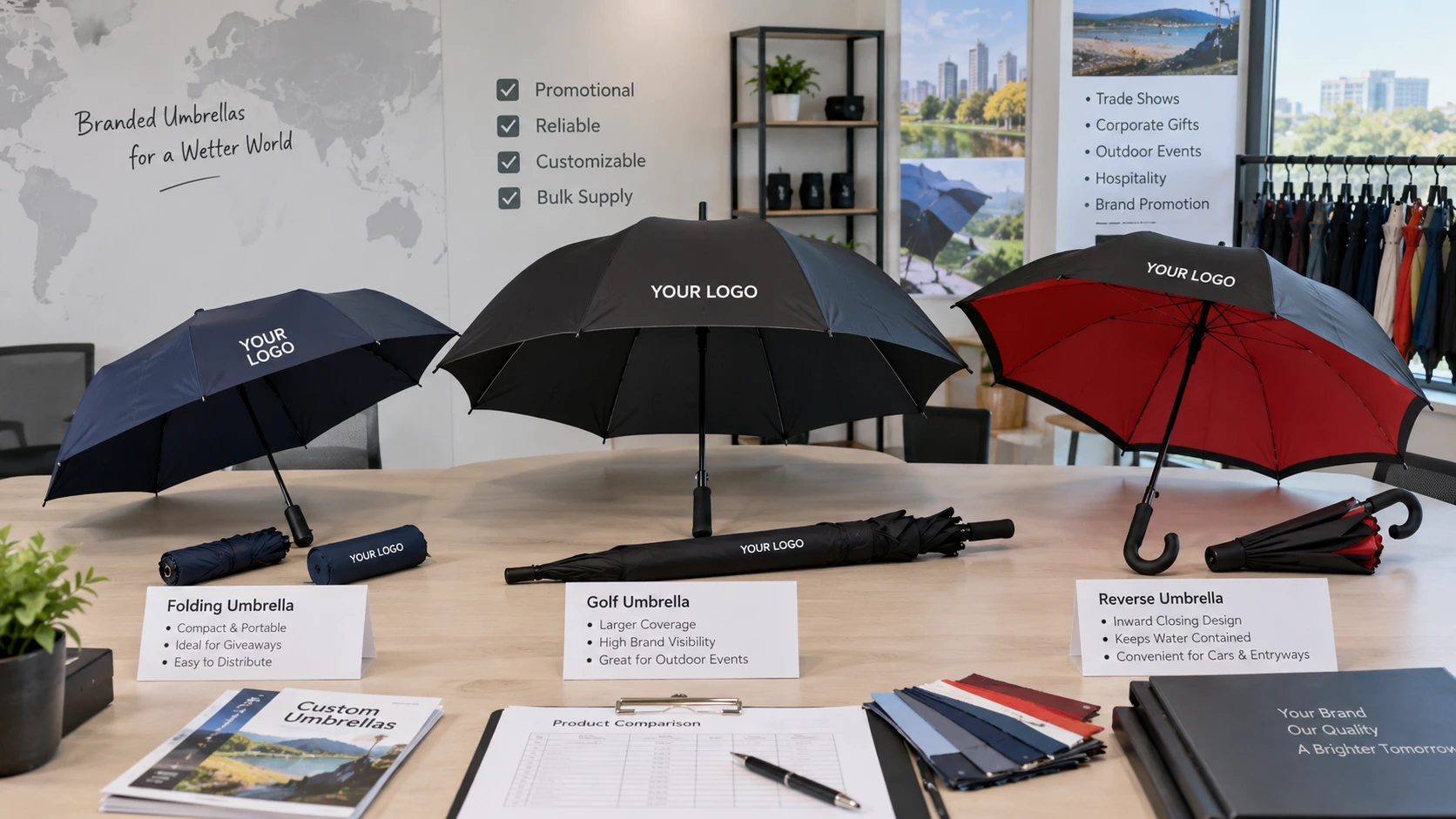
Compact custom folding umbrellas usually have smaller panels and more prominent fold lines. A centered single-panel logo may be practical, but the position should be checked in both open and folded states. Artwork placed across a fold may look uneven after repeated storage, depending on the fabric and print configuration.
Straight umbrellas generally provide fewer folding interruptions, while custom golf umbrellas offer larger canopies that can support visibility at longer distances. Opposite or repeated panel logos may suit golf events and sponsor programs, although larger available space does not remove the need for balanced sizing. On vented models, the supplier should identify overlapping sections and confirm that the logo remains clear when the canopy is fully open.
Match Placement to the Buying Application
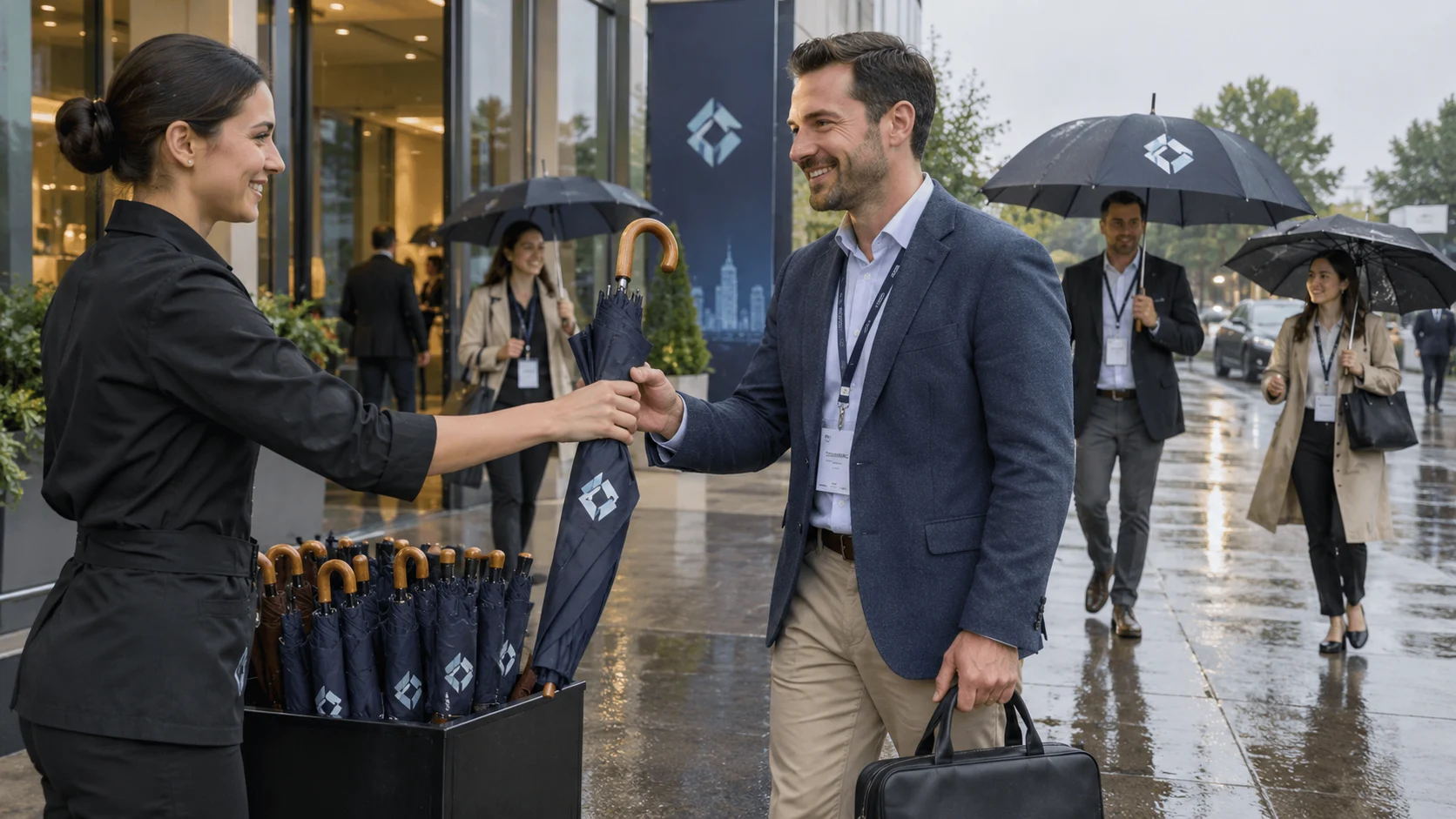
At trade shows and outdoor campaigns, the priority is often visibility from moving pedestrian traffic, making opposite or multiple panels worth considering. Hotels may need branding that works when staff hand over a closed umbrella and when guests later open it. Corporate gifts can favor a restrained canopy logo supported by a branded sleeve or handle.
Golf events may require distant recognition, photographic visibility, or space for multiple sponsors. Retail merchandise must also look organized when folded and packaged. In each case, buyers should rank open-canopy exposure, closed presentation, user-facing detail, and budget. This prevents secondary branding features from consuming resources that would be more useful on the main viewing surface.
How to Prevent Logo Placement Errors Before Bulk Production
Placement errors are easier to prevent during artwork approval than after production. A useful approval process should cover the digital proof, the assembled product, and the reference standard for the bulk order.
Artwork Proof and Pre-Production Sample Checklist
A digital proof should show the selected umbrella model, numbered panels, logo dimensions, orientation, colors, and distance from structural boundaries. Buyers should verify spelling, panel sequence, opposite-panel symmetry, and whether every repeated logo faces the correct direction.
A physical sample becomes more valuable when artwork approaches seams, crosses panels, appears on a vented canopy, or includes sleeve or handle decoration. Review the sample open, normally held, fully closed, and packed. Photograph the approved views and retain the signed proof as a production reference. The need for a pre-production sample may depend on order value, artwork complexity, schedule, and the supplier’s sampling process.
What Buyers Should Include in a Promotional Umbrella RFQ
A clear RFQ makes quotations easier to compare and reduces revisions after pricing. It should state:
- Umbrella type, model, canopy size, and panel count
- Canopy fabric and color
- Number of printed positions
- Opposite, adjacent, alternating, or numbered panel arrangement
- Same or different artwork on each position
- Logo colors and available artwork files
- Sleeve or handle branding requirements
- Primary application and viewing direction
- Target quantity and packaging requirements
- Digital proof and pre-production sample expectations
The term “one logo” can be ambiguous. It may refer to one artwork design rather than one printed location. Buyers should ask whether quotations are calculated by imprint location, color, process, or another production factor.
How to Evaluate a Custom Umbrella Supplier
A suitable supplier should be able to connect artwork decisions with the construction of the selected umbrella. Useful capabilities include providing a model-specific panel template, marking panel orientation on the proof, identifying seam and vent restrictions, and explaining which sleeve or handle options are compatible with the configuration.
The supplier should also clarify how additional print positions affect the quotation and what approval method is appropriate for higher-risk designs. Generic statements that a logo “can be printed anywhere” are less useful than a documented placement recommendation tied to the product specification.
Raincoat Gift is based in Yiwu, China and specializes in raincoats, umbrellas, bags, and outdoor advertising products. Its umbrella range includes folding, golf, reverse, transparent, beach, and other umbrella categories. For a placement project, Raincoat Gift should be given the selected model, artwork, preferred panel arrangement, application, quantity, and sample expectations so that available customization can be checked against the specific product.
Conclusion
The most suitable umbrella logo placement depends on visibility goals rather than the number of available surfaces. One panel supports clean, focused branding; opposite or multiple panels improve exposure from different directions; sleeves strengthen closed-product presentation; and handles add a subtle user-facing detail.
Before bulk production, confirm the umbrella model, panel arrangement, material, artwork orientation, target quantity, packaging, and sample requirements. Buyers can request a custom umbrella quote from Raincoat Gift by submitting these details together with the logo file and intended application. This gives the supplier enough information to recommend a practical placement and prepare a comparable quotation.
Frequently Asked Questions
Is one logo panel enough for a promotional umbrella?
One panel may be enough for corporate gifts, controlled displays, and projects with one main viewing direction. Opposite or multiple panels are more suitable when visibility from several directions is important.
Are opposite panels better than adjacent panels for umbrella printing?
Opposite panels generally provide two-way exposure. Adjacent panels concentrate the visual effect on one side. The right arrangement depends on pedestrian flow, photography requirements, artwork, and budget.
Should a promotional umbrella sleeve also have a logo?
A branded sleeve can add value for gift presentation, hospitality, and retail display. It should normally support rather than replace canopy branding because the sleeve is removed while the umbrella is in use.
Can every umbrella handle be engraved or printed?
No single process fits every handle. Suitability depends on material, shape, finish, available decoration area, and the selected product configuration. The method should be verified with the supplier before artwork approval.
Does multi-panel umbrella printing cost more?
It may. Cost can change with the number of imprint locations, colors, artwork variations, printing method, quantity, and umbrella construction. Request an itemized quotation that defines each printed position.