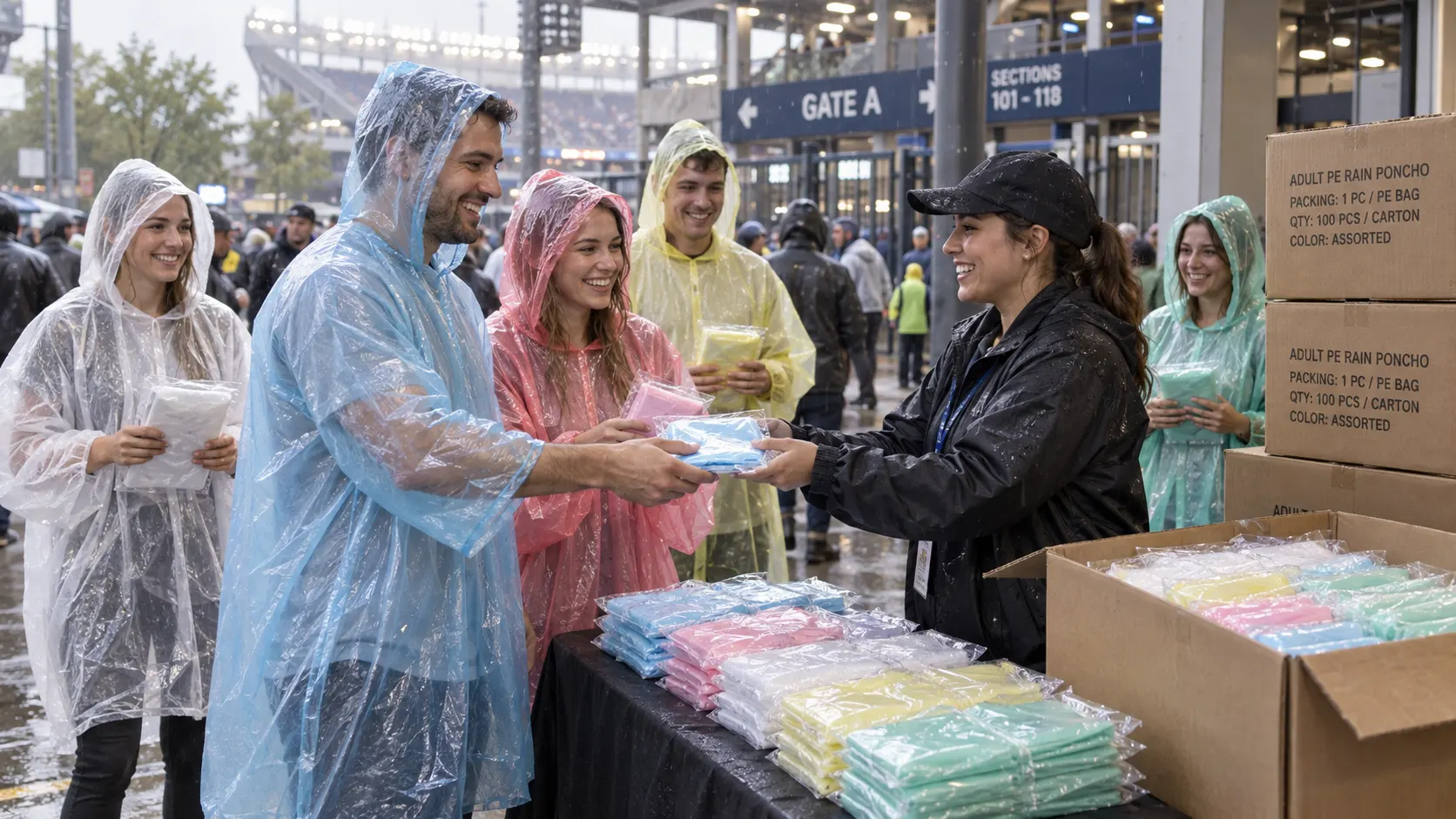
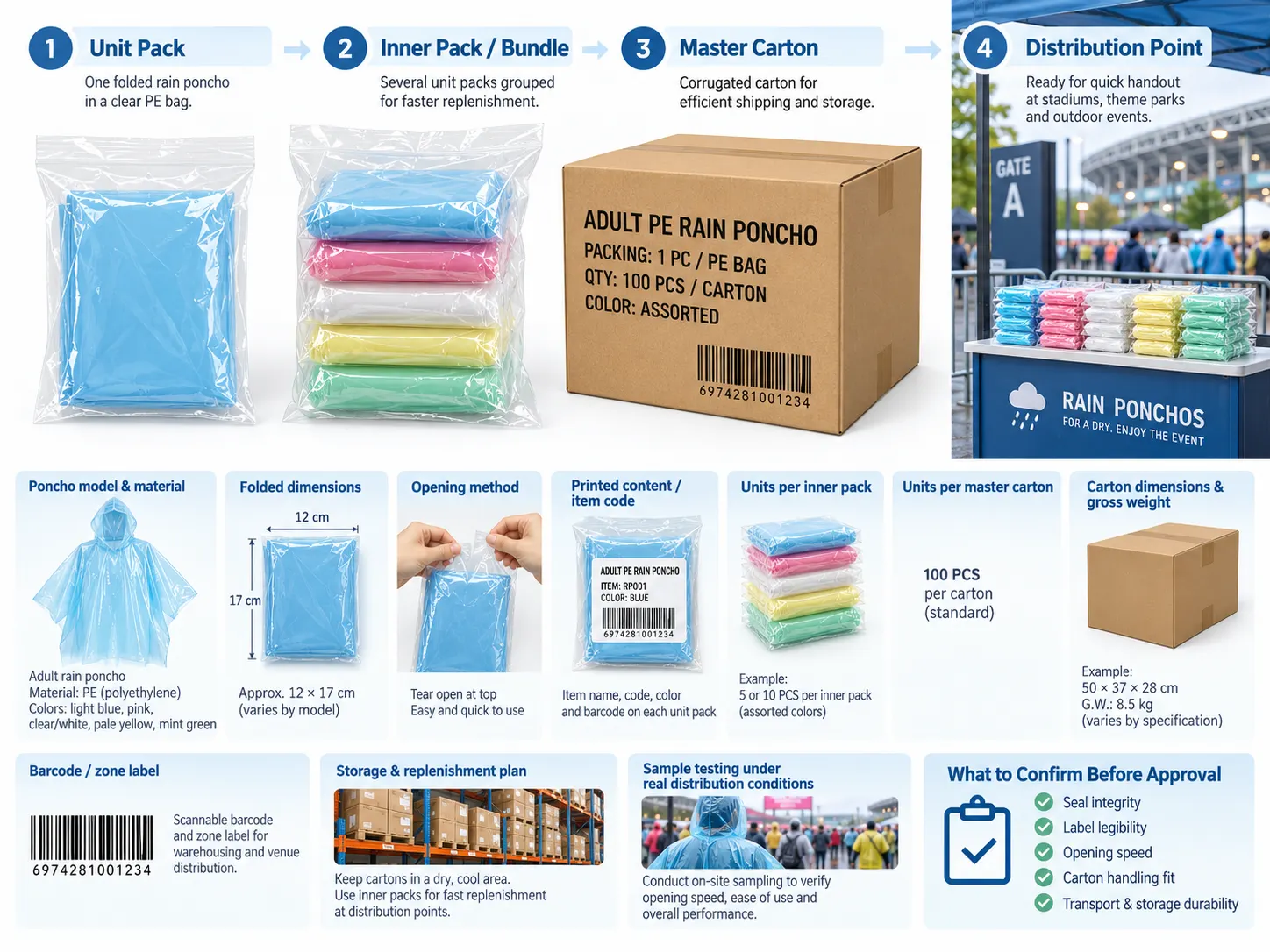
The most practical rain poncho packaging for a high-volume venue is usually a sealed unit pack grouped into clearly labeled inner packs and master cartons. The unit pack protects the folded poncho and supports hygienic handout; the inner and outer packaging help teams count, stage, move, and replenish stock. The correct specification depends on how the venue sells or distributes ponchos, where inventory is stored, and how quickly staff must serve guests when rain begins.
Packaging should be treated as part of the operating plan, not as decoration. A broader outdoor venue weather preparedness plan can determine quantities and distribution zones; this guide focuses on choosing the package that makes those plans workable.
What Rain Poncho Packaging Must Accomplish
A package has four operational jobs. It should keep the folded poncho clean and contained, make the item easy to identify, support accurate stock counts, and open quickly without creating unnecessary handling. These jobs matter more than a package that looks impressive but slows the queue or consumes too much storage space.
Start with the handout moment. Ask whether an attendant will pass one unit through a gate window, place it in a guest kit, sell it at a concession counter, or move dozens of units to a remote station. Then work backward to the unit pack, inner quantity, carton label, and pallet or delivery plan.
Compare Packaging Formats by Distribution Method
No single format is right for every venue. The comparison below is a planning guide; film type, dimensions, closure, print method, and pack counts should be confirmed against the chosen poncho and supplier specification.
| Format | Useful when | Main tradeoff | Verify |
| Sealed unit bag | Fast individual handout or retail sale | More individual material to handle after opening | Seal, tear-open method, label area |
| Sleeve or paper wrap | Visible branding and simple kit presentation | May offer less moisture protection than a sealed bag | Paper grade, closure, storage conditions |
| Reusable pouch | Premium or repeat-use guest programs | Higher cost and slower bulk handout | Pouch size, closure, pack-back method |
| Inner bundle or dispenser carton | Zone staging and controlled replenishment | Needs a separate unit-pack decision | Units per bundle, opening, carton strength |
Individual Packs for Fast Handout
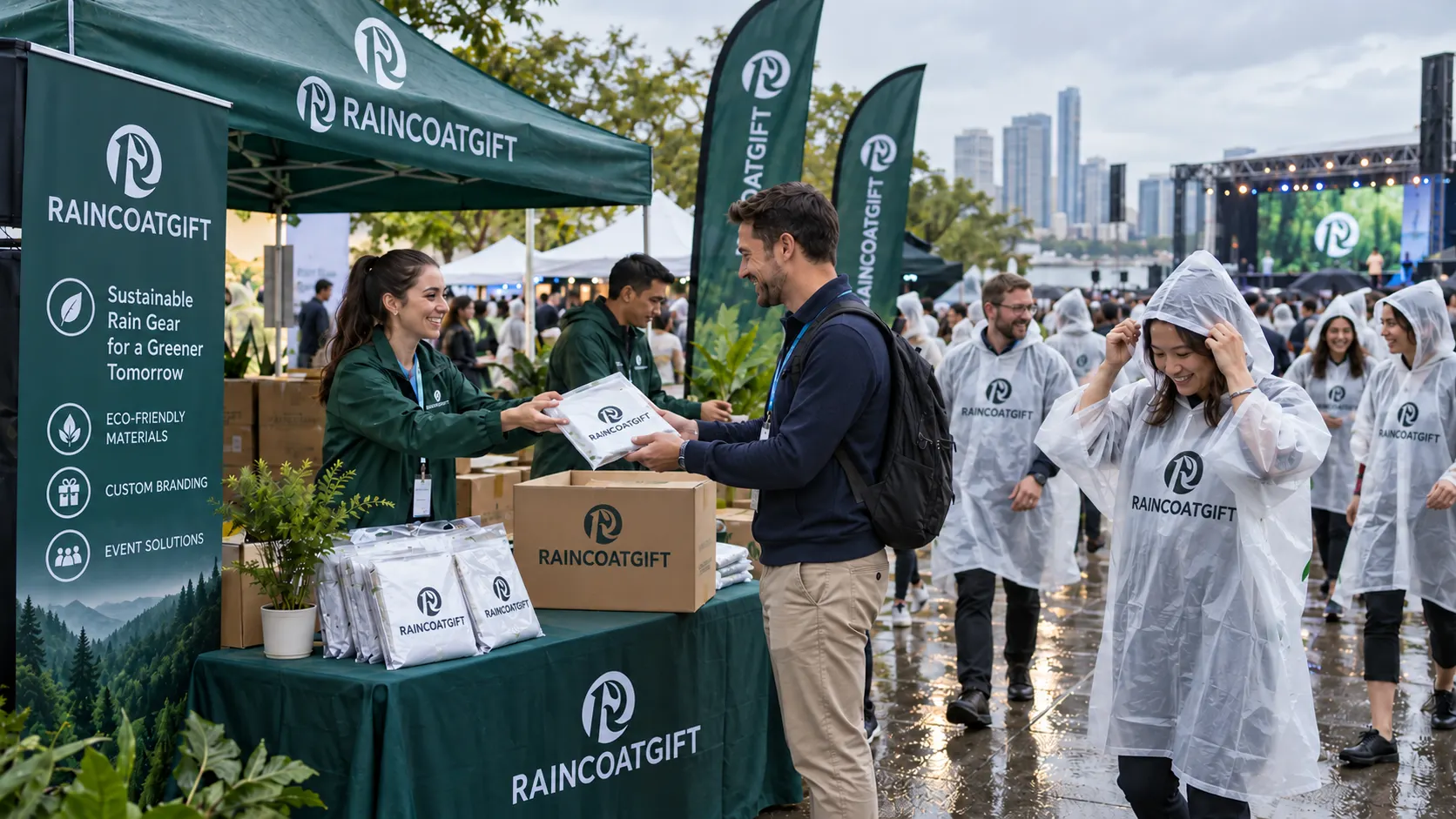
An individually packed poncho gives each guest a complete unit and makes it easier to count remaining stock. A clear bag can show the product color, while a printed or labeled pack can carry the item name, size or audience designation, use instructions, and any required event information. Confirm that staff can identify and open the pack with wet hands and that the discarded wrapper can be managed at the distribution point.
Inner Packs and Dispenser Cartons for Replenishment
Inner bundles reduce recounting when teams move stock from a storeroom to gates, kiosks, or queue areas. A dispenser carton can support controlled issue at a fixed counter, while sealed bundles may be easier to allocate across temporary stations. Specify the units per inner pack, how the bundle opens, and whether the remaining units stay contained after opening.
Reusable Pouches for Premium Programs
A reusable pouch may fit a branded guest package or a poncho intended for repeated wear. It is usually less efficient for an emergency handout to thousands of people because the package adds cost, space, and handling. Choose it only when the pouch has a defined role after distribution.
Adjust the Package to Each Venue
Stadiums
Stadium packaging should support rapid issue at several entrances and seating zones. Compact unit packs and predictable inner counts simplify staging. Labels should remain readable in storerooms and at temporary stations, and carton markings should identify the destination zone so replenishment teams do not open every box to find the correct stock.
Theme Parks
Theme parks may distribute or sell ponchos repeatedly throughout the day. Packaging should work for both back-room storage and front-counter presentation. If adult and child sizes, colors, or branded versions are stocked, use distinct item codes and visible package cues. Test how the pack fits existing shelves, bins, carts, and point-of-sale areas before approving the final dimensions.
Festivals and Temporary Outdoor Events
Temporary events often rely on mobile teams and short-term storage. Group unit packs into labeled bundles that can be assigned to gates, stages, hospitality areas, or medical and information points. When the poncho is part of a larger branded festival rain kit, confirm that all components fit the outer bag or box without crushing the poncho pack or hiding required labels.
Write a Complete Packaging Specification
A useful RFQ describes the packaging hierarchy, not only the poncho. Give the supplier enough information to calculate materials, printing, packing labor, carton dimensions, and shipping configuration. At minimum, state:
- the poncho model, material, folded dimensions, intended user, and target quantity
- the unit-pack format, film or paper requirement, closure, opening method, and printed content
- the number of units per inner pack and the number of units per master carton
- item codes, color or size identification, carton labels, barcodes, and destination-zone labels
- the required artwork files, print colors, approval method, and sample expectations
- delivery location, receiving limits, storage conditions, event date, and replenishment plan
Do not assume that a standard carton quantity will suit the venue. A carton that is efficient for factory packing may be too heavy, too large for a kiosk, or inconvenient for a team that replenishes in small batches. Ask for proposed packed dimensions and gross weight, then compare them with doorways, shelving, carts, and staff handling procedures.
Test Samples Under Real Distribution Conditions
A packaging sample should be tested with the poncho inside. Check seal integrity, print legibility, opening time, and whether the poncho can be removed without tearing it. Have staff unpack a full inner bundle, count units, restock a bin, and clear the discarded packaging. This trial reveals issues that a flat artwork proof cannot show.
Also inspect the package after normal transport and storage. Look for punctures, trapped air that increases carton volume, labels that rub off, and folds that make the unit difficult to return to its pack. Record any required changes before mass production and approve the revised sample or written specification.
Connect Packaging Choices to the Poncho Specification
Packaging dimensions and presentation depend on the folded garment. Buyers can review PE rain poncho options before fixing the package. RAINCOATGIFT lists a disposable adult PE rain poncho with a customizable logo and identifies one-piece-per-PE-bag packing, 100 pieces per carton, and custom package options. Treat those details as a starting specification; final dimensions, printing, quantities, and packing method should be confirmed for the selected model and order.
Request a physical or production-representative sample when package opening, artwork, size identification, or point-of-sale presentation affects the event plan. RAINCOATGIFT should also confirm which packaging changes alter minimum quantities, production timing, carton configuration, or shipping volume before the buyer approves the order.
Conclusion
Effective rain poncho packaging combines a protected unit with a practical counting and replenishment system. Stadiums need fast zone distribution, theme parks need repeatable storage and retail handling, and temporary events need mobile bundles with clear destination labels. Define those workflows first, then specify the wrapper, inner pack, carton, labeling, and sample tests.
Frequently Asked Questions
Should every event poncho be individually packed?
Individual packing is useful for clean, countable handout and retail presentation, but it adds wrapper handling. Confirm the choice against distribution speed, waste procedures, and storage conditions.
What information belongs on a rain poncho package?
Use the information the venue needs to identify and issue the product, such as item name, size or audience, color, unit code, opening or use instructions, and approved event branding. Legal or market-specific labeling should be verified separately.
How should cartons be labeled for a stadium or theme park?
Show the item code, description, quantity, size or color, and destination zone when relevant. The receiving and operations teams should be able to route a sealed carton without opening it.
When is a reusable pouch appropriate?
A reusable pouch fits premium kits or ponchos intended for repeat wear. For emergency mass distribution, a compact sealed unit bag and clearly counted inner packs are usually simpler to stage and hand out.
For a fit check, request a packaging and fit review from RAINCOATGIFT with the venue type, event date, poncho model, quantity, package hierarchy, carton limits, artwork, delivery location, and sample requirements.